WE ARE READY TO BRING YOU TOGETHER WITH ART %60 Discount
Claude Monet and The Seine at Giverny: A Study in Luminous Perception
The Impressionist Vision and Riverine Beginnings
At the heart of late nineteenth-century art, Impressionism sought to break free of precise representation and instead embrace the fleeting quality of light and atmosphere. Claude Monet emerged as a defining voice in this movement, repeatedly returning to the same subjects in order to explore subtle shifts in hue and mood. In his mature practice, the Seine at Giverny becomes a canvas for his fascination with momentary perception, choosing a riverine scene that offered an ever-changing interplay of reflections and textures. This deliberate focus placed perception and sensation above meticulous contour, framing the river not just as subject but as collaborator in his artistic experiment.
Monet’s engagement with the Seine extended far beyond a single tableau. He would paint from a boat or along the banks, moving through dawn and dusk to capture the continuum of light as it sequenced across the water. Each canvas in his riverine series rehearsed a different chapter of this symphony of reflections, revealing how sky, bank vegetation, and subtle movements on the surface responded to shifting conditions. Through this serial approach, Monet elevated the simple act of observation into a rigorous investigation of time and atmosphere in color.
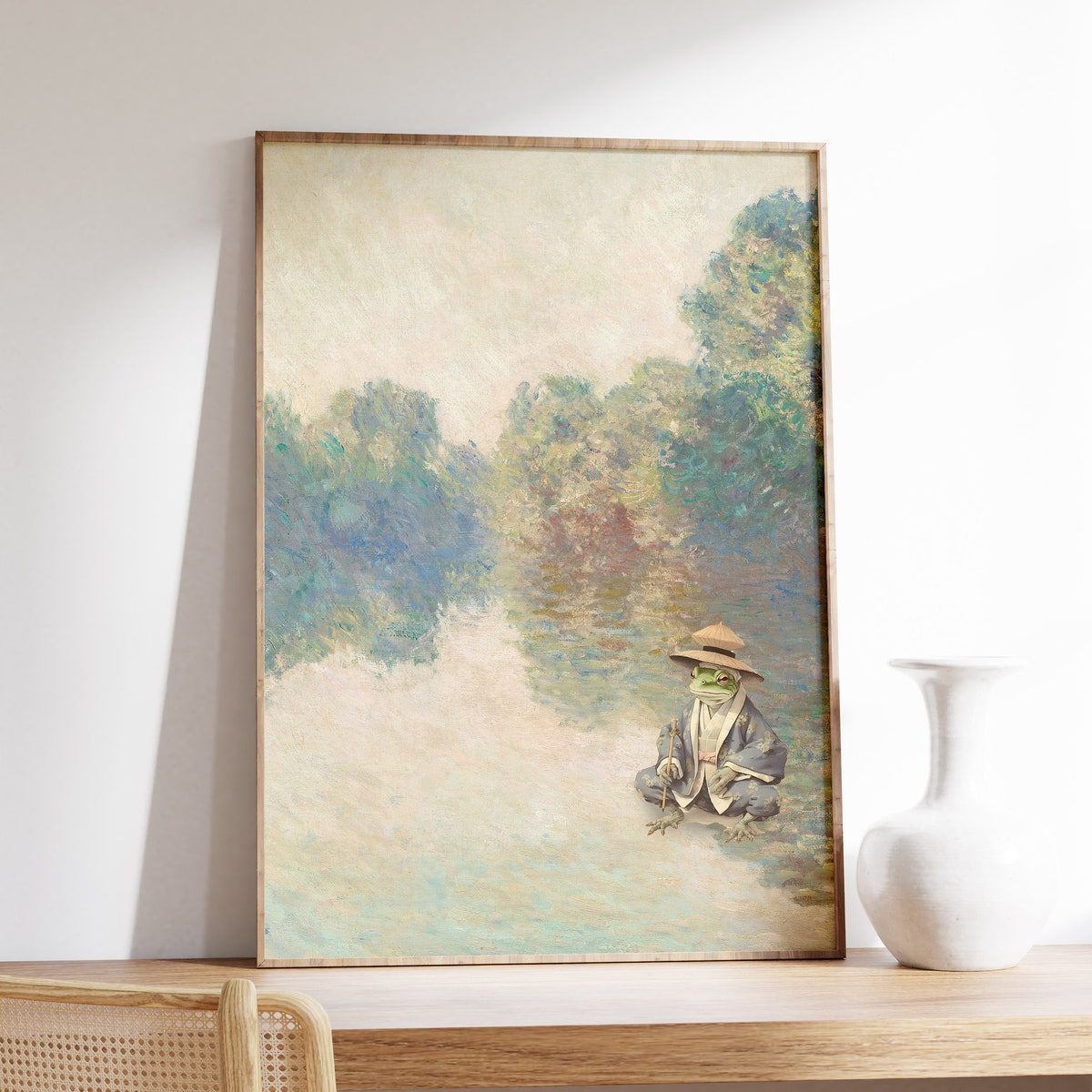
The work titled The Seine at Giverny, created in 1897, sits firmly within this lineage of experimentation. Held by major collections such as the National Gallery of Art, it exemplifies Monet’s oil on canvas method, applying pigment directly to arrest the immediacy of light before it dissolved. Contemporary scholarship situates the painting among related canvases executed along the Seine and around Giverny, each contributing to a broader argument about the artist’s negotiation between optical truth and painterly invention. This pivotal moment in Monet’s career underscores his transition from pure depiction toward a more perceptual pictorial language.
Color, Brushwork, and the Materiality of Light
Monet’s signature technique in The Seine at Giverny centers on broken brushwork that favors flecks of color over blended tonal gradients. Instead of rendering every wave or reed with a uniform stroke, he allows small fragments of pigment to sit side by side, trusting the viewer’s eye to fuse them into a cohesive impression. This practice yields a surface alive with vibration, granting a sense of luminosity that a more detailed approach might stifle. The painter’s decision to flatten forms further dissolves edges, imbuing trees and riverbanks with a rhythmic undulation that echoes shifting light.
In studies linked to The Seine at Giverny, Monet’s handling of water and sky reveals a sophisticated vocabulary of hue. Soft blues meld into pale greens, punctuated by warmer highlights where sunlight kisses the surface. Vegetation along the banks appears as pulses of olive, vermilion, and ochre, resisting strict botanical accuracy to emphasize atmospheric resonance. This chromatic strategy underscores his departure from precise modeling, opting instead for a vital simulation of perception that depends on the interplay of complementary tones.
The physicality of Monet’s materials mirrors his conceptual aims. By applying oil paint directly and without excessive underpainting, he preserves the immediacy of his outdoor studies. The canvas becomes a site of encounter, where paint is a record of a fleeting reflection. Observers can almost feel the damp air and see the mist rise, as Monet’s surface texture evokes both the weight of water and the lightness of atmosphere. Such tactile qualities reiterate his belief that painting is as much about sensation as it is about form.
Atmosphere, Perception, and Legacy
A defining theme in Monet’s late riverine work is the depersonalization of form in the service of atmosphere. In The Seine at Giverny, trees, ripples, and structural details recede into tonal relationships, inviting viewers to complete shapes with memories and associations. This strategy aligns seamlessly with Impressionist ideals, emphasizing the lived experience of seeing rather than the authority of an all-knowing artist’s hand. Consequently, the painting becomes a collaborative event between Monet’s brush and the viewer’s eye.
Viewed alongside other works from the 1890s, The Seine at Giverny can be read as both a specific document of locale and a manifesto of perceptual painting. Curators and critics highlight the evolution in Monet’s brushwork over time, from broader strokes to nuanced color modulations that retain a sense of texture. His commitment to serial experimentation underscores a sustained inquiry into how the mutable qualities of weather and time can be translated into enduring compositions that resonate on a retinal level.
This exploration of water as a vehicle for atmospheric immersion has left an indelible mark on subsequent generations. By prioritizing sensation and color interaction, Monet influenced artists who continue to probe the boundaries between seeing and perceiving. The Seine at Giverny remains both a testament to his bold methodology and an invitation to embrace the instability of vision itself. In its shimmering surface, we find not only a river in Normandy but a portrait of nature’s transient poetry.