WE ARE READY TO BRING YOU TOGETHER WITH ART %60 Discount
Inside Odilon Redon's Dreamscapes
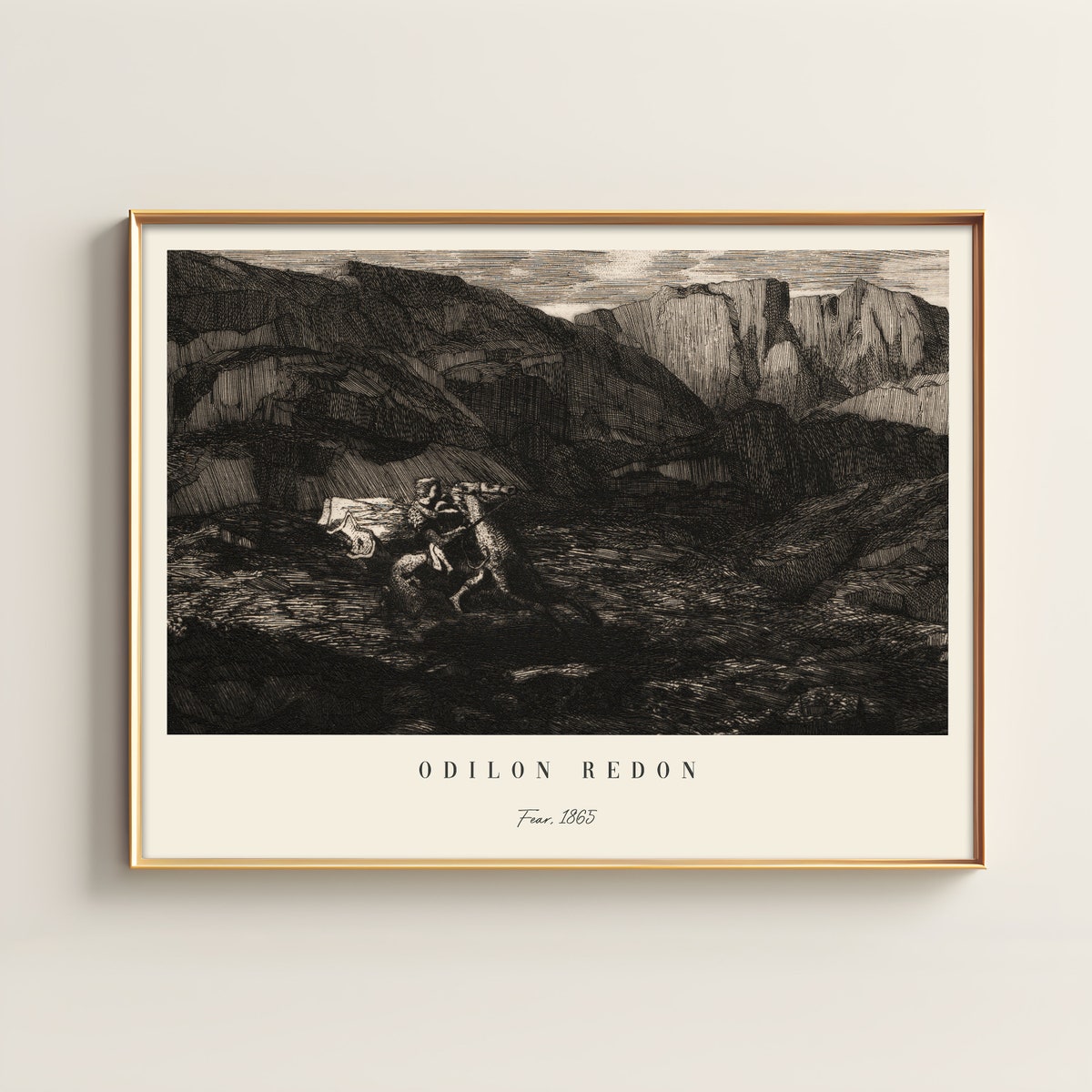
Origins of a Symbolist Pioneer
Odilon Redon’s artistic journey began amid the murk of charcoal and ink long before his name became synonymous with color and mythic reverie. Born as Bertrand Redon in Bordeaux in 1840, the artist adopted his evocative moniker later in life, marking a shift from introspective nocturnes toward a more vivid palette. The early decades of his career saw him immersed in the creation of nearly two hundred lithographs, each print an invitation to explore shadows that hint at unseen realms. These monochromatic drawings, often called noirs, reveal an artist intent on visualizing the psychology of dreams rather than documenting the visible world. Within these early images, Redon tested the boundaries of visual expression, forging a personal vocabulary where the contours of shadow spoke as eloquently as any line drawn in light.
At a time when naturalistic depiction dominated academic circles, Redon chose the opposite path, seeking to externalize the internal. His noirs are not mere illustrations of material reality but meditations on the intangible, filled with strange creatures and forbidding landscapes that resemble the dark corners of a psyche. In these drawings, form emerges from the void as if summoned by memory or fantasy, setting the stage for his later explorations of color and mood. Critics of his era recognized this unique perspective, noting how each composition blurs the boundary between nightmare and reverie with an almost hypnotic quality. His noirs achieve a fragile coherence that suggests more than they reveal, encapsulating the power of mystery and the allure of what lies beneath surface appearances.
By the end of the nineteenth century, this dialogue between darkness and luminance had become the core of Redon’s practice. His early works laid a conceptual foundation: the notion that art can act as a conduit to deeper emotional states. Underpinning this foundation was a belief in suggestion over illustration, a critical stance that would later resonate with avant-garde movements. It is precisely this early fusion of introspection and visual poetry that earns Redon his place as a true forerunner of Symbolism, even before his palette began to blossom with color. This insistence on introspective depth forged a conceptual core that would reverberate through his entire career, even as his palette grew ever more vibrant.
The Evolution of Form and Color
The turn of the 1890s witnessed a remarkable transformation in Redon’s approach to his work, as he began to embrace color with a daring previously unseen in his noirs. Pastel drawings emerged alongside luminous oil paintings, each hue selected not merely for appearance but for its emotional resonance. In these later works, blossoms seem to glow from within, and spectral heads hover as if caught between consciousness and slumber. Redon’s plant studies and portraits reveal a nuanced understanding of how color can serve as a vessel for metaphysical weight, lending his images a lyrical, almost musical quality. The shift underscores his belief in color as a dynamic, psychological force, capable of evoking responses beyond the reach of monochrome.
This period also saw the artist expand his technical repertoire, moving fluidly between lithography, etching, pastel, and oil. His prints, once confined to the stark interplay of black and white, began to incorporate subtle washes of tone that heightened their poetic impact. The tactile softness of pastel allowed Redon to convey both delicacy and intensity, while oil paint granted depth and richness to his mythic compositions. Each material offered its own grammar for expressing the fleeting impressions of dreams, and Redon wielded them with the confidence of a master linguist. In each medium, Redon confronted technical challenges with a pioneering spirit, blending methods to heighten the sensory impact of his visions.
Throughout this phase, his work retained an open-ended quality, inviting viewers to linger over ambiguous forms that defy literal interpretation. It is in this embrace of visual suggestion that Redon’s formal innovations find their full force. The interplay of line, color, and negative space functions as a silent dialogue with the observer’s imagination, encouraging repeated viewing and fresh discoveries. Such a method foregrounds the act of perception itself, transforming each glance into an emotional encounter. This approach underscores the artist’s vision as an act of co-creation with the audience, a delicate interplay between what is shown and what is intuited.
Legacy of the Unseen
Odilon Redon’s commitment to the primacy of inner vision established him as a bridge between the Romantic imagination and the modernist revolutions that followed. His insistence on symbol over mere appearance paved the way for Surrealists and Dadaists who would later delve into the irrational and the uncanny. Rather than serving as a direct precursor in style, Redon’s oeuvre offered a conceptual framework in which dreams and invisible forces become legible through art. Curators and scholars continue to revisit his prints and paintings, recognizing in them an early vocabulary for the exploration of the unconscious. By emphasizing symbol over explicit depiction, he encouraged later artists to probe the depths of psyche rather than replicate the surface of the seen world.
The cultural impact of Redon’s symbolism can be traced in the way artists today still turn to his notion that color and form carry emotional and metaphysical meaning. His work embodies a theory of perception in which suggestion and ambiguity hold more power than explicit narrative. This theoretical openness resonates with contemporary viewers who seek art that transcends straightforward illustration. Redon’s images function as visual poems, each line and hue imbued with layers of possible interpretation. His visual poetry continues to inspire new generations to consider how ambiguity and fragmentary imagery can speak more profoundly than literal forms.
In our current moment, when the boundary between reality and imagination feels especially porous, Redon’s art offers a profound reminder of creativity’s capacity to reveal the invisible. His technical versatility and fearless embrace of both darkness and light invite us to consider the hidden realms within our own minds. By engaging with his prints, drawings, and paintings, we embark on a journey through emotion, memory, and myth—one that remains as compelling today as it was over a century ago. In revisiting Redon’s oeuvre, we are reminded that the most powerful art often dwells in the threshold between what we perceive and what we yearn to imagine.