WE ARE READY TO BRING YOU TOGETHER WITH ART %60 Discount
Winslow Homer’s Home Sweet Home: A Realist Glimpse of Soldierly Longing
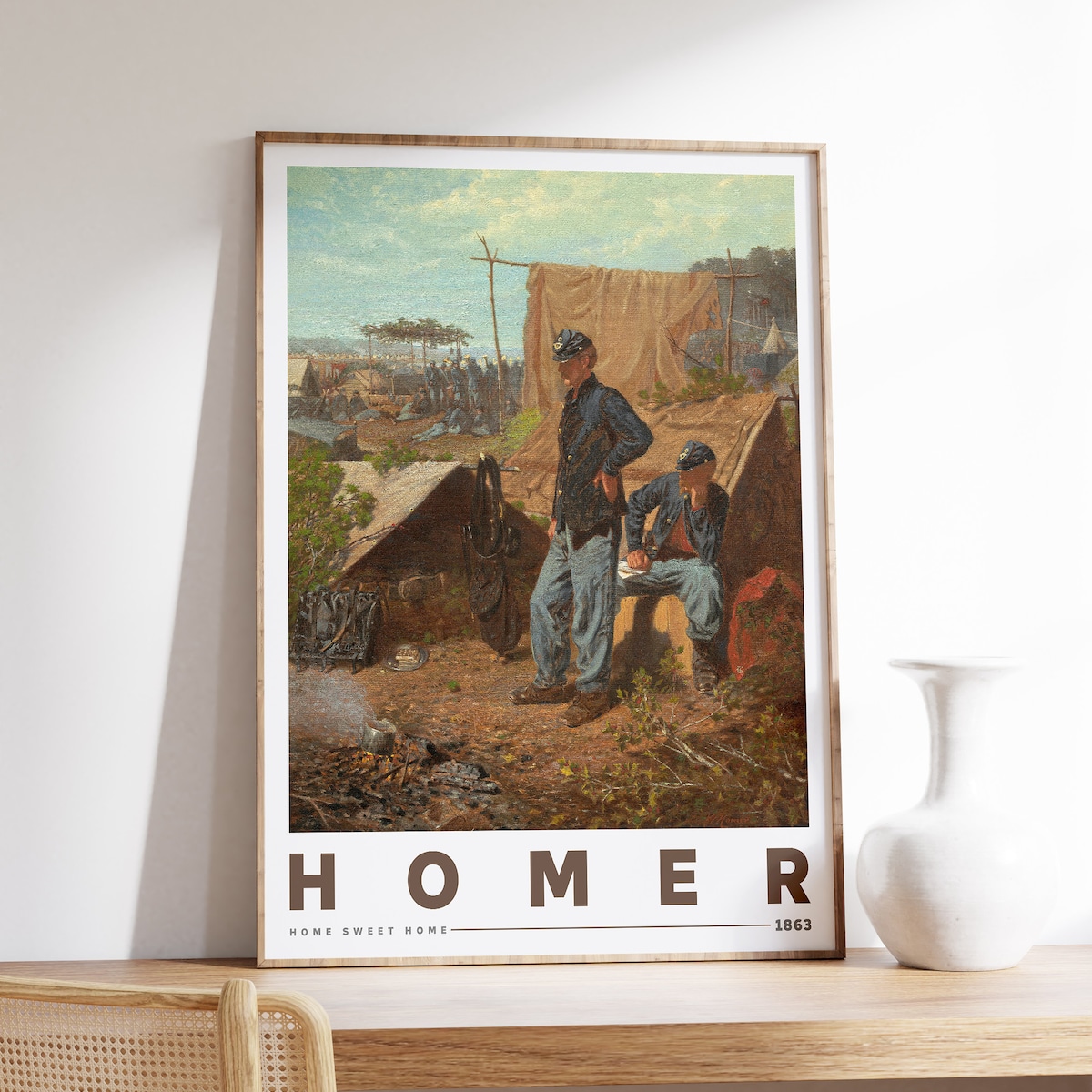
Framing Realism Amidst Conflict
Nearly three decades before his passing in 1910, an aspiring Winslow Homer emerged from Boston, where he drew his earliest scenes for Harper's Weekly. Those illustrations, dispatched to readers hungry for vivid accounts of Civil War life, reveal a sensitivity to the banality and pathos within soldierly existence. Unlike contemporaries who favored dramatic clashes of tattered flags and charging cavalry, Homer gravitated toward documentary realism, capturing the unadorned atmosphere of camp life. His commitment to simplicity rejected sensationalism, instead favoring a measured portrayal that emphasized human feeling over heroic spectacle.
During the Civil War years, Homer's emerging style stood out for its intimate attention to quotidian routines rather than battlefield heroics. His canvases record fleeting instances like a shared meal or an exchanged glance, drawing us into moments suffused with quiet longing. Soldiers at rest, tents at sunset, and the fragile camaraderie of makeshift quarters speak to the emotional undercurrents so often omitted from grand historical panoramas. By centering on these understated details, Homer forged a path that foregrounded everyday humanity amid chaos, sketching a portrait of conflict grounded in lived experience.
Home Sweet Home, painted in 1863, represents Homer’s earliest experiment in oil painting and a pivotal testament to his realist endeavor. The scene depicts two Union soldiers in a lull between engagements, one carefully reading a letter and the other listening as distant music drifts across the camp. This offering marked a shift from line work on newsprint to fully realized color and texture, amplifying the immediacy of Homer's vision. Here, he compresses the complexity of war into a single quiet moment, allowing viewers to inhabit the soldier’s private contemplation and ache for home.
Visual Materiality and Compositional Clarity
At first glance, the composition reveals a serene domesticity transplanted into a martial environment. A modest fire burns low beside a soup or coffee kettle, its vapor rising in gentle curves that echo the smoke of battle just out of frame. The pitched tent in soft focus becomes a silent witness to this intimate episode, framing the two figures who share the smallest of actions. Homer’s careful arrangement eschews clutter, ensuring that every brushstroke serves the narrative of waiting, memory, and the pull of shared melodies carried by unseen musicians.
The materiality of homely objects transforms into profound symbols under Homer’s hand. The tin pot resting over glowing embers and the folded flaps of canvas become conduits for evoking sustenance and shelter. Each element—down to the rough-hewn bench and the soldier’s coat draped casually over a box—functions as a visual note in an unspoken score of longing. The muted palette of earthy tones and restrained highlights maintains an emotional equilibrium, avoiding theatrical contrasts in favor of direct authenticity, hallmark traits of his realist vocabulary.
Home Sweet Home’s title acts as a subtle invocation, summoning the viewer’s own associations with comfort and refuge. There is no overt dramatization—no clenched fists or exaggerated expressions—only stillness and the knowing tilt of a head absorbed in memory. This deliberate simplicity reflects Homer’s belief that emotional truths emerge not from spectacle but from the disciplined portrayal of ordinary scenes. Through this lens, Homer's canvas becomes an intimate memoir of displacement, a tribute to the endurance of hope in the face of uncertain horizons.
Resonance in Collective Memory
Beyond its formal qualities, Home Sweet Home resonated deeply with a society reeling from war's aftermath. The image of soldiers quietly yearning for hearth and kin spoke to a collective desire for reconciliation and return to normalcy. By foregrounding the unspoken bond between tents and towns, letters and lullabies, Homer tapped into a shared narrative of endurance that transcended rank and geography. It was not merely a painting of camps but a mirror held up to a nation in transition, seeking solace in the ordinary markers of home.
In this work, the interplay between individual emotion and collective memory becomes palpable. Each brushstroke recording the warmth of firelight or the crisp crease of a letter carries the trace of countless personal stories. The painting suggests that the true measure of war lies in its intimacy—the soft echo of a favorite tune drifting across rows of tents, the fragile hope contained in a soldier’s hands. In capturing such nuances, Homer contributed to the shaping of American society’s own remembrance, forging a path for realism as both art and archive.
The legacy of Home Sweet Home extends far beyond its immediate historical moment, guiding Homer’s later explorations of landscape and maritime life. Its blend of technical prowess and emotional restraint became hallmarks of his mature style. By refusing to romanticize or sensationalize, Homer insisted that art could convey profound sentiment through the simplest of gestures. Nearly two centuries later, the painting endures as a testament to the quiet dignity of survival and the enduring power of remembrance.