WE ARE READY TO BRING YOU TOGETHER WITH ART %60 Discount
Edouard Manet and The Dead Toreador: Mortality in Modern Brushstrokes
A Spanish Inflection in Late 1860s France
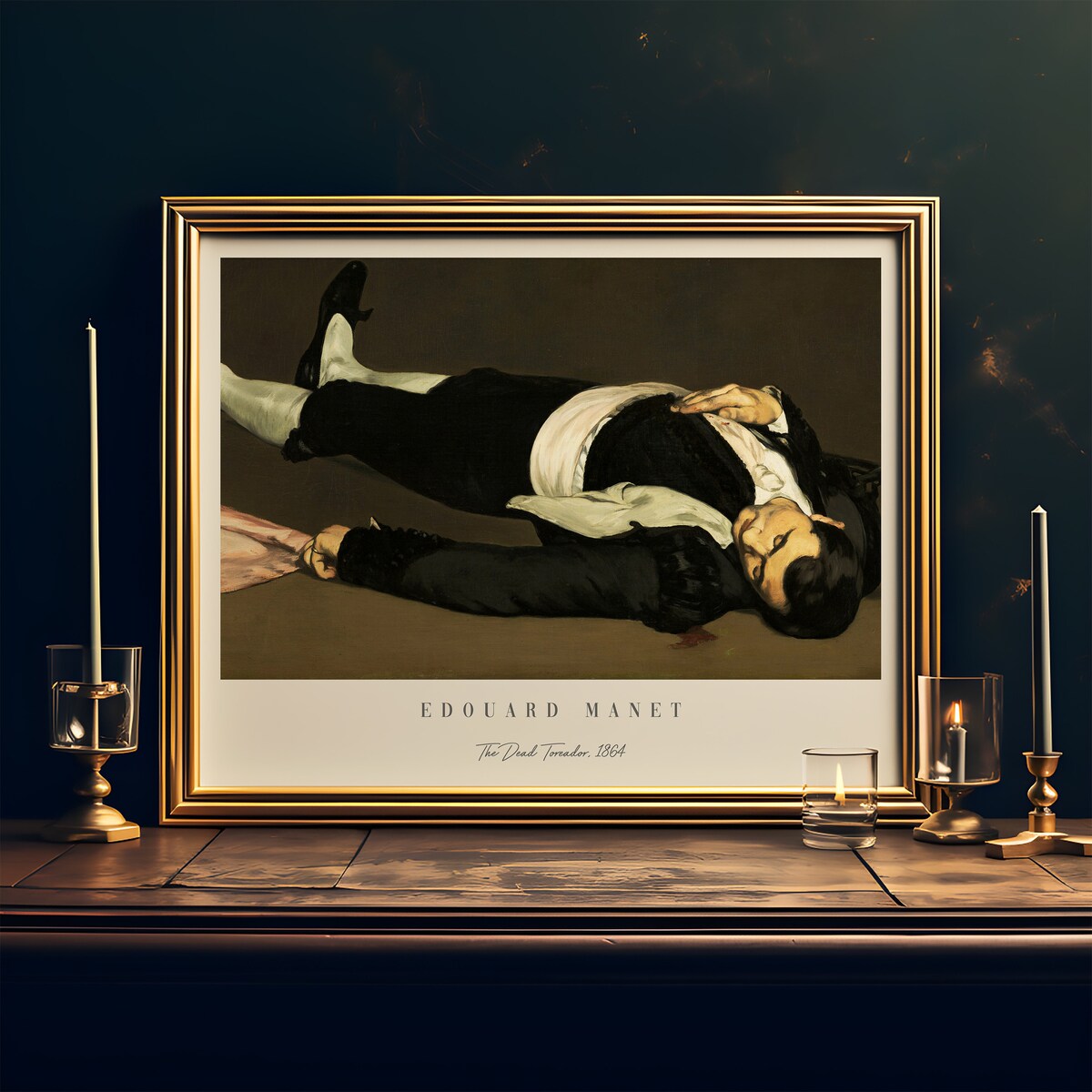
In the late 1860s, Edouard Manet turned his artistic gaze toward the vibrant yet brutal spectacle of the bullring as a novel lens on modern life. The Dead Toreador emerged from a larger canvas titled Episode from a Bullfight, and it survives today as the lower fragment that once pulsed with the chaos of the arena. In isolating the supine figure of the fallen toreador, Manet recast a public spectacle into a private moment of quiet mortality. This strategic cropping and reworking of the scene shifted the emphasis from collective drama to individual stillness, suggesting a study in contrasts between life’s ritual and its finality. By painting a single casualty with such meticulous care, he invited viewers to reconsider the intersection of cultural ritual and personal fate.
Manet’s choice of a Spanish motif aligned him with a lineage tracing back to Velázquez and Goya, whose own portrayals of the peninsula’s courtly and popular life resonated with a Parisian audience hungry for exotic color and stirring narratives. Yet rather than indulge in caricature or sensationalism, he pursued formal and compositional concerns that transcended simple evocation. The belated public reception of The Dead Toreador—first shown within the Salon of 1864 and later elsewhere—stoked debate about the ethics of depicting death in the grand halls of 19th century art. Critics questioned whether such realism verged on the theatrical or ventured into morbid territory, and spectators grappled with their own complicity as onlookers. Manet stood firm in his vision, demonstrating that a painting could be both contemporary and anchored in a storied Iberian tradition.
In the fracture between the original tableau and the surviving fragment, one senses Manet’s deliberate commentary on fragmentation itself, as if the scattered pieces of a once-coherent reality mirror the disjointed rhythms of modernity. Stripped of the broader bullring scenery, the canvas becomes an echo chamber for contemplation on ritualized violence and the solitude of its outcome. The dramatic narrative is no longer front and center; instead, we encounter a subdued testament to impermanence that lingers in the mind long after the image is seen. This approach embodied a turning point in Manet’s career, where conceptual framing and subject matter converged in a distilled purview of contemporary experience. The painting thus stands not merely as a study of a fallen figure, but as a manifesto of introspection within an age of spectacle.
Composition and Chromatic Resonance
In The Dead Toreador, Manet’s discipline in handling materials and pigments is unmistakable, with the oil on canvas format measuring approximately seventy six by one hundred fifty three centimeters. The life-sized scale invites an intimate encounter that blurs the boundary between painting and observer, drawing the viewer into the toreador’s final repose. The austere backdrop resembles a muted architectural wall, its neutral tones setting the stage for the dramatic interplay of dark costume and delicate flesh. Against this subdued plane, the toreador’s black jacket and white stockings emerge with crisp clarity, each brushstroke calibrated to accentuate the textural differences between fabric and skin. The delicate sheen of the pink sash or cape skirts the edge of ornamentation without overwhelming the restrained elegance of the scene.
Manet’s command of contrast manifests in the tension between the sumptuous upholstery of the matador’s garb and the pallid, almost cadaverous complexion of his face and limbs. The dark folds of his jacket create deep shadow pools that the pale skin punctures, lending the figure an uncanny, lifelike presence despite his stillness. Meanwhile, the soft glow of the pink fabric introduces a fleeting warmth that seems to breathe color back into a moment defined by cessation. Such chromatic choices were not accidental embellishments, but strategic elements in an arrangement concerned primarily with compositional harmony. Every hue and stroke serves the dual purpose of guiding the eye and reinforcing the emotional resonance of a serene yet unsettling tableau.
Beyond color alone, Manet’s spatial organization further underscores the figure-ground relationship at play. The viewer’s gaze is led horizontally along the length of the body, from the rigidly coiffed head to the relaxed arc of crossed legs, creating a visual path that reads almost like a still life in repose. This linear flow is counterbalanced by subtle diagonals in the musculature and the cascading drape of the sash, preventing the composition from plunging into static uniformity. By foregrounding a single figure in such deliberate alignment, Manet emphasized the sculptural qualities of paint itself, transforming surface into volume and motion into quietude. The result is a masterclass in material deliberation, where absence of gore amplifies the drama of form and color.
Death, Ritual, and Modern Spectatorship
At its core, The Dead Toreador speaks to the paradox of stillness within a spectacle intrinsically rooted in kinetic energy and communal fervor. The bullfight is conventionally a collective ritual, but here Manet subverts expectations by freezing its outcome in a private meditation on mortality. The absence of onlookers within the frame collapses the distance between audience and subject, implicating us in the act of witnessing and transforming our gaze into an extension of the spectacle itself. In choosing to omit the gore and dramatize absence, Manet refrains from sensationalism and instead foregrounds the solemn ritual of death as a universal human drama. This distillation of violence into serene reflection challenges our notions of what constitutes acceptable subject matter in modern art.
By tempering graphic detail, the painting attains a quiet dignity that transcends cultural specificity and invites endless reinterpretation. The sober palette, sparing in its application of red, acknowledges the bloodshed without indulging in it, while the formal rigor asserts that meaning resides in compositional precision as much as in narrative. Manet’s approach anticipates later modernist quests to capture the essential over the ornamental, turning what might have been a literal depiction into a potent symbol open to shifting readings. Viewers today continue to find in The Dead Toreador a vivid illustration of the fragile boundary between public performance and private fate, a boundary that remains resonant in any age of spectacle.
Its prestigious placement in national collections, notably the National Gallery of Art in Washington, D.C., has cemented the painting’s reputation as a touchstone in discussions of Spanish influence and figure-ground interplay. Scholars and enthusiasts alike return to this work to probe Manet’s evolving dialogue with mortality, ritual, and the responsibilities of depiction. The Dead Toreador endures as an artistic and cultural artifact that weaves together historical homage, painterly innovation, and the timeless contemplation of life’s transience. In every measured brushstroke and considered hue, the painting beckons us to pause, reflect, and acknowledge the quiet power of a moment forever frozen in time.