WE ARE READY TO BRING YOU TOGETHER WITH ART %60 Discount
Winslow Homer’s Snap the Whip: A Celebration of Youth and Unity
A Moment Captured in Postbellum America
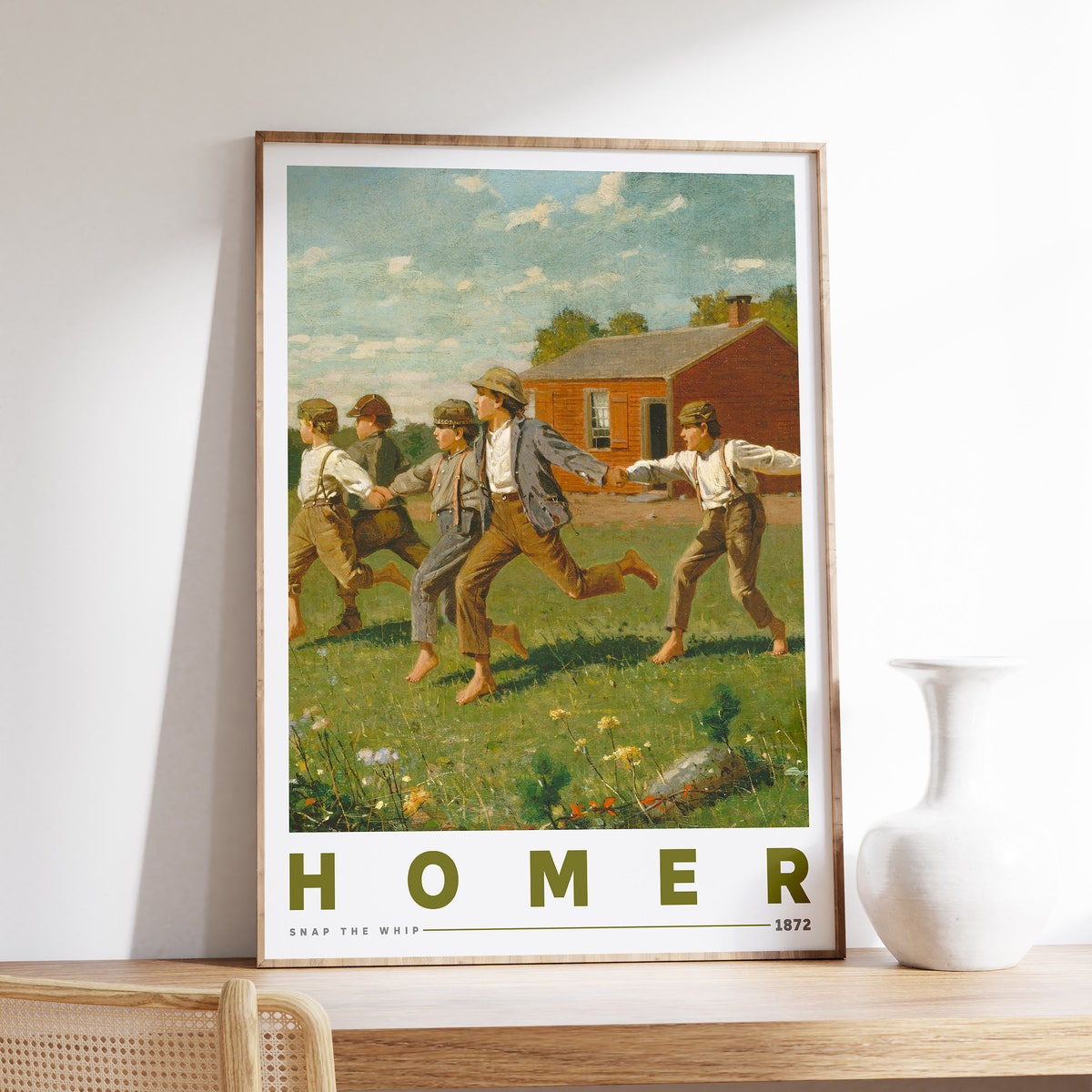
At its core Snap the Whip embodies a vivid fragment of American life during the early 1870s when the nation strove to rediscover a sense of unity after the Civil War. Winslow Homer, already invested in a naturalist idiom, turns away from grand historical subjects to focus on the simple intensity of childhood play. The painting’s setting among rolling fields and near a small red schoolhouse transports viewers to a rural landscape that felt both familiar and suffused with idealized possibility. By anchoring the scene in a common schoolyard game, Homer conjures a narrative of recovery and continuity in a country rebuilding its identity. More than a nostalgic tableau, it captures an aspirational moment when shared leisure could stand as a metaphor for national healing.
Homer’s mature style in this work reflects a commitment to immediacy and psychological depth that defined his postbellum output. His brushwork moves with brisk assurance across the canvas, modeling each boy’s form in a way that balances individual character with collective motion. The choice of medium and the scale of the 1872 canvas further emphasize the grandeur of ordinary life, rendering a simple act of play almost monumental. In this light, the boys’ interconnected posture becomes an allegory for interdependence and mutual support at a time when American society yearned for cohesion. This painting thus ranks among the most enduring of his oeuvre to capture a fleeting moment with a mythic quality.
The presence of the modest schoolhouse in the background serves as more than a picturesque detail; it functions as a cultural shorthand for education, literacy, and communal life. Its muted red facade recedes gently against the horizon, allowing the exuberant activity in the foreground to take visual precedence without losing its symbolic weight. Viewers are invited to sense the faint echo of the school bell and the promise that learning provides a foundation for future aspirations. This interplay of youthful energy and rural simplicity captures a nostalgic yet forward-looking mood that resonates beyond its time. In that way, the schoolhouse functions as both a landmark and a silent chorus to the boys’ energy.
Light, Color, and the Rhythm of Movement
Homer’s mastery of natural light in Snap the Whip is immediately apparent in the crisp delineation of shadows and the warm glow that washes over the scene. Every shoulder and sinew of each boy seems sculpted by the sun itself, lending a luminous intensity to what might otherwise be an everyday moment. This quality of light heightens the sense of motion, as if the figures are caught in mid-stride and airborne fractions of a second longer than reality would allow. The effect is at once dynamic and serene, inviting the eye to trace the game’s arc from onlooker to participant. The viewer feels almost transported to stand beside the boys, sensing the warmth of the afternoon sun.
The artist’s use of color further underscores the painting’s emotional clarity and formal cohesion. Earthy ochres and greens ground the playground in its rural context, while bright white shirts provide visual punctuation at regular intervals along the human chain. The red schoolhouse emerges as a focal contrast, its vibrant hue echoing the boys’ flushed cheeks and the vitality of open-air play. Together, these tonal contrasts map out a carefully measured sequence of attention, guiding the viewer through a narrative of anticipation, momentum, and release. The alternating hues create a subtle rhythm that echoes the physical cadence of the children’s game.
Through spatial composition and rhythm, Homer transforms a static canvas into a fleeting event that seems to pulse with life. The horizontal stretch of the children’s bodies leads seamlessly across the frame, creating a directional force that mimics the physical exertion of the game itself. At the same time, the open sky above and the gentle slope beneath establish an expansive setting that feels both boundless and intimate. This orchestration of form and light ensures that Snap the Whip transcends mere depiction to become an immersive visual experience. In inviting the imagination to complete the next move, the painting blurs the line between observer and participant.
Symbols of Unity and National Renewal
The sight of bare feet touching grass in unison offers a powerful metaphor for collective resilience and shared purpose. In Homer’s hands, the simple schoolyard pastime takes on symbolic weight as a stand-in for a nation’s fragile but aspirational unity. Each link in the chain of boys becomes a pledge of solidarity, a testament to the idea that progress relies on cooperation as much as on individual strength. The allegory becomes clearer when one considers how the postwar United States sought narratives of reconciliation as a balm for recent wounds. The universal quality of childhood at play bridges divides and resonates as a shared memory across generations.
Scholars and curators have long noted how the painting channels national memory into an almost mythic vocabulary of innocence and promise. The universal quality of childhood at play transcends regional or partisan differences, suggesting a collective future that remains accessible through shared experiences. Homer’s portrayal avoids overt sentimentality by grounding the scene in naturalism, yet it never relinquishes its capacity to inspire. As a result, Snap the Whip endures as a visual proverb about the value of simple joys amid social transformation. Its mythic status has been reinforced through countless exhibitions and academic discussions.
Over the past century and a half, this image has circulated widely in museum collections and popular reproductions, cementing its place as a touchstone of American art. Its reputation owes much to Homer’s unique gift for forging an intimate yet expansive narrative that speaks both to the individual and to the broader social canvas. In every detail of movement, light, and communal play, the painting reaffirms a hopeful vision of youth as the cornerstone of national renewal. Through its quiet allegory, Snap the Whip invites successive generations to rediscover the power of unity drawn from the simplest of pleasures. Its persistent presence in exhibitions testifies to the timeless appeal of Homer’s vision.