WE ARE READY TO BRING YOU TOGETHER WITH ART %60 Discount
Jacques-Emile Blanche’s The Readers: A Portrait of Quiet Contemplation
Situating The Readers in Blanche’s World
Across the late nineteenth and early twentieth centuries Jacques-Emile Blanche established himself as a portraitist attuned to the nuances of refined society. His training and practice straddled London and Paris, absorbing 18th-century English precedents while remaining deeply rooted in the modern Parisian milieu. In his hands, sitters acquired a poised air of cultivated ease, their presence shaped by a salon-worthy polish that became his signature. It is within this context that The Readers takes shape as an intimate variant of his more public commissions, revealing how even a quiet ritual could be elevated into a study of social elegance. His biography and the reception of his portraits help situate The Readers within a broader cultural frame of late-Victorian and Edwardian taste.
Blanche’s sensibility was characterized by a lucid paint handling and a controlled articulation of light and form. The smooth surfaces and subtle tonal shifts in his work speak to a desire for clarity without sacrificing the warmth of human presence. In both London drawing rooms and Parisian salons, his portraits catered to patrons who valued a combination of English restraint and French modernity. The Readers thus emerges not only as an image of a momentary indulgence in literature but also as a culminating statement of a transatlantic style that bridged two sophisticated worlds. Its refined finish gained recognition amid a milieu of literary and artistic figures drawn to Blanche’s cultivated style.
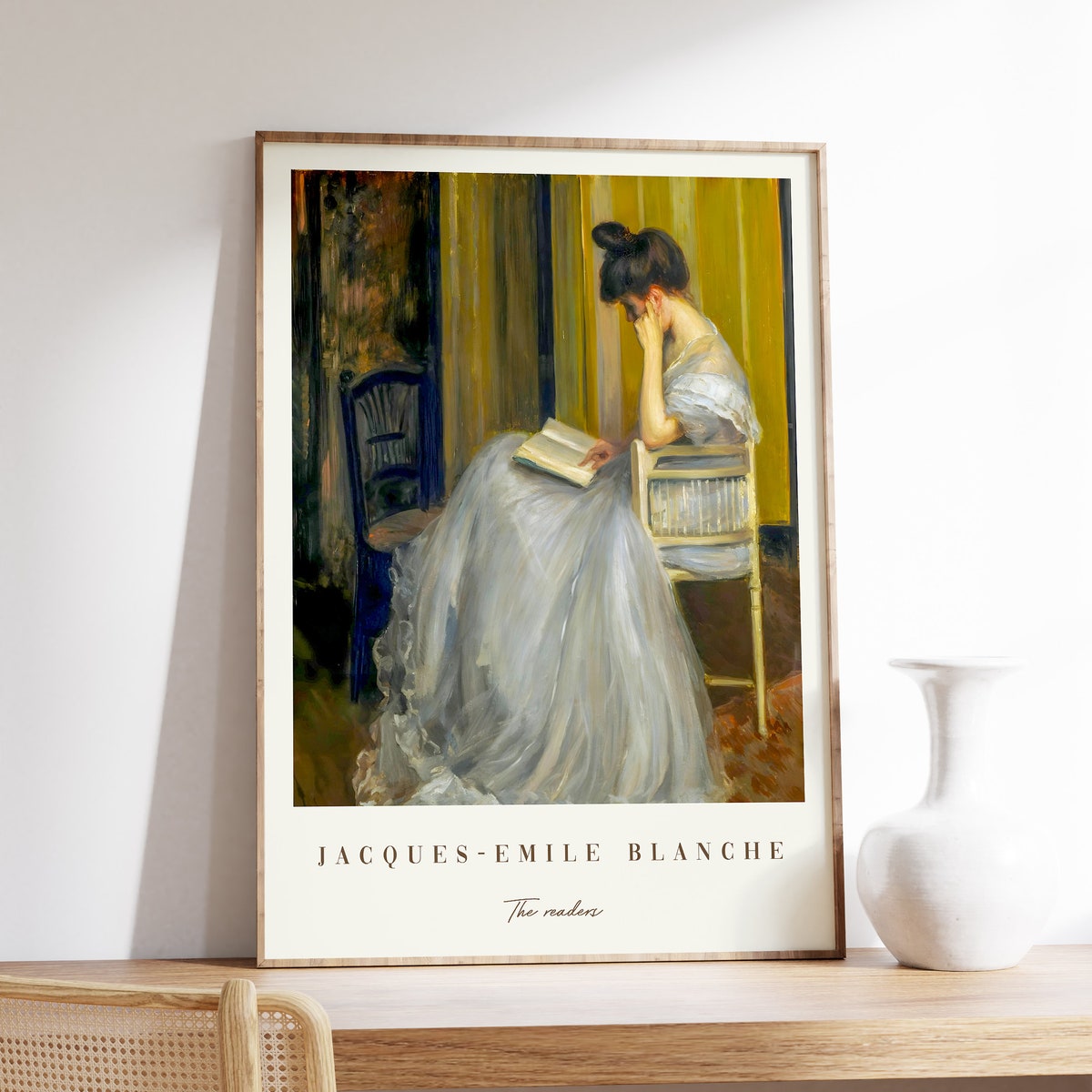
Although the sitter in The Readers remains unnamed, she stands in for a social archetype rather than a specific public figure. Dressed in pale fabrics against an interior dimmed by shadows, she embodies the archetype of the educated woman of the Belle Époque. This choice reflects Blanche’s broader portrait practice, which often traded literal identification for a distilled social persona. Through her composed posture and inward gaze, the painting invites viewers to consider the cultural ideals of taste, civility, and domestic gentility that he sought to capture.
Over decades, Blanche’s portraits have circulated between private collections and occasional museum exhibitions. While The Readers often appears in decorative or market listings, its formal qualities have drawn scholarly interest in mid-20th-century reassessments. Such revivals highlight how Blanche’s compositional restraint came to be valued anew for capturing the spirit of fin-de-siècle refinement. Even in commercial contexts, the painting retains an aura of cultivated elegance that speaks to his mature portrait sensibility.
Craft and Composition in The Readers
The formal structure of The Readers centers on the act of reading itself, expressed through a careful orchestration of figure, furnishings, and light. The lone sitter, seated in a chair, holds her book with deliberate poise, while the surrounding drapery and furniture create a quiet stage for her contemplation. Blanche’s arrangement of elements is precise, ensuring that the viewer’s eye moves naturally from the curve of her arm to the gentle folds of her dress. In this way, the composition underscores the ritualistic quality of reading as both performance and refuge. Every carefully chosen element supports the sitter’s focused engagement, suggesting that Blanche saw composition as an extension of character.
Light plays a critical role in articulating mood and materiality within the painting. A soft illumination highlights the pale textiles of the sitter’s attire, allowing the subtle undulations of fabric to become focal points of tactile interest. These highlights contrast with warmer shadows enveloping the room, creating a sense of depth and enveloping calm. By modulating these tonal relationships with restraint, Blanche achieves an effect that is simultaneously serene and sensuously precise. Such tonal harmony also underscores his affinity for capturing both the physical presence and the inner mood of his patrons.
At the technical level, The Readers exemplifies Blanche’s mastery of oil on canvas, deployed with layers of refined glazes to produce a luminous complexion and a polished finish. The brushwork remains controlled, with smooth transitions between planes of color that avoid any abrupt gestures. Such meticulous handling affirms the sitter’s introspective mood, as each surface seems to radiate a subtle inner glow. The result is a portrait that, though limited to a domestic scene, resonates with the gravitas of a formal commission.
Beyond compositional choices, the material presence of The Readers asserts its crafted nature. The oil on canvas substrate supports successive layers of glaze, lending a translucent depth to highlights and shadows alike. These delicate buildups of paint reveal Blanche’s commitment to creating surfaces that appear both tactile and luminous. Such attention to the paint’s own properties reinforces the sitter’s stillness and anchors her within a palpable, luminous space.
Reading as Cultural Performance
In portraying a woman absorbed in her book, The Readers taps into the late Victorian and Edwardian fascination with leisure and self-cultivation. Reading served as a visible signifier of literacy and refinement, a quiet assertion of intellect in a society increasingly defined by cultivated display. Blanche’s image elevates this private pastime into a moment of aesthetic contemplation, wherein the very act of reading becomes a codified ritual of personal elegance. In this way the painting speaks to an audience beyond its time, echoing a timeless allure of personal study.
The interior setting assumes the role of a stage for this social performance, its furnishings and draperies arranged to highlight the sitter’s poise. Objects within the room—the upholstery of the chair, the texture of the carpet, and the hanging fabrics—frame the book as an object of reverence. Such attention to domestic detail reflects a broader trend in which everyday life was itself brought into the realm of high culture, suffused with meaning and aspirational grace. This choreography of interior elements illustrates how everyday items become co-authors in the narrative of self-presentation.
By focusing on an archetypal figure rather than a famous individual, Blanche’s painting comments on the democratization of cultural ideals. Books are presented not merely as tools of knowledge but as symbols of an inner world accessible to any person of sensibility. This quiet dignity, encapsulated in The Readers, resonates with viewers across time, suggesting how simple moments of private reflection can reveal deep social values.
This painting also joins a broader artistic conversation around domestic reading scenes that includes precedents recovered by scholars of late 19th-century Europe. Artists who depicted readers often focused on interiors as sites of personal cultivation, yet Blanche’s interpretation remains distinct for its seamless mix of polished finish and introspective poise. By distilling the archetype of the cultured woman at leisure, The Readers occupies a unique position among reading portraits of its era. It stands as a testament to how a simple book can be transformed into a symbol of cultivated identity.