WE ARE READY TO BRING YOU TOGETHER WITH ART %60 Discount
Henri Rousseau’s The Dream: A Visionary Jungle Reverie
A Naïve Visionary at the Crossroads of Modern Art
At a time when academic painting ruled the salons, Henri Rousseau emerged as a self-taught dreamer whose last great creation, completed in 1910, challenged conventional hierarchies. First unveiled at the Salon des Indépendants, it met with puzzled glances and guarded praise before poets like Guillaume Apollinaire recognized its singular charm. This work sealed Rousseau’s transformation from an outsider laboring on Parisian partitions to a central force in the unfolding narrative of twentieth-century art. Despite his reserved pace and naïve technique, he fashioned a composition that would resonate far beyond his lifetime.
From the outset, The Dream stood at the threshold of primitivism and romantic idealism, articulating a new vision of the exotic through an exacting yet untrained hand. Rousseau’s jungle scenes, populated by vivid flora and fauna, transcended the simple genre status of folk art and ventured boldly into modernist territory. The painting’s flat planes and decorative rhythm sat alongside contemporary debates about formal control and mythic subject matter. In bridging these currents, Rousseau resisted easy categorization and invited viewers to question the boundaries between naive sincerity and conceptual finesse.
Rousseau arrived at his unique style through patient study rather than formal training, mining natural history illustrations and personal reverie to build a microcosm of tropical fantasy. Every leaf and petal in The Dream was conjured from his disciplined imagination rather than a single, identifiable habitat. In this way, he wove together observation and invention, endowing the canvas with both botanical specificity and a sense of the supernatural. The measured rhythms of his brushwork speak to a consciousness at once meticulous and unfettered by academic constraint.
In The Dream, Rousseau deployed a remarkably ordered composition that belies the apparent freedom of his scene, echoing principles of modern formalism even as it channels a romantic pursuit of wonder. The painting’s pattern-like organization of foliage, animals, and human form reflects a wallpaper sensibility, yet it pulses with a living intensity. Here, primitivism is not a crude borrowing but a strategic embrace of elemental signs to evoke a deeper mythic resonance. Such conceptual rigor positions Rousseau’s dreamscape at the core of early twentieth-century explorations of color, space, and narrative.
Painting the Jungle: Formal Rhythm and Cinematic Mystery
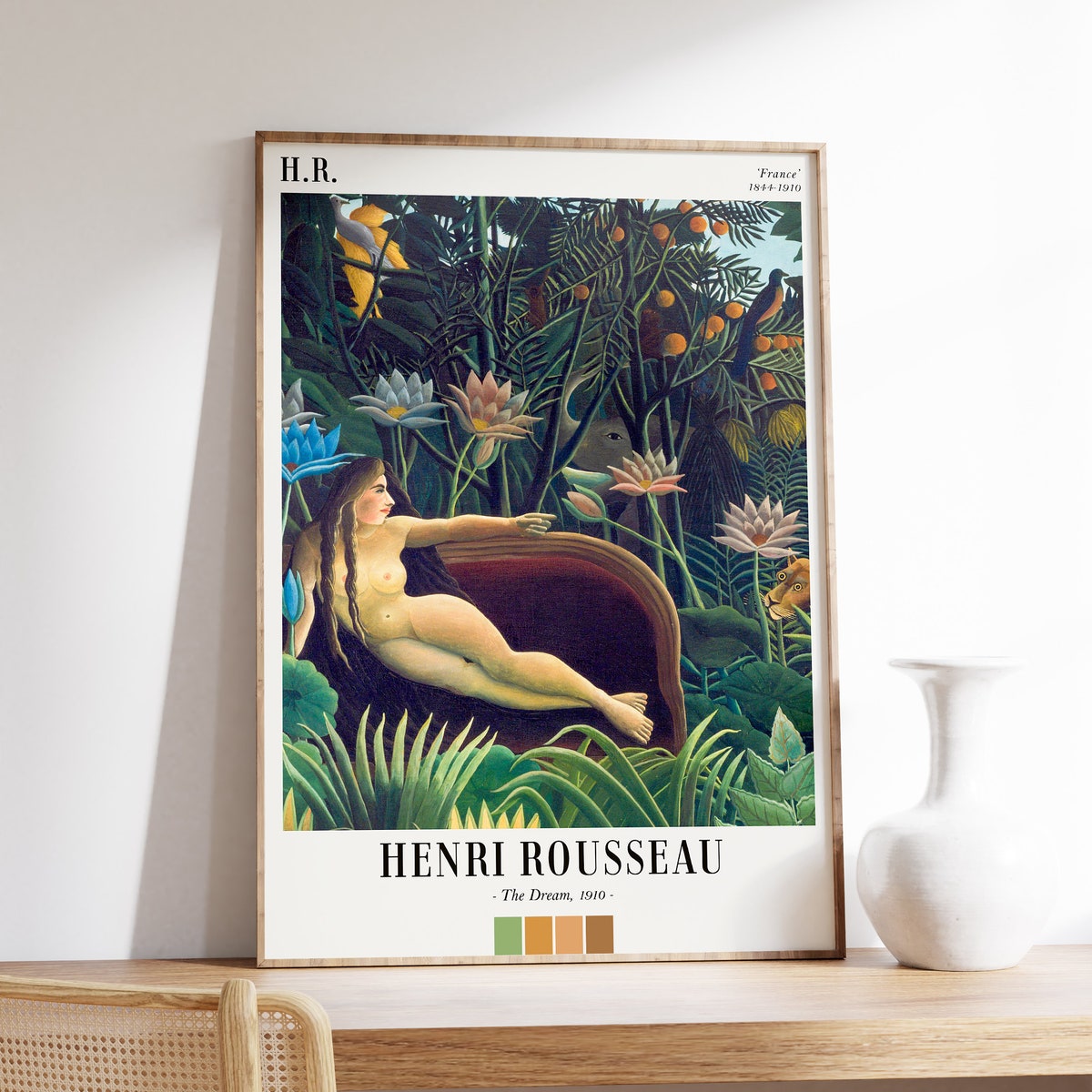
On the sprawling oil-on-canvas surface, Rousseau orchestrated a lush panorama of dark greens and glowing highlights that conjure a moonlit jungle stage. He favored a flat, decorative palette that treats each leaf and flower as a distinct motif, yet the overall unity of the composition remains undiminished. By distributing shapes with wallpaper-like precision, the painting draws the spectator into its densely layered depths. This sensorial arrangement lures the eye along a rhythmic journey through foliage and shadow.
Beneath the surface calm of the stylized vegetation, a latent energy simmers, hinted at through the bold silhouettes of simplified leaves and the watchful eyes of hidden creatures. The tension between serene repetition and potential wildness generates an almost hypnotic charge. Each animal, rendered with childlike clarity, becomes part of a larger visual symphony, underscoring the painting’s promise of discovery. The nocturnal atmosphere intensifies this cinematic effect, lending the scene a sense of narrative pause at the height of suspense.
At the heart of this verdant theatre reclines a nude figure, her languid posture both inviting and detached, as if she floats between dream and reality. Placed upon an incongruous sofa, she embodies the boundary between conscious thought and primal reverie. Is she an active dreamer crafting this lush world, or a passive observer drifting through its wonders? The ambiguity of her gaze amplifies The Dream’s exploration of desire and the exotic, positioning the human figure as both subject and witness.
Rousseau’s visual rhetoric combines painstaking detail with an almost childlike spontaneity, producing a scene that feels meticulously designed yet boundlessly imaginative. The contrast between perfectly articulated flora and freer, gestural outlines of creatures creates a dynamic tension. It is this balance that grants the painting its cinematic potential, as though a silent film frame were frozen in time. Through the disciplined interplay of color, form, and pattern, The Dream orchestrates a narrative that unfolds in the viewer’s mind.
Dreams, Exoticism, and the Politics of Representation
Although initially met with skepticism, The Dream gradually became a lodestar for conversations around so-called naïve art and its power to reshape modernism. Critics who once dismissed Rousseau’s technique came to admire the work’s poetic integrity and conceptual depth. Guillaume Apollinaire’s early praise helped pivot public perception, recasting the painter as a visionary rather than a dilettante. Over time, the painting’s reputation evolved, securing Rousseau’s place as a foundational figure unbound by academic pedigree.
The enduring presence of The Dream in homes and galleries around the globe owes much to its reproduction as posters, prints, and decorative motifs, which have sustained its magical allure across generations. This circulation has transformed the painting into a cultural artifact, readily accessible to anyone who seeks an encounter with its staged jungle. In its poster form, The Dream continues to captivate, inviting new audiences to slip into its sensorial world. Each reproduction underscores Rousseau’s success in crafting a universal symbol of exotic reverie.
Beyond its decorative appeal, The Dream has become a focal point for discussions about colonial gaze, desire, and the politics of representation in art. The exoticized jungle, peopled by curious animals and draped around a reclining nude, raises questions about the viewer’s own role in projecting fantasies onto the canvas. The painting’s ability to evoke both intimacy and distance speaks to the delicate negotiation between admiration and appropriation. By framing the exotic within a carefully controlled formal vocabulary, Rousseau forces us to reckon with our own imaginative impulses.
Contemporary exhibitions often revisit The Dream to explore how a self-taught artist could wield sophisticated formal control without academic training, reshaping notions of artistic authority. Its lush composition and choreographed immersion continue to inspire debates about primitivism and modernity, affirming the painting’s capacity to engage viewers across time. As a cultural touchstone, it invites enduring reflection on the interplay between imagination and representation, reminding us that every dream, however manufactured, points toward the vastness of human creativity.