WE ARE READY TO BRING YOU TOGETHER WITH ART %60 Discount
Dreaming the Tropics: Henri Rousseau’s The Equatorial Jungle
Rousseau’s Vision Beyond Boundaries
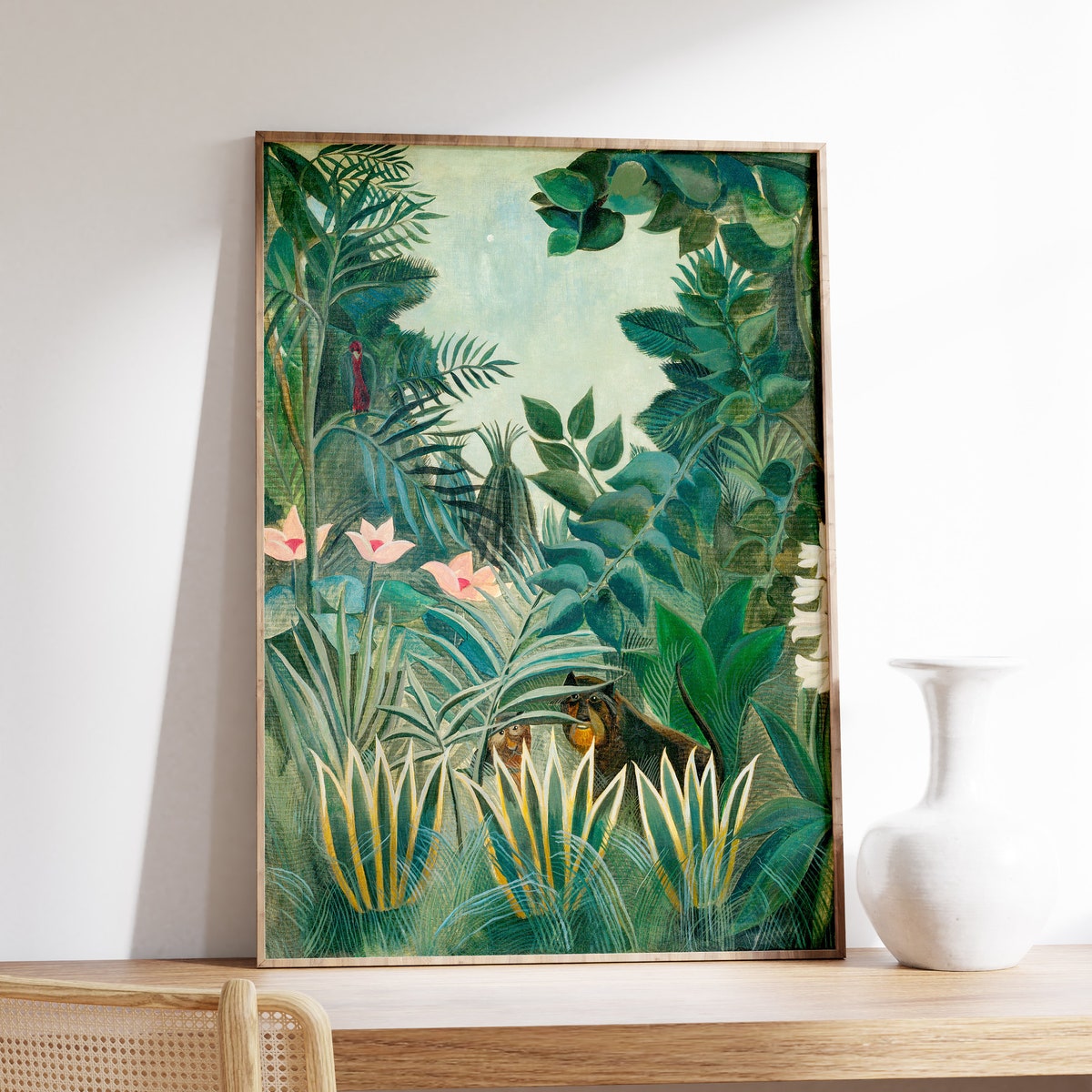
In 1909, Henri Rousseau unveiled a vision that would transcend the conventions of his time with The Equatorial Jungle. As a touchstone of naïve or primitive style, this painting channels a sense of childlike wonder even as it demonstrates a deliberate compositional rigor. Instead of measuring his world against strict academic standards, Rousseau crafted a scene where imagination orchestrates every leaf and shadow. This moment marked a clear departure from 19th-century academic painting, guiding European art toward a more self-conscious, modern sensibility. Today housed in the National Gallery of Art in Washington, D.C., the work continues to captivate audiences with its unique balance of simplicity and sophistication.
The story of The Equatorial Jungle begins not in distant tropics but within the bounds of France, where Rousseau never ventured beyond his homeland. Rather than direct experience, the artist relied on botanical guides, zoological plates, and excursions to city conservatories and menageries to assemble his lush tapestries. This blend of secondhand observation and personal invention gave rise to an imaginary tropicality that feels vivid yet uncharted. By tapping into published sources and personal reverie, he wove a coherent, individual mythology that resonated powerfully amid colonial-era curiosities. In doing so, Rousseau redefined how “foreign” landscapes could be envisioned and experienced in European art.
Rousseau’s jungle compositions, including this iconic canvas, foreshadowed aspects of primitivism that would later inform avant-garde movements. His work introduced a poetic alternative to realism, suggesting that emotional truth and pictorial impact might outweigh the fidelity of observed detail. Above all, these scenes invited viewers into a private theater of wonder, where rhythmic foliage and stylized creatures shaped a distinctly dreamlike environment. The artist’s naïve approach challenged critics and contemporaries to reconsider the boundaries of artistic sophistication. Over time, this painting emerged as a touchstone for conversations about outsider art and the broader evolution of modernism.
An Anatomy of Lush Enchantment
The visual power of Rousseau’s painting lies in its towering, vertical format defined almost entirely by layers of exuberant vegetation. Oversized leaves and winding vines aggressively overtake the picture plane, creating an immersive field of green that feels both enveloping and limitless. A canopy of foliage arches overhead, as though one were gazing up from an unseen path into a secret realm of living textures. The sense of enclosure is heightened by the deliberate flattening of space, which suspends the viewer in a pictorial plane where realism yields to a decorative, rhythmic logic. Each leafy form is outlined with bold graphics, emphasizing pattern over illusion.
By favoring a palette of sage, olive, and moss-green, Rousseau establishes a cohesive backdrop that allows brighter flora and small animals to assert their presence. Here and there, vivid blooms punctuate the verdant scene like notes in a visual melody, while glimpses of cerulean sky peek through the dense greenery above. Two monkeys, rendered with simple contours and approachable expressions, inhabit the composition as stylistic vignettes rather than precise zoological studies. Their presence reinforces the painting’s lyrical quality, reminding viewers that this world operates under the artist’s imaginative rules. Through these formal choices, Rousseau transforms the canvas into a harmonious network of flat color fields and decisive lines.
The overall effect is far from documentary. Instead, the work reads as a curated forest stage, where every element contributes to an associative narrative rhythm. The strategic placement of motifs—leaves, blossoms, creatures—creates a continuous procession that draws the eye deeper into the scene, encouraging repeated discoveries of hidden details. This visual cadence exemplifies how Rousseau’s so-called “naïveté” was anything but accidental; it was a conscious strategy to infuse his compositions with a pictorial poetry. In this light, the painting stands as a masterclass in how primitive simplicity can coexist with sophisticated formal design, forging a uniquely immersive aesthetic.
Imagined Ecosystems and Symbolic Depth
At its heart, The Equatorial Jungle is an exploration of abundance and enclosure, where the teeming foliage suggests both the intoxicating richness of nature and the claustrophobic density of a hidden world. The dense network of vines seems to embrace the viewer, evoking the thrill of trespassing into a realm of secret flourishing. Because depth is conveyed through overlapping planes rather than realistic perspective, the experience remains one of decorative wonder rather than precise topography. This tension between suffocation and delight invites viewers to ponder their own relationship to wild landscapes and the mysteries they evoke beyond everyday experience.
Rousseau’s decision to foreground plant life so aggressively engages broader dialogues about exoticism and representation. Rather than striving for ethnographic accuracy, he stages a dream-like theater where colonial curiosities merge with personal fantasy. The painting thus becomes a commentary on how modern spectators encounter “the exotic” through mediated glimpses—guidebooks, prints, glasshouses—rather than firsthand exploration. In this synthetic environment, nature’s vitality becomes a symbol of unbridled possibility, while the artist’s creative orchestration raises questions about authenticity and the politics of depiction.
Ultimately, the power of Rousseau’s vision lies in its ability to conjure an interior geography that transcends the limitations of personal travel. By weaving together secondhand sources and vivid imagination, he constructs a landscape that feels emotionally true, even if it defies botanical exactness. This approach presages modernist debates about the nature of truth in art—whether fidelity to observed detail or the force of evocative design holds greater sway. In presenting the jungle as a stage for memory and dream logic, Rousseau invites a meditation on why humans yearn for unmediated contact with nature and how art can fulfill that longing. This enduring appeal underscores why his work remains a seminal touchstone in the history of modern art.