WE ARE READY TO BRING YOU TOGETHER WITH ART %60 Discount
Winslow Homer’s The West Wind: Human Fortitude by the Sea
Framing Homer’s Coastal Vision
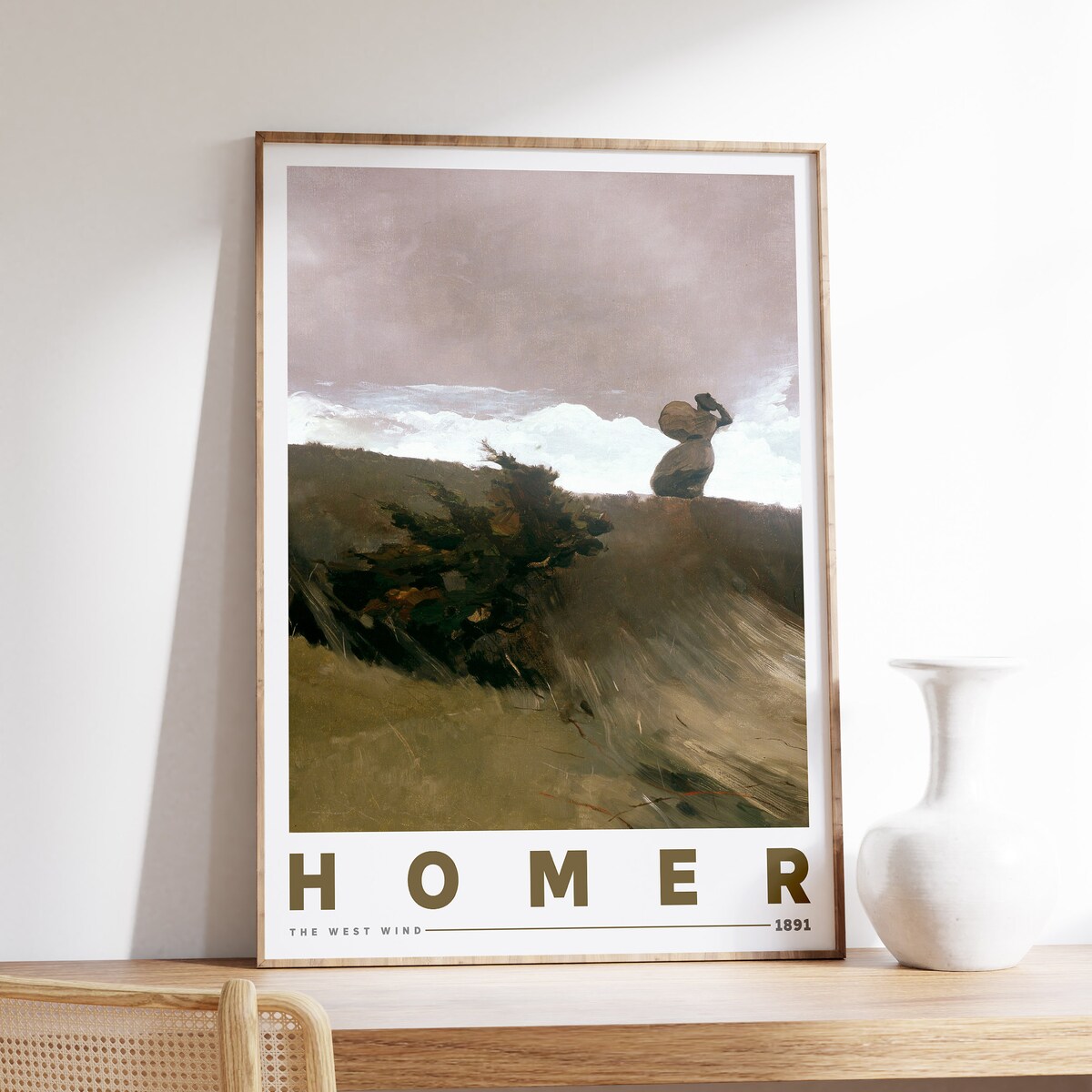
Winslow Homer occupies a singular position in the history of American realism, crafting images of the shore and ocean with an unflinching eye for truth to experience. Born in 1836 and working into the early twentieth century, he turned repeatedly to the rugged Maine coastline as both subject and studio. His paintings reveal an abiding fascination with weather and wind, elements that he depicted not as mere backdrop but as active agents in human drama. Within this late-Maine coastal repertoire, The West Wind of 1891 stands out for its formal confidence and compelling narrative. The work captures a moment in which human resolve meets the raw power of nature.
The West Wind, calibrated at roughly 76.2 by 111.8 centimeters on canvas, exemplifies Homer’s ability to translate elemental forces into a disciplined, narrative study of endurance. The painting exhibits what one might call formal bravura in its orchestration of sky, sea, and shore. In it, the vertical thrust of the lone figure anchors the composition against a sweeping horizon. Billowing clouds and restless tides seem on the verge of overflow, yet Homer balances this turbulence with a measured sense of mass and proportion. The result is a scene that feels both immediate and timeless.
Now housed at the Addison Gallery of American Art in Andover, Massachusetts, The West Wind resumes its place within a curated dialogue about American landscape painting at the turn of the century. Its presence in a museum context underlines the ways Homer and his contemporaries reframed national identity through marine imagery and weather-tinged atmospherics. These coastal works from the early 1890s continue to resonate as emblematic expressions of American realism. They insist on truth to material experience and on the understated drama of figures standing firm against nature’s whims. In this way, the painting reminds us of the symbiotic bond between artist, subject, and place.
The Formal Grammar of Elemental Turmoil
At first glance, the scene seems spare: a solitary figure stands poised on a wind-blasted ledge, head and coat collar turned into the gale. Yet within that sparseness lies a powerful compositional design, with a strong vertical line bisecting a vast expanse of sky and sea. The jutting cliff and cresting waves form a rhythmic counterpoint to the figure’s stance, creating a visual push and pull that mirrors the elemental tension. This interplay of forces draws the viewer into a tactile moment, as if one can feel the spray of saltwater and the ache of the wind in the lungs. Homer’s mastery of spatial arrangement makes the atmospheric drama palpable.
Homer’s handling of mass, line, and texture further amplifies this immediacy. He contrasts the weight of the rocky promontory with the fluidity of rushing water and the ambient glow of sky. The wind’s energy is not only indicated by billowing drapery but by the lean of the figure and the sweep of the brushstrokes themselves. Subtle gradations of color in the wave crests and the shifting tones of the cliff face impart a tactile resonance. Through these details, the painting transcends mere representation and becomes an immersive experience.
The West Wind also stands as a technical achievement in paint handling and compositional equilibrium. At its heart lies a disciplined narrative structure in which every element contributes to a cohesive whole. Homer’s economy of means—few figures, a limited palette, and bold strokes—attests to a mature confidence in his craft. This controlled bravura transforms what might be a simple coastal study into an enduring meditation on human resilience. Even the canvas dimensions, modest by grand historical standards, reinforce the painting’s intimate yet commanding presence.
Resonances of Resilience and Identity
More than a landscape painting, The West Wind serves as a meditation on human fortitude in the face of nature’s formidable might. The lone figure poised against an indifferent sea evokes a broader nineteenth-century contemplation of man’s precarious stance before vast elemental forces. In Homer’s view, endurance is revealed not through heroic gesture but through stillness and resolve. This emphasis on quiet strength recurs across his Maine coast works from the early 1890s. Together these paintings trace a thematic arc of mortality, perseverance, and the sublime.
The West Wind also embodies a sympathy for the raw energy of sea and wind that defies easy sentiment. Instead of romanticizing nature’s splendour, Homer presents it with a respectful austerity. Beneath the painting’s surface drama lies an understated human narrative: the figure, small against the relentless expanse, is both part of and apart from the scene. This tension between vulnerability and composure lies at the heart of American realism as Homer practiced it. His work insists on a truth to material experience that is devoid of exaggeration yet charged with emotion.
Viewed through this lens, The West Wind becomes more than a technical triumph; it is a thematic anchor for understanding Homer’s engagement with mortality and everyday life by the sea. The interplay of elemental tumult and human tenacity reveals a worldview shaped by firsthand encounters with wind-whipped shores. It is a reminder that the sublime resides in the smallest of moments—a stance against a gusting wind or a refusal to turn away from the unknown. In this sense, Homer’s painting remains as resonant today as it was when first unveiled in 1891.