WE ARE READY TO BRING YOU TOGETHER WITH ART %60 Discount
Ernst Haeckel’s Muscinae: A Journey Through Nature’s Artistic Forms
Bridging Science and Art
Ernst Haeckel emerged in the 19th century as a singular figure who wove together biology, philosophy, and artistry in a unified vision. His magnum opus, Kunstformen der Natur, stands as a testament to his desire to communicate the structural wonder of living beings in an accessible yet profound visual language. Haeckel’s background in evolutionary theory informed his appreciation for the underlying patterns that connect all forms of life, from the simplest cell to complex organisms. By treating each specimen with the same meticulous care, he invited viewers to perceive nature as both a scientific marvel and an aesthetic tapestry. The careful organization of his plates reflects an ambition to educate while enchanting, bridging a gap between specialist knowledge and public curiosity. In this light, Haeckel’s approach remains a model for how images can convey concepts that words alone might struggle to express.
Kunstformen der Natur introduced an early visual lexicon for evolutionary processes by depicting organisms with unprecedented clarity and artistic flair. Haeckel’s plates blurred the lines between empirical record and creative interpretation, suggesting that observation itself can be an act of artistic engagement. The series resonated in the late 19th century as both a scientific resource and a source of inspiration for designers, artists, and thinkers. Audiences encountered intricate lithographs that captured the symmetry and rhythm of natural forms in a way that spoke directly to the imagination. At a time when microscopy was unveiling unseen worlds, Haeckel offered a framework for understanding microbial morphology as part of a grander aesthetic order. His work thus functioned as an educational tool and a catalyst for broader conversations about the unity of nature’s design.
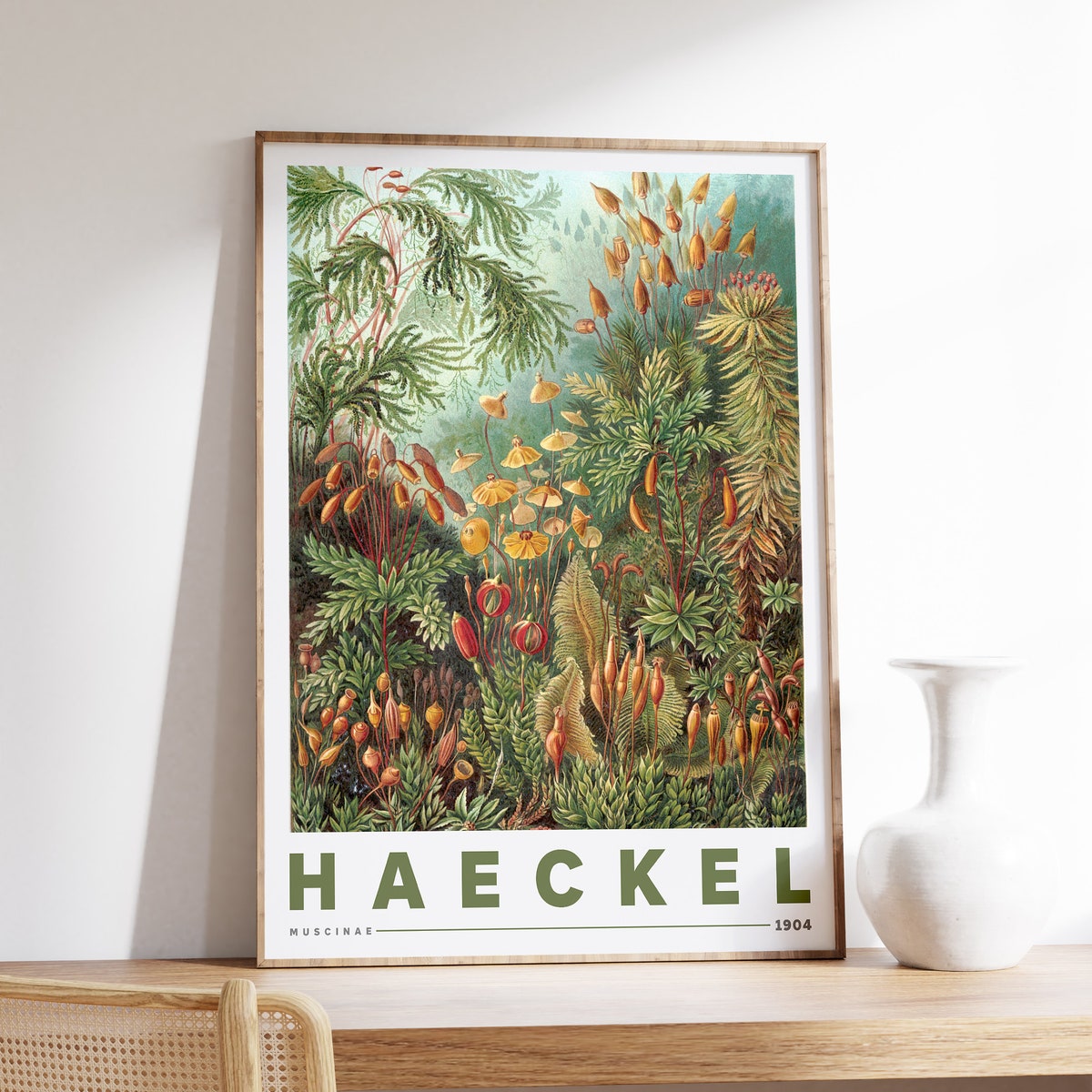
Among these plates, Muscinae emerges as a vivid example of Haeckel’s micro-and-macro synthesis, focusing on the subfamily within Muscidae with remarkable precision. This plate translates minute anatomical features into a broader ornamental composition that draws the viewer into its structured beauty. Haeckel’s balanced arrangement of forms invites contemplation, encouraging a deeper engagement than a mere catalog of species might provide. In Muscinae, one senses the harmony of patterns repeated across scales, hinting at the evolutionary forces that shape life. The work stands as both a taxonomic document and a celebration of nature’s artistic potential, demonstrating Haeckel’s belief that scientific illustration can transcend its utilitarian purpose. Through this plate, the boundary between data and decoration dissolves, revealing a continuum of form that resonates on multiple levels.
The Intricacies of Form
Haeckel’s mastery of lithography manifests in Muscinae through exquisitely fine lines and precise contrasts that delineate each structural element. The print’s tonal gradations suggest volume and depth, transforming flat surfaces into living reliefs of morphological detail. By leveraging the interplay of light and shadow, Haeckel accentuated the textures of tiny exoskeletons and wing membranes with scientific fidelity. His symmetrical compositions echo the inherent balance found in many natural systems, reinforcing the sense of order that underpins biological diversity. The deliberate choice of muted color palettes highlights subtle variations without overwhelming the viewer’s focus on form. Each nuance in line weight and shading serves to illuminate the complexity of even the smallest creatures.
Morphological intricacies in Muscinae extend beyond mere anatomical accuracy, as Haeckel infused each element with an aesthetic logic that unifies the ensemble. The repetition of shapes and curves across multiple specimens creates a visual cadence that guides the gaze from one detail to the next. Plant-like motifs intermingle with microbial analogies, revealing an underlying kinship among life’s varied expressions. This poetic orchestrations of forms underscores Haeckel’s conviction that nature adheres to principles of symmetry and proportion reminiscent of artistic composition. In this way, the plate functions both as a scientific atlas and a piece of visual poetry, each specimen contributing to an overarching narrative of universal design. The result is a harmonious integration of data and decoration that continues to captivate contemporary audiences.
Every component in Muscinae carries dual meaning: it is a node in a taxonomic framework and a stroke in a broader aesthetic argument. As viewers absorb the geometric regularity of legs, wings, and segmented bodies, they simultaneously witness an exercise in compositional balance. Haeckel’s formation of this visual lexicon transforms form into a conduit for understanding, where the act of looking becomes an act of learning. The interplay of repetition and variation on the plate mimics evolutionary dynamics, offering insight into how structure evolves through subtle shifts. By presenting these microcosmic forms in a refined artistic setting, Haeckel encouraged audiences to appreciate both the precision of science and the beauty of discovery. This dual engagement continues to inspire modern practitioners in fields ranging from cognitive science to design.
Enduring Influence and Interpretation
Haeckel’s illustrations operate beyond the boundaries of botanical or zoological records, serving as powerful tools for visual communication that transcend disciplinary walls. In contemporary contexts, his work informs cognitive science research into pattern perception and the relationship between form and function. Artists and educators alike draw upon his plates to explore how images can scaffold understanding of complex ideas and reveal unseen connections among living beings. The clarity and artistry of Muscinae exemplify the potential for scientific art to bridge gaps between specialized knowledge and public engagement. By translating microscopic forms into a universally resonant aesthetic language, Haeckel anticipated modern approaches to science communication that prioritize visual narrative. His legacy underscores the idea that aesthetic experience can be a gateway to intellectual curiosity and deeper appreciation for nature’s intricacies.
Within Muscinae lies a subtle invitation to consider nature as a source of universal patterns, one that echoes across centuries of artistic and scientific inquiry. The plate’s symmetrical arrangements and repetitive motifs gesture toward a harmonic order that many traditions have celebrated as a reflection of deeper cosmic principles. Haeckel’s aesthetic interpretation of biological diversity encourages viewers to perceive living forms not merely as isolated specimens but as participants in a grand visual symphony. This framing aligns with late 19th-century dialogues about the interdependence of life, form, and meaning, situating Haeckel’s work within broader cultural currents. By raising scientific plates to the level of metaphor, he demonstrated how visual art can shape our conceptual frameworks for understanding the natural world. In this sense, Muscinae transcends its era, inviting reinterpretation through new lenses of philosophy and design.
The public domain status of Haeckel’s plates, including Muscinae, has ensured their ongoing presence in educational materials and artistic projects around the globe. Digital platforms have amplified their reach, sparking fresh dialogues about the intersection of science and art in classrooms, studios, and online exhibitions. This accessibility reinforces the timeless appeal of Haeckel’s vision, allowing successive generations to discover the elegance of microscopic life. As a vintage print or fine art poster, Muscinae continues to inspire curiosity, serving as both a decorative object and a focal point for reflection on the unity and complexity of nature’s forms. In every context where it appears, the plate stands as a reminder that the smallest structures can yield the grandest insights. Through this enduring influence, Haeckel’s work affirms the power of visual language to convey the harmonies woven into the fabric of life.