WE ARE READY TO BRING YOU TOGETHER WITH ART %60 Discount
Edgar Degas’s The Dancing Class: A Prelude to Modern Ballet
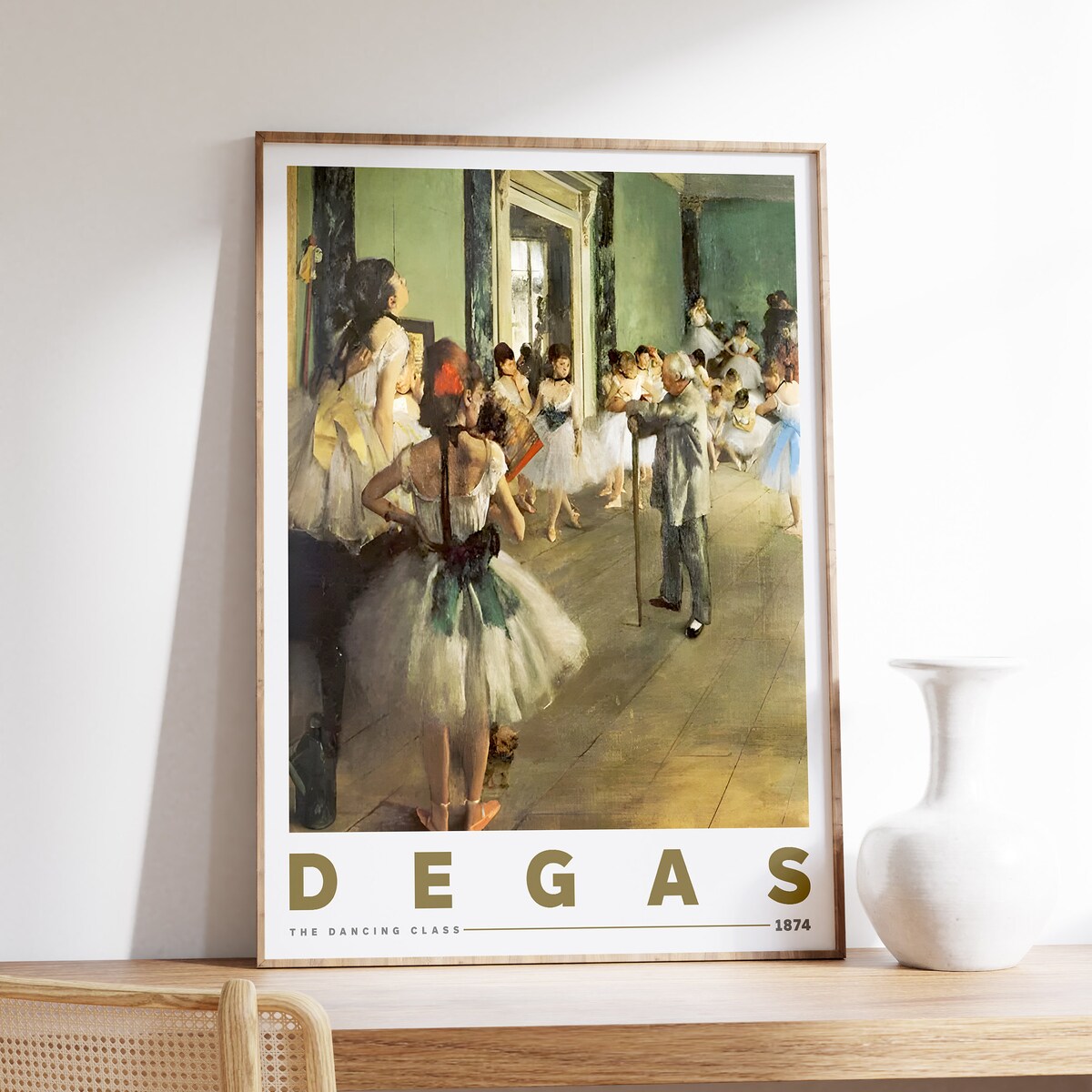
A Moment of Transition
Edgar Degas's painting The Dancing Class, created around 1870–1871, emerges as a quietly revolutionary exploration at the crossroads of tradition and modern life. Executed as an oil-on-wood study, it presents a cluster of young dancers in a rehearsal-like environment, each captured in a moment of diligent preparation. The scene unfolds within a bare, utilitarian interior that nevertheless becomes charged with anticipation and focus. This early canvas reveals Degas's fascination with ballet not as finished spectacle but as a living process, a laboratory of movement and discipline. The simple wooden floor and sparse architectural details set the stage for a drama of concentration rather than theatrical flourish, signaling Degas's shift toward a new, observational discipline that would define his career. The interplay between observed detail and artistic interpretation reveals a fresh approach to modern subject matter. Degas invites us to feel the weight of each poised limb and the hush that precedes the next arabesque.
During this period Degas had not yet ventured extensively into the actual backstage passages of the Paris Opéra, instead relying on preparatory sketches and controlled studio observations. The result is a composition that carries a certain restraint in posture and expression, a self-awareness mirrored in the dancers' cautious gestures. Scholars often contrast this early stiffness with the more fluid, intimate movements of Degas's later ballets. Yet here, in this self-conscious arrangement, we can already sense his structural engagement with space—the barre that lines one wall, the mirrored surface that slices and multiplies reflections, and the precise choreography of figures within architectural confines. In these elements he was laying the groundwork for a visual vocabulary that would crystallize in his subsequent series of classroom and backstage studies. This blend of calculated staging and empathetic distance offers a glimpse into Degas's broader attempt to photograph the unseen rhythms of everyday performance.
As a turning point in his ballet imagery, The Dancing Class introduces motifs that recur throughout his later dance compositions. The intersecting lines of the barre and the reflective plane of the mirror fragment the bodies of the dancers, while the bare wooden floor underscores the gravity of physical effort. A teacher or senior figure stands watchful at the edge of the class, silently evaluating technique and posture. The central dancer, caught in a preparatory gesture, anchors the viewer’s eye, while the surrounding figures create an intricate social network of concentration and shared discipline. These visual cues codify the ritual of learning, offering viewers an almost anthropological insight into the mechanics of ballet instruction. It is this balance of communal practice and documentary-like observation that foreshadows the deeper psychological immediacy Degas would bring to his more mature canvases.
Structure and Space
One of the most compelling features of The Dancing Class is its masterful use of the room as both subject and stage. Degas treats the rehearsal space with the precision of an architect, arranging bodies and objects in a carefully calibrated geometry. The wooden support of the painting itself echoes the materiality of the floor depicted, lending a unified sense of tactility to the work. The study’s compact scale imbues every contour with clarity of line, as if each element had been distilled to its essential form. Rather than softening edges into painterly suggestions, Degas favors crisp delineation, allowing the compositional logic to emerge through structure rather than through romantic sentiment. Rather than allowing romantic flourishes to dominate, Degas imposes a disciplined geometry that underscores the material reality of the room and its occupants.
The mirrored wall serves not merely as a backdrop but as an active participant in the composition, reflecting and refracting the dancers’ bodies into a web of overlapping forms. The intersecting lines of the barre guide our gaze through the scene, from one dancer to the next, organizing space with deliberate rigor. This formal arrangement invites viewers to step into the rehearsal room, to feel the taut anticipation before movement is released. Even the placement of the senior instructor becomes part of this choreography of space, anchoring the composition’s left margin and reinforcing the sense of pedagogical order. Every plane of light feels measured, as if Degas were conducting a rehearsal in paint, directing attention to the subtleties of posture and proximity.
Degas's handling of light and shadow is equally disciplined, illuminating the dancers with an even, almost clinical glow that brings out the texture of costumes and the subtle curve of muscles at rest. The absence of grand theatrical lighting or opulent décor shifts emphasis onto the physical and psychological labor of practice. Every posture seems weighted by intent, every expression a study in discreet concentration. Through these formal choices Degas achieves a tension between the anticipated motion of dance and the stillness of observation, laying bare the dual nature of rehearsal as both preparation and performance. The painting’s structural clarity enhances its emotional resonance, inviting reflection on the unseen work behind every polished show.
Dynamics of Labor and Gaze
Within the world of The Dancing Class one perceives not only the beauty of ballet technique but also the social forces at work behind the scenes. Degas's interest in 'modern life' finds fertile ground in the Paris Opéra's ballet classes, where issues of class, labor, and gender converged in a microcosm of public bourgeois culture. By focusing on the unglamorous moments of rehearsal, he illuminates a quieter narrative of effort and instruction. The dancers are neither idealized muses nor detached automatons; they are young practitioners engaged in a collective ritual of training. The unadorned interior becomes a microcosm of broader social dynamics, implicating audience and performer in an ongoing dialogue about refinement and labor.
The iconography Degas introduces here—the wooden barre, the reflected silhouettes, the watchful instructor—resonates as a coded language of power and observation. The central figure’s poised gesture reflects a moment of personal resolve, yet her perfection is contingent upon the scrutiny of the instructor and the company of her peers. This network of gazes—student to teacher, artist to subject, spectator to spectacle—establishes an intricate web of authority and vulnerability. In these dynamics we glimpse Degas's continuing fascination with the interplay of collective discipline and individual aspiration within the ballet world. Each reflected fragment in the mirror speaks to both the unity and the fragmentation inherent in artistic collaboration.
Early critics responded to The Dancing Class with mixed sentiments, some lauding its candid portrayal and structural orderliness, others noting its occasional stage-like stiffness. Over time, however, art historians have praised Degas's nuanced balancing act between documentary observation and orchestrated composition. They see in this foundational canvas the seeds of his later monumental ensemble paintings, in which he would explore the backstage realities of performance with a heightened sense of movement and mood. The Dancing Class remains a key touchstone for understanding how Degas transformed a simple rehearsal scene into a broader meditation on modern labor, gaze, and the shaping of artistic identity.