WE ARE READY TO BRING YOU TOGETHER WITH ART %60 Discount
Henri Rousseau’s The Equatorial Jungle: A Dream in Green
Origins of a Primitive Vision
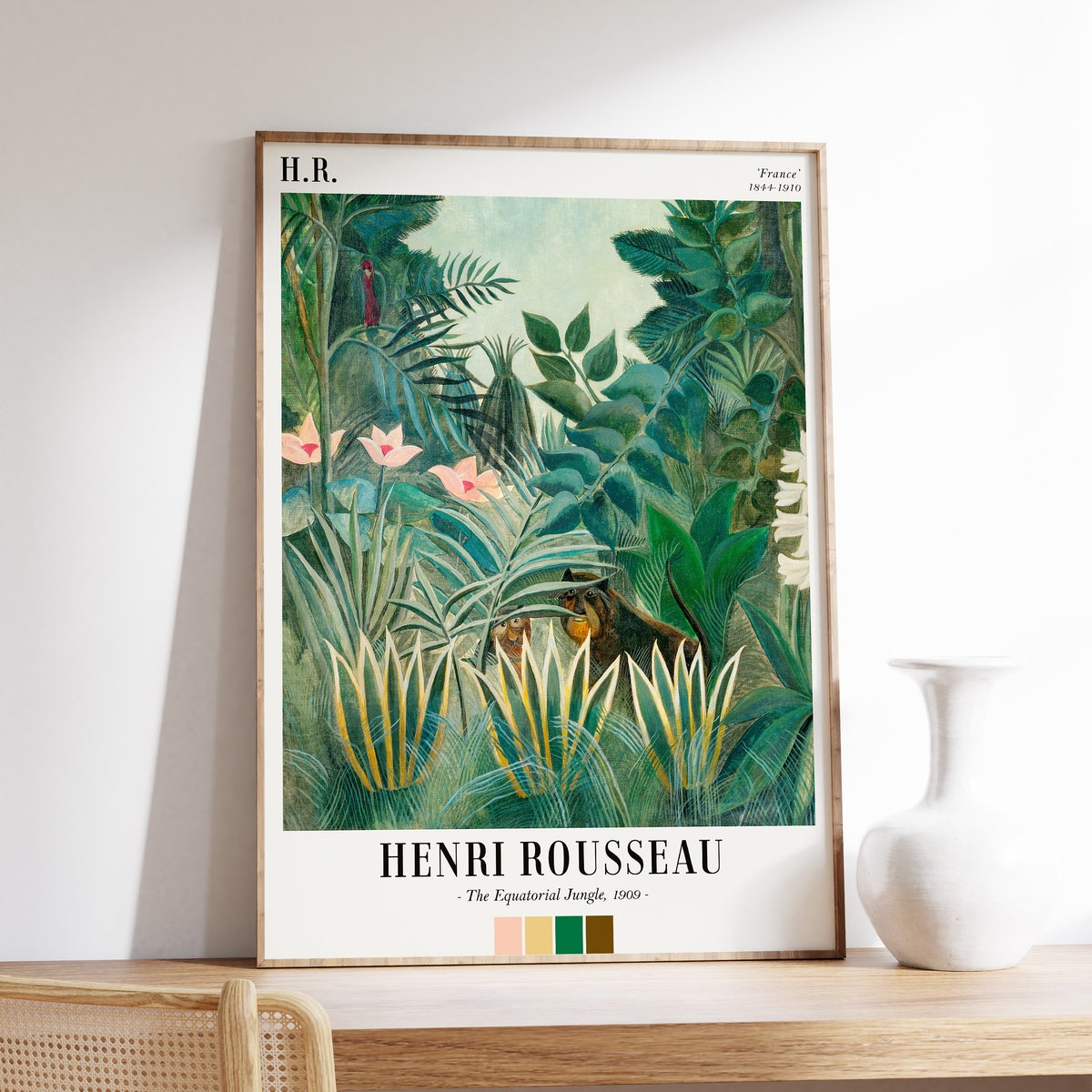
Henri Rousseau began his journey far from Parisian ateliers as a humble toll collector. He embraced painting in later life without formal training, driven by personal curiosity. His early experiments soon blossomed into lush, dreamlike jungle scenes full of decorative detail. The Equatorial Jungle of 1909 crystallizes this vision through flat, richly colored planes and stylized motifs. Today he remains a central figure in the history of Naïve or Primitive art.
Rousseau’s approach defied academic conventions with deliberate simplicity of form and exact outlines. He embraced a flattened perspective that transforms each stylized frond and winding vine into decorative pattern. In The Equatorial Jungle, vibrant planes of color and careful outline choreograph an immersive, dreamlike microcosm. The title itself transports us into a tropical fantasy conjured in Parisian neighborhoods rather than distant equatorial climes.
Rousseau never traveled to actual jungles but built his exotic tableaux through memory and studio rehearsals. He observed animals at the zoo and referenced botanical prints to stock his canvases with vivid flora and fauna. By merging these secondhand sources, he crafted an imagined ecology that feels both coherent and fantastical. This imaginative synthesis reinforces the dreamlike quality that defines his jungle narratives.
Early critics dismissed Rousseau’s work for its naïve execution and his lack of formal schooling. Over time, however, audiences embraced his vivid storytelling and imaginative power. Scholars later recognized The Equatorial Jungle as a precursor to Surrealist explorations of the unconscious. His work triggered enduring fascination with exotic locales as sites of mystery, danger, and beauty. Today the painting also invites reflection on representation and colonial discourse found within its lush imagery.
Anatomy of a Lush Composition
Painted in oil on canvas, The Equatorial Jungle measures roughly 140 by 130 centimeters. Its surface brims with meticulously rendered foliage in an almost architectural layering of forms. Graceful palm fronds and broad, heart-shaped leaves overlap in continuous, pattern-like repetition. Through the dense green field, a violet-blue sky peeps between gaps in the canopy overhead. This careful balance of color and form invites the viewer to wander through a living decorative tapestry.
Hidden within the verdant tapestry, a small cast of animals punctuates the green expanse with moments of dramatic color. The hungry lion, slithering snake, and vibrant birds act as visual counterpoints to the layered foliage. Firm outlines around each creature sharpen their presence amid the patterned backdrop, creating dynamic focal points. These punctuated bursts of life guide the viewer’s gaze through the composition like narrative bookmarks. The result is an immersive scene where fauna and flora engage in silent, rhythmic dialogue.
Rousseau’s decorative prowess shines through in repeated motifs of stylized flowers and curling vines. Each element is rendered with flat planes of pure color, sidestepping traditional shading and depth. This approach elevates every leaf and bloom to a patterned entity within the overall composition. Viewed as a surface ornament, the canvas becomes a tapestry where pictorial narrative and pattern converge.
Under close inspection, one notices the steady precision of Rousseau’s outlines, as if drawn with pen and ink. His controlled brushwork maintains the crispness of each form, resisting the softness of blended strokes. The contrast between bold color fields and fine linear details establishes a gentle visual rhythm. By forgoing painterly gestures, Rousseau achieves a harmonious balance between graphic clarity and narrative warmth.
Dreamscapes and Colonial Reflections
The Equatorial Jungle stands alongside The Dream and The Hungry Lion as cornerstones of Rousseau’s jungle repertoire. Together, these works fueled early twentieth-century interest in Primitivism and the exotic. They offered a romanticized vision of distant lands that resonated with European audiences hungry for the unfamiliar. In doing so, Rousseau’s paintings helped shape modern tastes for mystery and adventure in art.
At first glance, The Equatorial Jungle feels like a documentary habitat, yet its construction remains knowingly fantastical. This enigmatic play between realism and imagination invites viewers to project myths onto the painted landscape. The painting’s visual abundance offers no definitive narrative, leaving room for personal interpretation and wonder. Scholars often explore its colonial undercurrents, considering how such exotic imagery reflects European desires. Through this lens, the work becomes a site where fantasy and historical context converge in rich tension.
As part of the National Gallery of Art’s public-domain collection, the painting remains freely accessible for study and reinterpretation. Contemporary exhibitions and museum pages highlight its availability as a resource for exploring colonial-era imagery. Students, scholars, and designers alike draw upon its vibrant forms to debate the ethics of representing the ‘exotic.’ In this way, The Equatorial Jungle continues to inspire fresh dialogues around Primitivism and cultural imagery.
The painting’s enduring appeal rests in its lush decorative beauty as much as in its open-ended mystery. Each meticulously arranged leaf and creature seems to whisper untold stories beyond the canvas edge. Its mythic ecology offers more questions than answers, encouraging viewers to become active interpreters. This quality has ensured Rousseau’s jungle dream remains a vital reference for modern and contemporary art. Ultimately, The Equatorial Jungle endures as a living testament to imagination’s power to reshape how we view nature.