WE ARE READY TO BRING YOU TOGETHER WITH ART %60 Discount
Johannes Vermeer’s The Milkmaid: A Quiet Masterpiece of Light and Labor
Framing Vermeer’s Domestic Vision
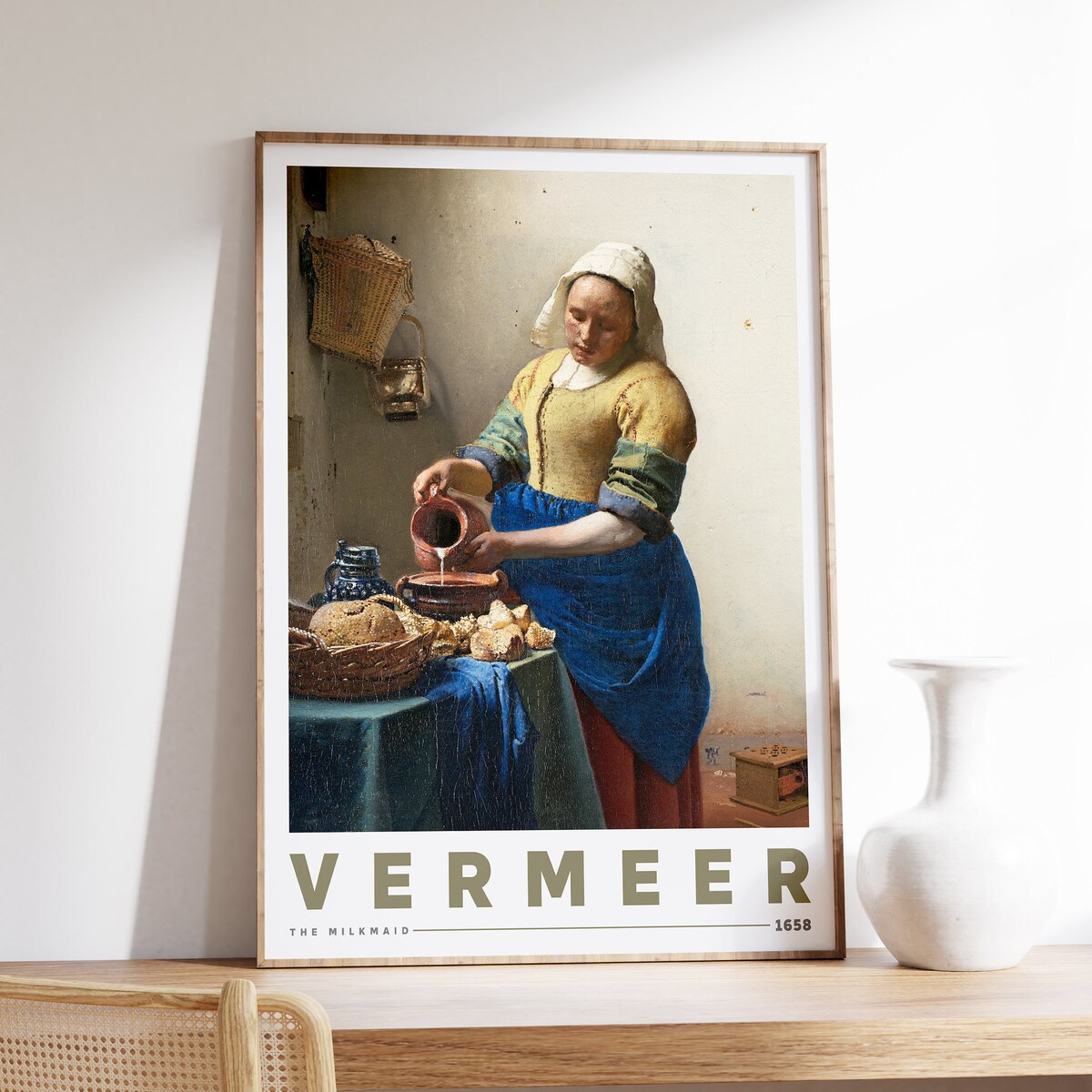
The Milkmaid by Johannes Vermeer stands as a quietly powerful testament to the artist’s vision of everyday life. Painted around 1658 and destined for the collection of the Rijksmuseum in Amsterdam, it emerged at a time when Dutch genre painting celebrated scenes of domestic activity. In this unembellished kitchen corner, Vermeer invited viewers to witness a moment of simple labor, yet he treated that scene with exceptional weight and grace. The sparse setting allows the human presence to become the central focus, emphasizing the singular action at hand.
In its subject and execution, Vermeer’s domestic scene transcends routine illustration. The solitary servant, once labeled a milkmaid but more likely a kitchen maid engaged in all manner of chores, is captured mid-pour with such solidity that her gesture feels almost sculptural. Vermeer’s handling of space, combined with a sense of volume in the table and the loaves of bread, gives the scene a measured gravitas. Through this careful balance, the mundane act of serving milk becomes a moment of contemplation, offering a respectful portrayal of ordinary work.
Within the broader landscape of 17th-century Dutch art, The Milkmaid embodies the genre’s twin impulses toward realism and quiet reflection. Vermeer’s mature style reveals itself in the restrained palette, dominated by natural ultramarine and soft earthy tones, which heighten the painting’s luminous clarity. His choice to avoid elaborate storytelling or opulent detail underscores an aesthetic that finds monumentality in the commonplace. In doing so, he carved out a niche where light and texture transform the everyday into a subject worthy of prolonged attention and admiration. Such emphasis on the ordinary quietly revolutionized the way artists approached interior scenes.
Light, Color, and Material Mastery
At the technical heart of The Milkmaid lies a masterful orchestration of light and form that draws the observer into the scene. Vermeer adopted a relatively low vantage point, directing sightlines upward toward the pouring motion without ever disrupting the painting’s serene balance. The composition’s pyramidal arrangement anchors the viewer’s gaze at the maid’s wrist, where the graceful arc of milk becomes both focal point and connective thread between figure and object. These strong diagonal axes lend a quiet energy to an otherwise still room.
Color emerges as a vital partner to light in conveying the work’s tactile reality. The rich ultramarine of the apron, sourced from costly natural pigments, glows against the canvas, while subtle ochres and muted whites provide contrast and depth around the ceramic jug and earthenware bowl. This luminous interplay accentuates the tactile qualities of bread crusts, the cool sheen of pottery, and the gentle texture of fabric. Vermeer’s palette, measured and deliberate, animates surfaces with an authenticity that feels almost tangible.
Beyond pigment choices, it is Vermeer’s nuanced surface treatment that elevates The Milkmaid to a near-technological marvel of its age. Layers of glaze and finely modulated brushwork produce a sense of three-dimensional volume, suggesting the heft of the table and the density of the milk itself. Historians often marvel at the painting’s photo-real clarity, an effect born of patient layering and a profound understanding of light’s behavior on varied textures. Through this process, the commonplace scene acquires an emotional resonance that extends far beyond its physical dimensions. This vibrant immediacy contributes to a sense of timelessness despite the painting’s centuries-old origin.
Symbolism and Everyday Virtue
While The Milkmaid presents a straightforward scene, it also contains subtle symbolic cues that enrich its narrative possibilities. Delft tile motifs, including a tiny Cupid figure behind the central figure, hint at interpretations that range from playful erotic allusion to themes of domestic fidelity. On the floor, a foot warmer quietly asserts its place as a symbol of homely comfort or potential longing. These elements, though restrained in scale, invite viewers to consider the layers of meaning woven into an apparently simple interior.
Interpretations of these symbols have varied, reflecting the painting’s capacity for dual readings. Some scholars emphasize a moral commentary on honest labor and upright conduct, aligning the maid’s focused task with ideals of domestic virtue. Others detect more subversive undercurrents—whispers of desire or social dynamics hinted at by the incongruous presence of Cupid. This tension between modest realism and evocative suggestion mirrors broader trends in Dutch genre painting, where everyday scenes could conceal nuanced reflections on desire, status, or moral rectitude.
Finally, the journey of this painting from its likely commission by Pieter van Ruijven to its celebrated status in the Rijksmuseum underscores its enduring impact. Exhibited in Europe and America throughout the nineteenth and twentieth centuries, it helped to solidify Vermeer’s reputation as a master of light and everyday drama. Contemporary curators continue to highlight its technical prowess and the serene dignity of its subject, ensuring that each new audience can rediscover the quiet power of a woman at work, bathed in golden daylight. In this way, The Milkmaid remains both a historical treasure and a timeless invitation to find meaning in the smallest of moments.