WE ARE READY TO BRING YOU TOGETHER WITH ART %60 Discount
Winslow Homer’s Flower Garden and Bungalow: A Tropical Reverie
Historical and Conceptual Framing
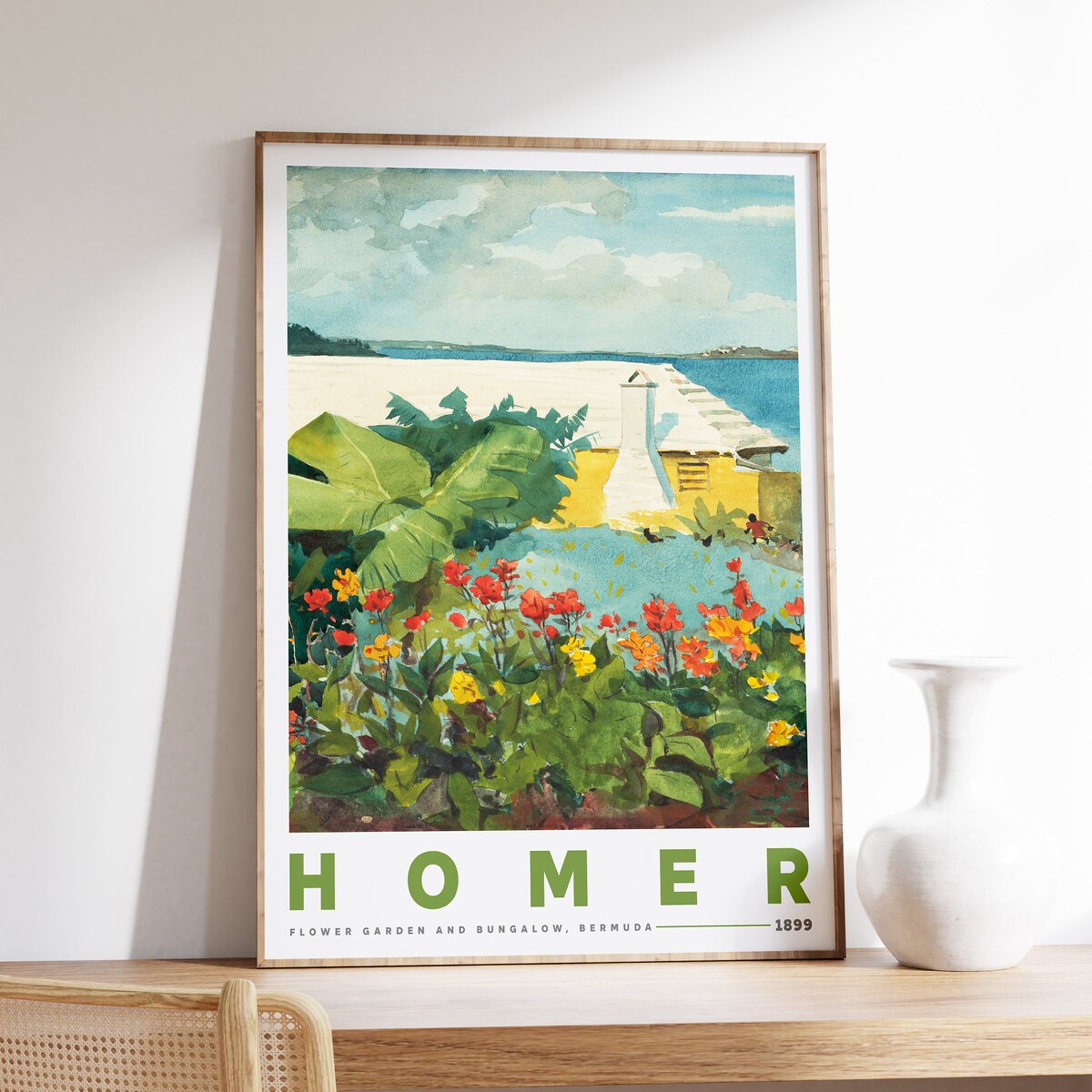
Winslow Homer turned to the tropics late in his career, embarking on a pivotal stay in Bermuda during the winter of 1899–1900. This period marked a shift from his celebrated seascapes and continental vistas toward scenes imbued with a warmer palette and a fresh architectural vocabulary. In Flower Garden and Bungalow Homer captures both the casual intimacy of a garden plot and the broader sweep of a sunlit bay. The work stands as a testament to an artist eager to explore how climate and setting could reshape his visual language and deepen his formal inquiries.
Within Homer’s oeuvre these Bermuda watercolors occupy a unique space between spontaneous travel sketch and studio-refined composition. He arrived with a keen awareness of how light can sculpt both natural and built forms, and he made the region’s stepped white limestone roofs and vibrant flora his subjects rather than mere backdrops. This painting exemplifies his mature sensibility, where architectural anchors and lush plantings serve as compositional waypoints. The experience of the island’s sun and humidity invited him to experiment boldly with color choices that he had hesitated to pursue in cooler climates.
While Homer’s engagement with the Bermudian landscape was rooted in direct observation, memory plays an equally important role in the final watercolor. The scene feels neither strictly documentary nor purely imagined; instead it moves between recorded detail and the lingering sensation of warmth, color, and air. In this sense, Flower Garden and Bungalow illustrates a key theme in Homer’s late practice: the gliding between the immediacy of the moment and the structural rigor of memory, resulting in work that feels fresh but also carefully composed. This balance offers viewers a glimpse into his evolving approach to place and perception.
Formal and Material Exploration
At first glance the painting presents a compact composition: a border of saturated flowers in the foreground, a white-roofed bungalow at its center, and a tranquil bay leading into sky at the back. Homer’s use of watercolor allows each plane to breathe, with transparent layers suggesting dappled sunlight on petals and walls. The transition from reds and pinks up front into cooler greens and then to fluid blue washes creates a natural progression that guides the eye outward from the garden to the horizon. Architectural lines introduce a steady counterpoint to the organic riot of blooms.
Color is applied with both restraint and intensity. The flowers appear to glow with warm pigments, while foliage recedes through cooler, more diffuse washes. Over these fields of hue, Homer leaves traces of pencil or graphite to define edges and shadows. This interplay between loose, atmospheric color and crisp, linear structure gives the scene its characteristic immediacy and tactile presence. One can almost feel the brush’s touch as it skims across paper, alternating between precise gestures and fluid, embracing sweeps.
Homer’s handling of watercolor in this work highlights its dual nature as a playful and mercurial medium. The clear paper surface retains every nuance of pigment, from the softest wash to the most concentrated pool of color. By deliberately showing pencil lines, he offers insight into his process, as though inviting us to witness both the initial mapping and the final flourish. The result is a study that feels alive, suggesting that the moment of creation and the careful consideration behind each stroke are inseparable.
Cultural and Interpretive Resonance
Flower Garden and Bungalow speaks to a broader dialogue in American art between unvarnished realism and emergent modernist concerns. Homer’s focus on everyday architecture and plant life adheres to a Realist interest in the familiar, yet his willingness to saturate color and play with atmospheric openness hints at future tonal and colorist experiments. The painting thus occupies a space where topographical fidelity coexists with the evocation of mood. In this way it contributes to a lineage of artists who valued both the literal and the lyrical qualities of landscape painting.
The small bungalow functions as a human touchstone within the composition, organizing our gaze and offering a quiet anchor amid vivid flora. The interplay between the building’s clean geometry and the exuberant textures of the garden reflects Homer’s lifelong fascination with how human structures belong within, and are transformed by, natural settings. This dialogue renders the scene more than just a pretty view; it becomes a reflection on the ways people carve out shelter and beauty in the world around them.
Finally, the work captures how travel can reshape an artist’s vision. Homer’s move from New England to Bermuda is evident in every shift of light and color. The tropical environment challenged him to expand both his palette and his compositional strategies, leading to watercolors that feel at once direct and nuanced. Flower Garden and Bungalow remains a vivid example of how stepping into a new landscape can ignite formal innovation and deepen an artist’s dialogue with place.