WE ARE READY TO BRING YOU TOGETHER WITH ART %60 Discount
Henri Rousseau’s The Equatorial Jungle: A Dreamlike Wilderness
A Vision Beyond Naturalism
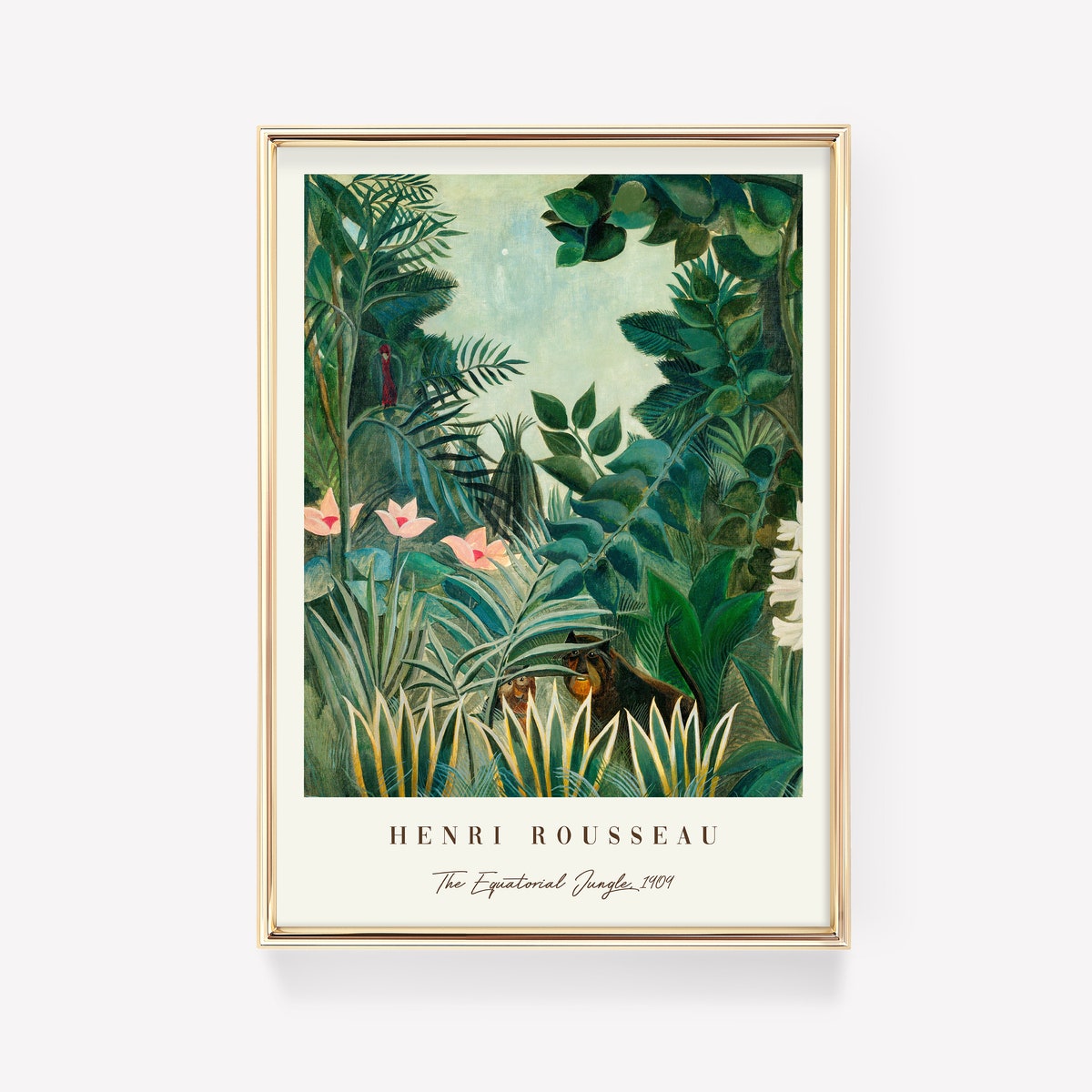
Created in 1909, Rousseau’s painting stands apart as a remarkable chapter in his journey through Naïve Art and Primitivism. Rather than meticulously recording botanical specimens with scientific precision, he chose to conjure an expansive tangle of foliage that feels both mythical and visceral, each leaf echoing a story untold. This jungle vision emerges from an unmistakable dream logic where bold outlines and simplified forms replace academic naturalism. The composition’s vertical depth suggests layers folding into unseen realms, urging the viewer onward. The sense of mystery grows as every leaf, flower, and lurking shadow seems charged with narrative possibility, inviting us to question what lies just out of view.
Rather than adopting the conventions of perspective that dominated his era, the artist organized this scene as a rich, vertical tableau in which every plane feels equally immediate. Under Rousseau’s hand, distant foliage appears as sizable and present as the foreground, creating a panorama that unfolds in a single, uninterrupted breath. Vivid greens and deep, yoked shadows mingle to birth a lush environment, punctuated by bursts of color where blossoms or animal glints momentarily seize our attention. This deliberate distortion of scale and space fosters an intimate dialogue between viewer and canvas, emphasizing wonder above botanical accuracy. In this vision, the jungle breathes as a living organism rather than sitting frozen like a specimen.
Within this immersive realm, Rousseau channels a lifelong fascination with the unknown, bending familiar conventions toward a narrative of discovery. His flattening of space achieves a dreamlike simultaneity, as though the entire jungle could be apprehended in an instant. By emphasizing contour and silhouette over minute detail, the work pulses with a rhythmic vitality that transcends photographic realism. Flowers, vines, and the occasional animal motif feel carved from shared memory or folklore. The overall effect is less a measurement of nature than an emotional journey through an enigmatic green world.
The Fabric of Color, Form, and Space
At first glance, the painting’s palette of saturated emeralds and deep forest hues captures attention, yet it is the deliberate interplay of light and shadow that sustains it. Rousseau’s meticulous brushwork outlines each leaf with calm precision, refusing the temptation to blend edges into uniform washes. Instead, bold silhouettes stand in relief against one another, generating a rhythmic dance of shapes. You sense a tension between the lush abundance of greenery and the carefully calibrated negative spaces that allow the eye to wander. This dynamic orchestration transforms static pigment into an animated jungle vista.
Organized as a vertical marvel, the scene unfolds in tiers of foliage that recede into painterly mists. The strongest leaves in the foreground bear sharp contours and concentrated pigment, while the background layers soften yet remain surprisingly vivid. Rousseau treats spatial depth not as a tool of realism but as a means to guide emotional response. Each receding plane invites a moment of wonder, as if stepping deeper into an enchanted undergrowth. It is a tour de force of decorative clarity, marrying color and composition in a single act of visual storytelling.
His technique privileges bold outlines and flattened silhouettes rather than botanical minutiae, fostering a sense of unity across diverse plant forms. The occasional burst of floral color or the glint in an animal’s eye becomes a deliberate focal point, punctuating the verdant tapestry. Shadows do not merely model form; they intensify the mood, coalescing into patches of mystery that beckon further exploration. By orchestrating these elements, Rousseau transforms a painted surface into a living organism, one where foliage and creature alike partake in a silent symphony. The result is a tableau that operates as much through feeling as through vision.
Myths, Meanings, and Modern Resonance
Scattered amid this verdant expanse are a few stylized creatures, each rendered with an almost sculptural simplicity. Their eyes meet ours with a direct, folkloric intensity that invites myriad interpretations. Do these figures serve as guardians of a hidden realm or as silent guides through this dreamlike landscape? The painting refuses to clarify, leaving us to ponder our role as outsider or invited traveler. In this ambiguity lies a profound tension between civilization and wilderness, a theme that courses through Rousseau’s entire body of work.
Rather than an exacting field study, the work offers a staged meeting of worlds, where the exotic brushes against the familiar in a single frame. This orchestrated collision teases at the unknown, yet it feels strangely accessible, as if we have chanced upon a secret ritual. The painting’s open-ended narrative permits endless readings: we might see a dream, a myth, or a playful fantasy. Its power rests in that very openness, allowing successive generations to project hopes, fears, and curiosities. This is the essence of its lasting appeal, a balance of wonder and uncertainty.
Beyond its original canvas, the image has permeated popular visual culture through posters and prints, extending its reach far beyond gallery walls. In this way, Rousseau’s jungle becomes a cultural conduit, bridging the divide between high art and everyday life. His naïve approach paradoxically shares affinities with early modernist experiments in color, scale, and psychological resonance. The Equatorial Jungle stands not only as an isolated masterpiece but as a touchstone for conversations about the nature of representation itself. It reminds us that the boundary between reality and imagination can be redrawn by the boldness of visual storytelling.