WE ARE READY TO BRING YOU TOGETHER WITH ART %60 Discount
Gustave Doré’s Elijah Is Nourished by an Angel: A Vision of Providence
A 19th-Century Visionary Illustrating the Sacred
Gustave Doré emerged in nineteenth-century France as one of the most prolific and influential illustrators, a figure whose name soon became synonymous with dramatic visual storytelling. His ambition to bring literary and religious works vividly to life led him to embark on an expansive cycle of Bible illustrations that transformed ancient texts into compelling imagery. Through wood engravings and lithographs, Doré distilled complex narratives into single frames that resonated with a growing literate audience. His dedicated focus on scriptural subjects cemented his reputation as a pioneering interpreter of sacred history.
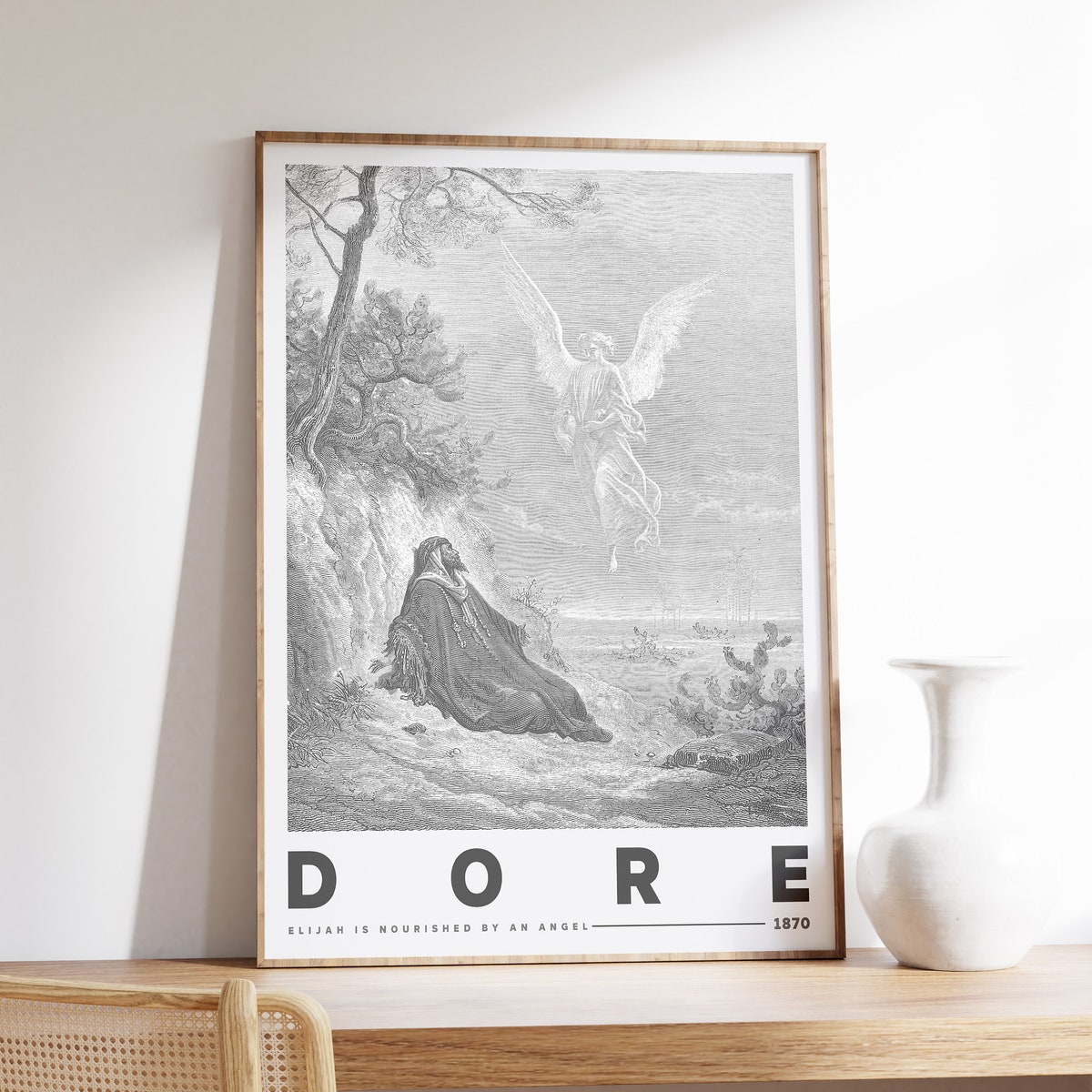
In the engraving titled Elijah Is Nourished by an Angel, Doré zeroes in on a pivotal moment of divine compassion. The weary prophet reclines beneath a sturdy tree, his body language conveying fatigue and spiritual trial, while an ethereal visitor descends in a gesture of comforting care. This tableau captures a moment of revelation at the precise instant when heavenly aid reaches a figure in profound need. Such concise drama typifies Doré’s talent for channeling entire emotional arcs into a single, arresting composition.
Doré’s mastery of wood engraving and lithography underpins the scene’s striking effects, allowing for fine line work and bold contrasts. His adept use of chiaroscuro—stark juxtapositions of light and shadow—lends the figures a tangible presence against the barren landscape. The engraved lines register the rough bark of the tree and the soft radiance surrounding the angel, producing a sensory richness that readers could readily absorb in printed form. Widespread reproduction of these plates in various editions amplified their impact, shaping nineteenth-century visual perceptions of biblical events.
Composition, Light, and Narrative Intensity
Light functions as a central dramatic device in this engraving, spotlighting the interaction between mortal and divine. The angel’s illuminated form emerges from shadow, immediately drawing the viewer’s attention to the sacred exchange. Meanwhile, deep shadows envelop the prophet, heightening his vulnerability and contrasting sharply with the heavenly glow. Doré choreographs these luminous elements to capture a moment that feels both intimate and epic, emphasizing the suddenness of divine intervention within an unforgiving environment.
Beyond illumination, the composition relies on structural clarity to guide the eye through the scene. The arching branches of the tree form a natural frame, their diagonal sweep echoing the angel’s descent as if channeling spiritual energy. The figures occupy the center of the composition, isolating them against a sparse backdrop of rocky terrain and scattered foliage. Expressive attitudinal details—the bend of the prophet’s head, the outstretched hand of the angel—further reinforce the narrative’s emotional core, making the engraving feel immediate and relatable.
Each engraved line demonstrates Doré’s technical fluency and his understanding of the reproduction process. Wood engraving and lithography offered the precision needed to convey textures from weathered garments to feathered wings, ensuring that each printed copy retained dramatic depth. Publishers capitalized on this reproducibility, distributing Doré’s plates in deluxe folios and popular prints alike. The resulting circulation allowed a broad range of readers to experience the same visual intensity, cementing Doré’s visual vocabulary as a standard for biblical illustration.
Enduring Resonance and Symbolic Depth
At its heart, Elijah Is Nourished by an Angel articulates a timeless theme of providence and renewal, one that Doré revisited throughout his Bible cycle. The interchange between Elijah’s human frailty and the angel’s sustaining presence encapsulates a universal narrative of grace bestowed in moments of dire need. This motif of divine aid in the face of desolation resonated deeply with nineteenth-century audiences and has continued to find relevance across cultural contexts. Doré’s repeated exploration of this theme underscores its centrality to his spiritual vision.
In the present day, this engraving enjoys renewed life through modern print markets, where fine art reproductions and mass-market posters alike attest to its ongoing appeal. Contemporary listings on platforms such as Etsy showcase the scene’s high-contrast drama and narrative clarity, proving that Doré’s visual language remains both evocative and accessible. Whether displayed as a framed print in a private study or revealed as a poster in a public space, the image’s capacity to convey divine consolation endures, inviting fresh audiences to engage with its potent symbolism.
The sustained prominence of this scene highlights Gustave Doré’s lasting influence on how sacred stories are visualized and disseminated. His emphasis on dramatic composition, technical precision, and emotional immediacy set a benchmark for religious art that subsequent generations would emulate. In distilling a sprawling biblical narrative into a single encounter, Doré achieved a clarity that continues to captivate viewers. Ultimately, Elijah Is Nourished by an Angel stands as a testament to the power of engraving to immortalize moments of grace in stark black and white.