WE ARE READY TO BRING YOU TOGETHER WITH ART %60 Discount
Moon Decor by Edward Mason Eggleston: Glamour Under the Moon
Historical Context and Conceptual Framing
In the burgeoning world of American illustration between 1900 and 1940, Edward Mason Eggleston emerged as a figure whose work transcended the boundaries separating fine art from advertising. His deft ability to capture the elegance of high-society fashion alongside touches of mythic fantasy allowed his images to find a place on calendars, posters, and magazine covers alike. The era’s fascination with Art Deco’s streamlined geometry and cinematic drama provided fertile ground for Eggleston’s imaginative excursions. Within this climate, the notion of an artwork like Moon Decor arrives as a natural extension of his wider practice.
Throughout his prolific calendar art, Eggleston repeatedly turned to evening tones and celestial motifs as a way to infuse his fashion plates with a sense of narrative momentum. Night-sky backdrops or subtle twilight gradients appear time and again, setting a stage for figures draped in silk or poised by fountains. Although Moon Decor does not appear explicitly in canonical listings, its conceptual roots can be traced through these luminous studies. This consistent engagement with moonlit imagery underscores a thematic throughline in his career.
Eggleston’s dual identity as both a painter and commercial illustrator shaped the stylistic reach of his imagery. On one hand, his polished renderings of glamorous women evoke the luxury of department-store advertisements or the prestige of exposition posters. On the other, his capacity for whimsy and fable-like settings transports viewers beyond the familiar into a realm of escapism. Moon Decor, imagined within this context, emerges as a work that speaks to both fine art sensibility and mass-market appeal.
Exploring the contours of Moon Decor invites reflection on how Eggleston’s aesthetic prefigures later cultural trends such as cottagecore and Dark Academia. Cottagecore’s celebration of pastoral romance resonates with the intimate scale of moonlit gazes in his fashion allegories, while Dark Academia’s literature-inflected atmosphere finds its echo in the serene hush of his nocturnal scenes. By tapping into a vintage visual language, Eggleston bridges early twentieth-century elegance with contemporary desires for nostalgic authenticity.
Formal and Visual Analysis
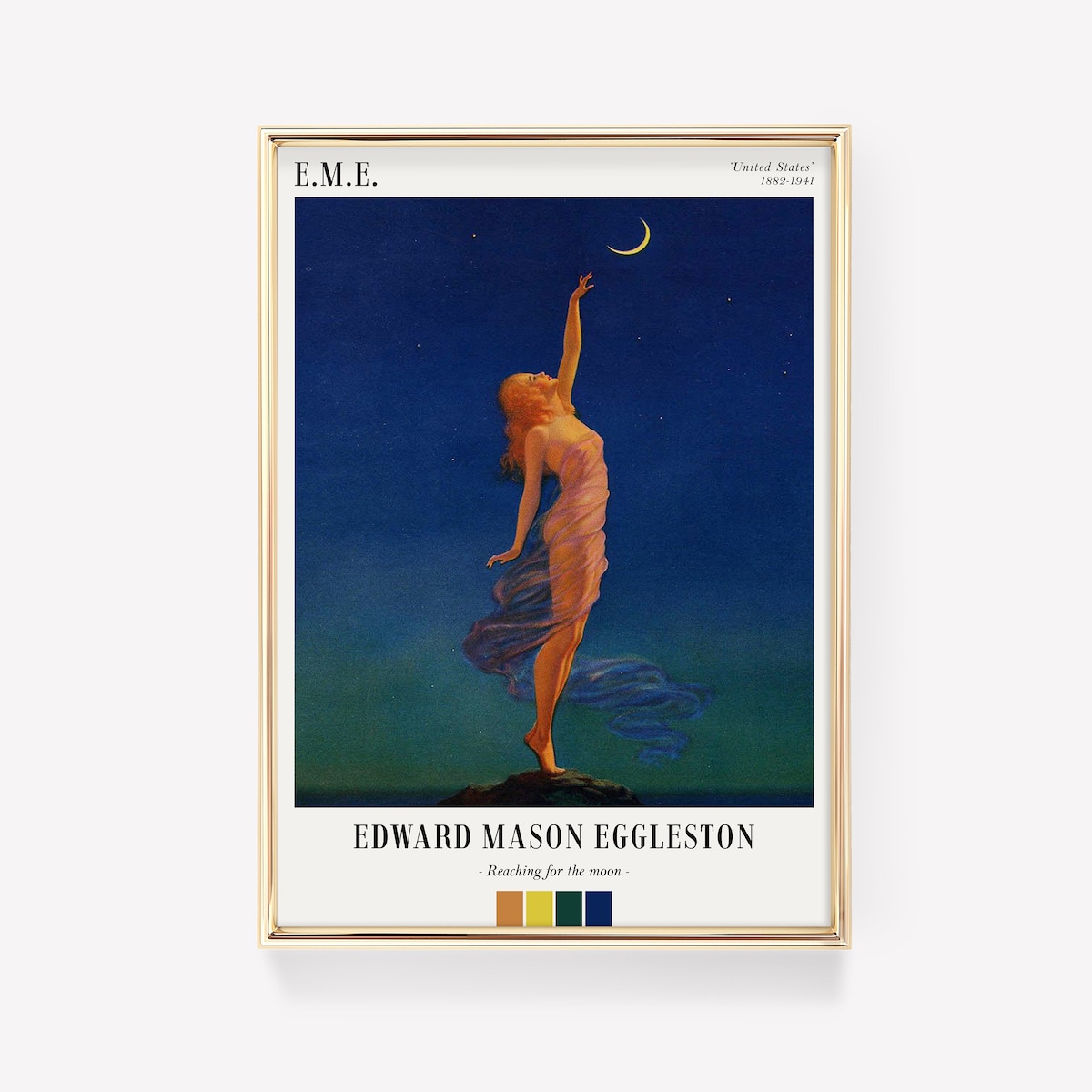
At the heart of any Moon Decor-inspired piece lies a masterful orchestration of light and shadow. Eggleston often situates his subjects against deep indigo skies softly gradated to charcoal at the horizon, allowing a luminous orb or crescent moon to become the principal source of drama. This moonlight cascades across fabrics and skin with almost cinematic precision, highlighting curves and drapery in gleaming silver. The interplay between dark expanses and pinpointed highlights creates a sense of depth and quiet theatricality.
The color palette in Eggleston’s nocturnal compositions remains remarkably balanced between cool and warm tones. While silvery blues and smoky violets dominate the background, accents of rose, champagne, and pale gold animate the figures and set pieces. This juxtaposition enhances the sense of refined glamour, as garments catch the moon’s reflection in subtle metallic sheens. Through this restrained yet nuanced approach, Moon Decor emerges as a celebration of both cosmic mystery and earthly luxury.
Texture plays a vital role in translating Eggleston’s vision into a tangible visual feast. Fine brushwork suggests the gossamer quality of tulle, the soft opulence of velvet, and the smooth gleam of satin under lunar illumination. Even in a commercial illustration context, he never sacrifices tactile realism, inviting the viewer to almost feel the weight of a gown or the slight chill of a night breeze. These tactile cues reinforce the dreamlike ambience of a Moon Decor setting.
Compositional balance further anchors the sense of narrative invitation in Moon Decor aesthetics. Figures are often positioned slightly off-center, as if in mid-step or reaching toward the celestial light, creating a dynamic tension between stillness and motion. Architectural elements—balustrades, arched windows, casting delicate silhouettes—frame the scene without overpowering it. The resultant effect is an open-ended vignette that beckons viewers to imagine their own nocturnal reverie.
Cultural Resonance and Contemporary Appeal
In today’s visual culture, Moon Decor aligns effortlessly with cottagecore’s gentle idealism and Dark Academia’s intellectual allure. Both movements prize an atmosphere of quiet contemplation and romantic nostalgia, qualities that Eggleston’s moonlit tableaux encapsulate. The tender interplay of fashion illustration and pastoral sensibility speaks to modern audiences longing for moments of poetic refuge. As such, Moon Decor sits at the intersection of historical illustration and present-day aesthetic craving.
Moonlit scenes in interior design serve as catalysts for introspection, offering an invitation to pause amid a frenetic world. Eggleston’s ladies, poised in elegant gowns beneath a soft celestial glow, embody a romance that transcends narrative specifics. Their gazes often drift beyond the frame, suggesting untold stories or whispered secrets carried on the night breeze. This element of mystery enhances the enduring magnetic pull of Moon Decor motifs.
For devotees of Dark Academia, where libraries and candlelit studies form the backdrop to philosophical musing, Moon Decor provides a fitting decorative anchor. A print or poster channeling Eggleston’s lunar atmosphere can transform a workspace into an immersive, mood-rich alcove. It resonates with the era’s appreciation for classical themes rendered in a modern, almost theatrical manner. The result is a timeless fixture that bridges scholarly tradition and stylized glamour.
Ultimately, Moon Decor stands as a testament to Edward Mason Eggleston’s ability to weave glamour, fantasy, and tasteful design into everyday decorative objects. Although born of a commercial art practice, these moonlit visions carry the weight of fine art ambition and narrative depth. In adapting such imagery for contemporary interiors, one taps into a legacy of elegance that refuses to fade with the sun. Here, moonlight becomes more than illumination—it becomes an enduring aesthetic beacon.