WE ARE READY TO BRING YOU TOGETHER WITH ART %60 Discount
Albert Aublet’s Selene: Unveiling the Moon Goddess in Pastoral Light
Historical and Conceptual Framing
Albert Aublet emerged as a French painter spanning most of the nineteenth and early twentieth centuries. His career unfolded between 1841 and 1938, a period that saw dramatic shifts in artistic language across Europe. Aublet’s signature lies in a graceful negotiation between classical motifs and a passionate attraction to Orientalist themes. The exotic currents of the Eastern Mediterranean and North Africa infused his later works with a rich tapestry of color, pattern and narrative resonance.
Within this cultural context, Aublet often turned to literature for visual inspiration, drawing upon the storytelling power of authors like Guy de Maupassant to shape his palette and subject matter. Simultaneously, he was drawn to mythological archetypes, feeling the pull of tales that transcended time and place. The figure of Selene, the Greek goddess of the moon, offered him a portal into nocturnal dreamscapes and the interplay of darkness and light. In embracing this myth, he affirmed his willingness to blend poetic imagination with his own travels and observations.
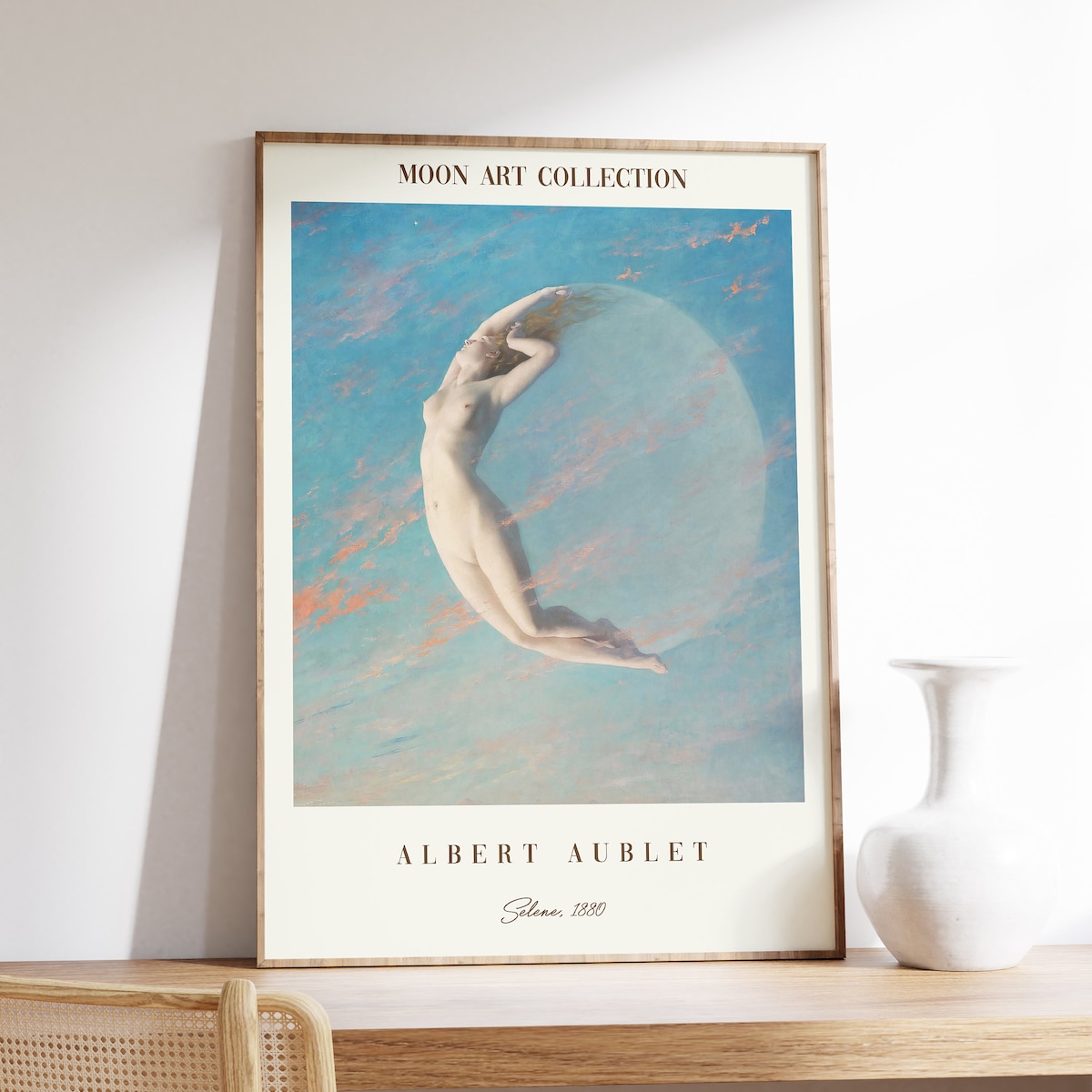
The painting known as Selene represents a pivot in Aublet’s practice toward explicitly mythic narrative. Created around 1880, this work situates a moon-bearing goddess amid a pastoral stage that feels both familiar and otherworldly. Archival notes and auction records confirm its production date and underscore its place within his broader output of figures in landscape settings. The choice to render Selene in soft, blended hues reveals Aublet’s skill at marrying classical tradition with a more Romantic sensibility.
Formal and Visual Analysis
In Selene, Aublet composes a scene where the primary figure appears to carry the luminous orb of the moon, her graceful form balancing cosmic weight and earthly grace. The composition unfolds with a gentle diagonality, drawing the eye from the glowing sphere toward the curves of her silhouette. Around her, the landscape seems to pause under a silvery glow, as though nature itself holds its breath. This momentary suspension highlights Aublet’s mastery of pacing and chiaroscuro within a natural setting.
The color palette of Selene is notable for its muted pastels and careful modulation of light and shadow. Soft blues and pale silvers mingle with tender flesh tones, while darker foliage and distant hills recede into twilight. Lines in the figure remain deliberately elegant yet unhurried, suggesting a timeless patience. Such formal restraint allows the mythological subject to resonate without overwhelming the viewer with extraneous detail.
Aublet’s brushwork further enhances the dreamlike quality of the scene, for he often blends edges to soften transitions between figure and landscape. The moon’s glow seems almost to emanate from the canvas rather than being applied on top of it, and the natural forms surrounding the goddess echo the curve of her body. The surrounding flora, etched in gentle strokes, anchors the scene in a familiar naturalism. This visual harmony reinforces the idea of Selene as both a celestial presence and an element of the terrestrial world.
Cultural and Symbolic Implications
On a symbolic level, Selene embodies the meeting point of day and night, humanity and the cosmos, framed by Aublet as an emblem of poetic mediation. The moon has long represented cycles of change and reflection, and here it becomes a companion to a solitary female figure. Aublet’s rendition invites contemplation of these rhythms, anchoring the celestial in a human dimension. In this sense, Selene stands as a metaphor for art itself, illuminating hidden corners of the psyche with a gentle luminescence.
The mythological anchor of Selene also reflects Aublet’s broader fascination with travel and cultural exchange. His works often record impressions gathered in distant lands, conveying a respect for local color and tradition. By invoking a Greek goddess against a pastoral Mediterranean backdrop, Aublet taps into layers of history and folklore that resonated in late nineteenth-century France. This cross-cultural dialogue elevates the painting beyond a simple allegory, casting it as a meeting ground for art history and literary imagination.
Today, Aublet’s Selene continues to captivate viewers who encounter its serene fusion of celestial symbolism and natural beauty. The painting illustrates how artists of that era negotiated between the allure of the exotic and the enduring power of classical mythology. It remains a testament to Aublet’s skill at transforming literary and cultural references into a visual language rich with atmosphere. Through Selene, one senses an artist confident in his voice, one who understood the potential of myth to speak across centuries.