WE ARE READY TO BRING YOU TOGETHER WITH ART %60 Discount
Winslow Homer’s Shooting the Rapids: A Study in Turbulent Motion
Contextualizing the Rapids
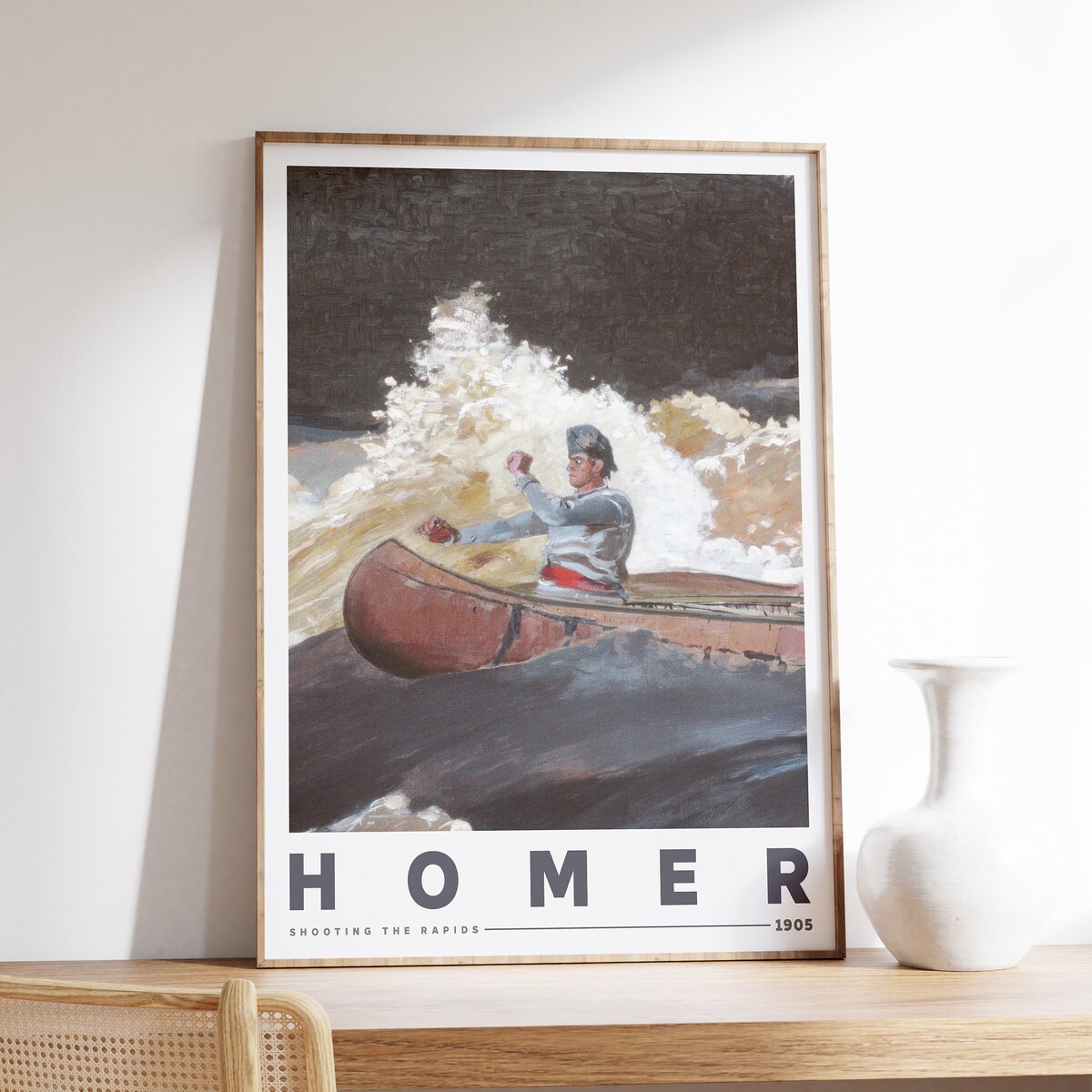
In the early years of the twentieth century, Winslow Homer turned his attention to the untamed energy of flowing water, creating Shooting the Rapids in 1902 as a watercolor demonstration of power in the American landscape. This small work, now housed in the Brooklyn Museum, exemplifies the artist’s late-career preoccupation with elemental force. Executed with pencil and decisive washes, the painting captures a fleeting moment of high tension between human agency and shifting currents. Within the museum’s collection, this piece stands out for its vivid immediacy and disciplined composition.
Homer’s Prouts Neck era marked a sustained engagement with river passages and canoe expeditions, a thematic thread that resonates through Shooting the Rapids. The artist repeatedly returned to scenes where light dances on whitewater, foregrounding the visual drama of foaming waves and restless skies. His watercolor technique allowed for an economy of line that suggests motion rather than fixes it, while the dynamic interplay of washes conveys the rush of water. In this way, Homer invites the viewer to experience both danger and exhilaration in a single glance.
The provenance of this watercolor is as meticulous as its brushwork, with the museum’s archives recording its signature 'Homer 1902' in the lower right corner and a visible watermark on the off-white paper. Accessioned through the Brooklyn Museum Collection Fund and Special Subscription, it occupies a significant place among the artist’s American Art holdings. Curators and scholars alike point to this work as a key example of Homer’s mastery of fragile media, balancing the intimacy of the sheet of paper with the grandeur of untamed terrain. Its modest scale amplifies the suspense encoded in every ripple and shadow.
Although the 1902 watercolor is often discussed on its own, it finds a thematic companion in Shooting the Rapids, Saguenay River, executed between 1905 and 1910 and held by another major museum. While that later oil on canvas introduces chalk and a broader Saguenay setting, the two works share a narrative of risk and human response. Together they frame a late stylistic consolidation in Homer’s practice, where medium and geography shift even as the core experiential focus remains constant. This dialogue across time and media deepens our understanding of his dedication to depicting perilous encounters with nature.
Brushstrokes of Tension
The technical virtuosity of Shooting the Rapids lies in its pencil-and-watercolor approach, which reveals Homer’s capacity for decisive mark making. His characteristic economy of line traces the contours of riverbank and vessel with few strokes, allowing the washes to define mass and movement. Each layer of pigment underscores the fluid momentum of the current, translucent pigments embracing the white of the paper for luminous highlights. The result is a composition that feels both immediate and deliberately composed.
Visually, the painting directs the viewer’s eye along the river’s arc, orchestrating a sense of journey and potential calamity. Figures in the canoe appear tentative at first, eventually leaning into the challenge as rapids gather strength. Homer’s restrained palette—dominated by cool blues, muted greens, and earthy neutrals—serves to heighten the viewer’s perception of danger rather than distract with decorative detail. The tension between control and surrender is palpable in the juxtaposition of calm pools and frothy cascades.
The intimate materiality of watercolor on paper imbues the scene with a delicate vulnerability that contrasts with the subject’s rough drama. The paper’s texture and watermark become part of the visual narrative, suggesting that the medium itself bears witness to the rush of water. In this fragile support, every wash must be intentional, a high-stakes decision echoing the peril faced by the travelers. Homer’s signature clarity of execution transforms each pigment decision into an act of survival within the composition.
Beyond the immediacy of brushwork, Shooting the Rapids demonstrates how a restrained approach can magnify perceptual drama without resorting to excessive detail. Homer’s fluid strokes delineate forms just enough to anchor our understanding of space and scale, while leaving areas intentionally ambiguous. This balance between suggestion and definition invites repeated viewing, as each glance may reveal hidden eddies or shifts in light. The painting’s formal rigor and emotional charge coexist in a careful tension.
Interpreting Peril and Persistence
At its core, Shooting the Rapids is a meditation on human endurance in the face of elemental forces. Homer’s figures are small but resolute, asserting their presence against a landscape that threatens to overwhelm them. The whitewater motif becomes a metaphor for adversity, with every stroke implying both struggle and triumph. Viewers can sense the rhythmic cadence of paddles striking water, echoing the broader narrative of resilience inherent in his late work.
The symbolic resonance of nature’s raw power in this piece speaks to a larger cultural fascination with the sublime and the perilous. Homer's late-career concentration on riverine motifs charts a course from passive appreciation of beauty to active engagement with danger. By placing human figures at the heart of turbulent currents, he underscores a philosophy of participation rather than observation. This dynamic interplay between spectator and spectacle challenges the traditional distance between art and experience.
Within American art, Shooting the Rapids exemplifies a shift toward experiential immediacy, privileging perception over grand narrative. Its modest dimensions belie the vast emotional terrain it covers, proving that scale does not dictate impact. Museums that display Homer’s watercolors often emphasize the intimate encounter between viewer and artwork, inviting a silent dialogue that transcends time. This painting remains a potent reminder of how art can channel both the beauty and threat of untamed nature.
Even today, the fragile medium and disciplined composition of Shooting the Rapids continue to captivate audiences, prompting reflection on the limits of control and the thrill of uncertainty. As we witness the canoeists’ journey through roaring rapids, the work prompts questions about our relationship to risk, mastery, and the world’s unpredictable rhythms. In combining visual restraint with thematic richness, Homer crafted a timeless encounter that still resonates with contemporary viewers.