WE ARE READY TO BRING YOU TOGETHER WITH ART %60 Discount
Winslow Homer’s Eight Bells: A Moment of Maritime Mastery
Maritime Realism and Human Mastery
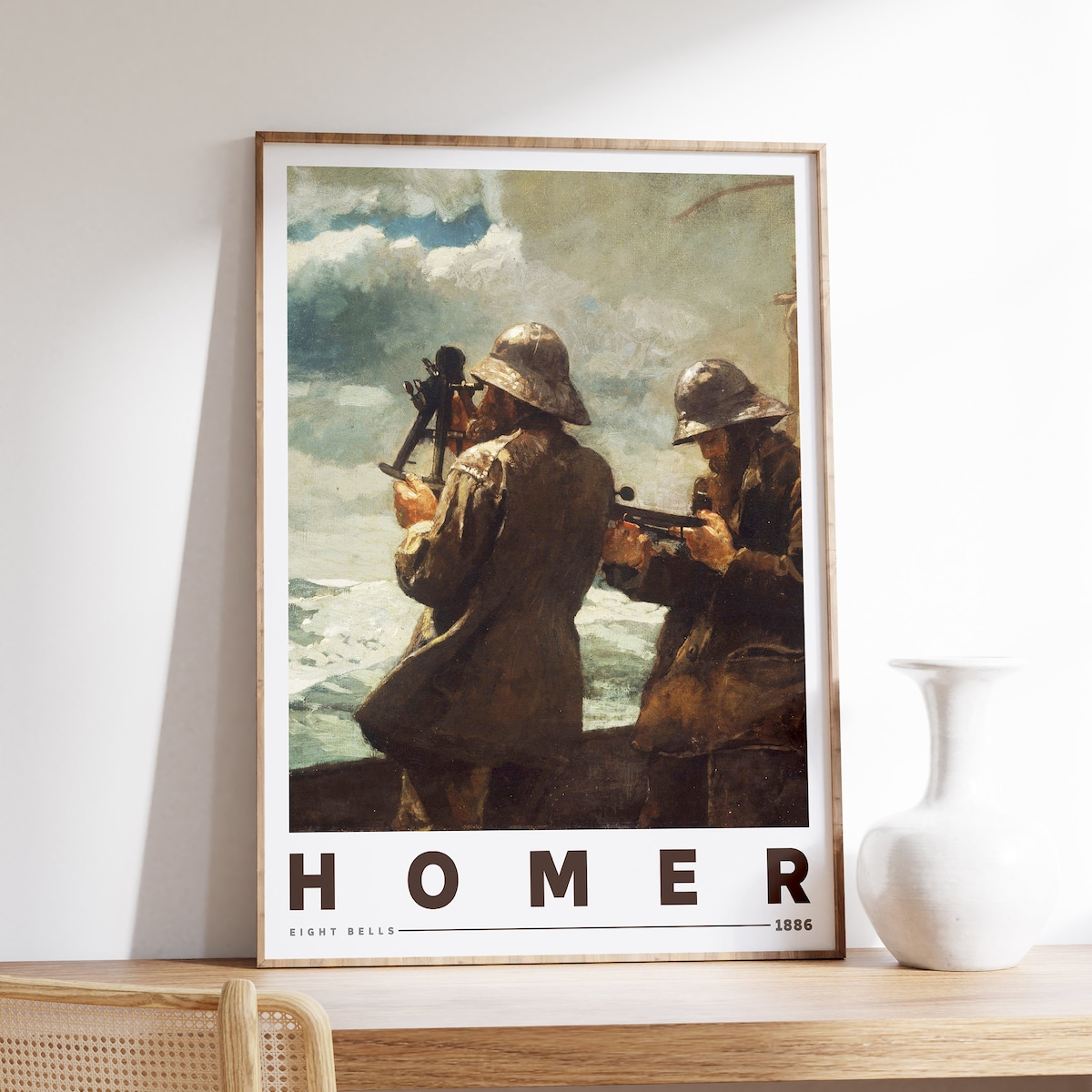
In the late 1880s Winslow Homer turned his attention to the sea with a resolute precision that feels almost cinematic in Eight Bells. Instead of staging dramatic rescues or heroic battles, he chose to place two sailors engaged in a routine navigational task at the heart of his composition. This focus on a noonday sight transforms ordinary seamanship into a moment of profound concentration and control. The massive, indifferent ocean that frames them underlines the precariousness of human skill even as it highlights the quiet confidence of the figures. Through this deliberate pairing of stoic gestures and elemental vastness, Homer invites us to consider the tension between expertise and the raw power of nature. Eight Bells stands as a towering example of this maritime-inflected realism, marking a pivotal moment in his evolving vision.
Homer’s journey toward this quiet intensity was built on a series of preparatory studies and related panels that anchored his final vision in careful observation. Prior works depicting mackerel fleets and a monochromatic grisaille allowed him to experiment with composition and the play of light on water without the pressure of a grand narrative. By the time he embarked on the final painting, the arrangement of rigging, deck planking, and the rhythmic sway of the vessel felt fully resolved. The choice to title the work Eight Bells refers not to a poetic flourish but to the methodical system of shipboard timekeeping, with its bells marking each watch. In spotlighting the noonday bell, Homer elevates an exercise in measurement into a moment of serene decision.
From its first exhibition, critics recognized in Eight Bells a masterful equilibrium of force and restraint that defied melodrama even while evoking the sea’s latent menace. The late nineteenth-century press praised Homer’s ability to capture the 'sturdy, manly character' of sailors through a palette that balanced sunlit whites against rolling, shadowed swells. Scholars since have viewed the painting as a hinge in his career, linking public maritime drama to the more introspective seascapes that would follow. Its presence in institutions like the Addison Gallery of American Art underscores how it crystallizes a transitional moment in American painting. As Homer's reputation grew, Eight Bells remained a touchstone for discussions of realism’s capacity to embrace both technical exactitude and philosophical depth.
Composition, Light, and Knowledge
The compositional structure of Eight Bells reads like a carefully plotted stage, with the two figures anchored symmetrically in the foreground as if pausing mid-dialogue with the ocean. Their postures frame an imagined diagonal that carries the viewer’s eye from the sextant’s arc to the distant horizon where sea meets sky. This balance not only grounds the scene but infuses it with a subtle narrative momentum, suggesting that measurement is both a practical necessity and a form of dialogue with the unknown. The unembellished rigging and scattered ropes act as visual echoes of the sailors’ focused concentration. Through this layout, Homer underscores how composition can guide our understanding of work, observation, and the elemental vastness that surrounds them.
Homer’s handling of light and shadow in Eight Bells is necessary to the painting’s tactile immediacy, as sunlight glints off brass instruments and rippling water in equal measure. The contrast between the crisp white of the sailors’ clothing and the dark, rolling ocean makes each form palpably present, as if the viewer could feel the grit of salt spray and the heft of the chronometer in hand. This chiaroscuro extends beyond pure modeling to become a metaphor for the precariousness of human mastery against elemental forces. Sunlight becomes both a tool for calculation and a reminder of nature’s indifferent luminosity. In this play of brightness and shadow, we sense that every confident gesture is contingent on an ever-shifting environment.
It is the conspicuous placement of octants, sextants, and marine chronometers that turns Eight Bells from a simple depiction of work into an inquiry into how knowledge is secured on the open sea. Homer emphasizes the mechanics of observation—angles read, time recorded—so that the instruments become extensions of the sailors’ intellect and skill. This emphasis on measurement transforms navigation into an act of cognition, highlighting the bridge between modern technology and timeless human curiosity. Yet even as the tools convey certainty, the boundless ocean looms beyond, suggesting that every datum is provisional. The painting thus gestures toward a broader theme in Homer’s art: the reconciliation of human intellect with the unpredictable rhythms of nature.
Symbolic Currents and Enduring Legacy
Eight Bells occupies a singular place in American art by embodying both the empirical rigor of realism and the introspective undercurrents of late-career seascapes. For Homer, the act of painting a routine noonday sight allowed him to probe the existential stakes of measurement, risk, and endurance without resorting to overt drama. Viewers are drawn into a quiet contemplation, invited to weigh the polished brass of a sextant against the surging tide beyond the rail. This mingling of practicality and philosophy gives the painting its universal resonance. It is less about triumph over nature than about the ongoing negotiation between human capability and the vast, indifferent world.
By centering ordinary sailors at work, Eight Bells asserts the dignity of skilled labor under extreme conditions, celebrating quiet competence as a form of courage. The steady hands that grip navigational instruments seem to anchor not just a vessel but the viewer’s own sense of efficacy. Each measured calculation and confident stance testifies to the disciplined labor that keeps sea travel possible. Yet Homer never allows this competence to feel complacent; the restless sea and shifting light remind us that every achievement is temporary and must be earned anew with each watch. In this tension, the painting becomes a meditation on resilience and human resourcefulness.
Over the decades Eight Bells has maintained a distinguished presence in major collections, with institutions like Phillips Academy’s Addison Gallery framing it alongside Undertow and other late-1880s works. Curation and scholarship have repeatedly highlighted how the painting bridges Homer’s early public maritime narratives and his later, more contemplative seascapes. Its frequent appearance in exhibitions and etchings demonstrates a persistent fascination with the way simple daily tasks can be elevated to grand meditations. Through ongoing art-historical discourse, Eight Bells continues to shape our understanding of realism’s capacity to confront both elemental danger and the human pursuit of knowledge. Rather than a static document of seamanship, the painting endures as a living inquiry into how people measure, interpret, and endure within a world that is always greater than themselves.