WE ARE READY TO BRING YOU TOGETHER WITH ART %60 Discount
Henri Matisse and the Modern Grammar of Color and Line
Tracing a Color Revolution
Henri Matisse’s early journey as a painter began within the conventions of late nineteenth century France, yet he soon became the voice of a radical shift in artistic language. Born in 1869 in Le Cateau-Cambrésis, he brought a fresh vision to the Parisian avant-garde by embracing a palette of pure, unmixed hues and fluid, liberated strokes. In this landscape of vivid surfaces, color transcended description and became a living force within each canvas. Matisse’s insistence that hue could sing its own melody laid the groundwork for a visually dynamic dialogue that reverberates through modern art.
At the heart of Fauvism lay the belief that line, plane, and color could interact with a musical cadence, evoking sensation before narrative. Bold contours and assertive brushwork replaced intricate detail, inviting viewers to feel as much as to interpret. This emotional register upended traditional hierarchy, elevating color to protagonist status and reshaping modern painting’s possibilities. Matisse stood at its forefront, a leader who aligned formal audacity with the search for expressive simplicity, forever altering how artists approached the relationship between pigment and perception.
Yet even as his style evolved, the primacy of color endured as a guiding principle in Matisse’s work. Rather than retreat from his initial impulses, he refined them, distilling compositions to essential elements while maintaining the vivid energy of his Fauvist phase. His career became a continuous exploration of clarity, moving between exuberance and restraint without sacrificing emotional depth. We can trace this continuous thread from the most jubilant Fauve canvases to the serene abstractions of his final works.
The Poetics of Line and Form
Following the Fauvist saga, Matisse embarked on a quest to simplify formal language, seeking the smallest number of shapes needed to convey his vision. He pared down complex scenes into sweeping outlines and flat planes, emphasizing contours over detail. In each spare outline, one senses an invitation to pause and reflect on the essential interplay of surface and space. The result was a deceptively simple vocabulary that still spoke volumes, proving that economy of form could expand expressive potential rather than limit it.
It was in the 1940s, after a bout of illness, that Matisse unveiled his papier découpé technique, an innovation that bypassed traditional painting’s laborious demands. By cutting painted sheets into free-form shapes, he merged line and color in real time, composing with scissors instead of brushes. The dimensional quality of these cutouts challenged viewers’ expectations, as flat shapes appeared to float and shift onscreen. This approach allowed for a joyful spontaneity, a direct articulation of form that felt both immediate and timeless.
Often described by the artist as ‘drawing with scissors,’ these cutouts stand as a testament to Matisse’s belief in synthesis over separation. Line and hue become inseparable partners, weaving together in silhouettes that press against the boundaries of abstraction without abandoning recognition. They stand as exemplars of how modern art could be both radical and accessible, celebrating the lineage of drawing while embracing the liberations of abstraction. His late work thus reinforced a core conviction: that clarity of vision arises through the interplay of essential lines and vibrant color.
From Studio to Living Space
The ripple effects of Matisse’s formal revolutions extend far beyond his own studio, influencing how succeeding generations of artists and designers conceive of seeing and making. Designers and artists continue to return to his models, exploring the space between suggestion and depiction. His work consistently probed the tension between representation and abstraction, never allowing itself to be confined to a single category. The dual trajectory of his career—from the explosive chromatic intensity of his Fauvist moments to the serene, architectural rigor of his cutouts—reveals a sustained inquiry into the balance of emotion and structure.
More than technical breakthroughs, Matisse’s legacy lies in his unwavering belief that art must marry emotional impact with aesthetic precision. His principle that simplicity could carry emotional weight resonates in countless creative fields beyond painting. He championed pared-down forms not as an endpoint but as a means to convey complex ideas and feelings. In doing so, he demonstrated that the most profound experiences can arise from simple gestures, whether the sweep of a brush or the snip of a scissor blade.
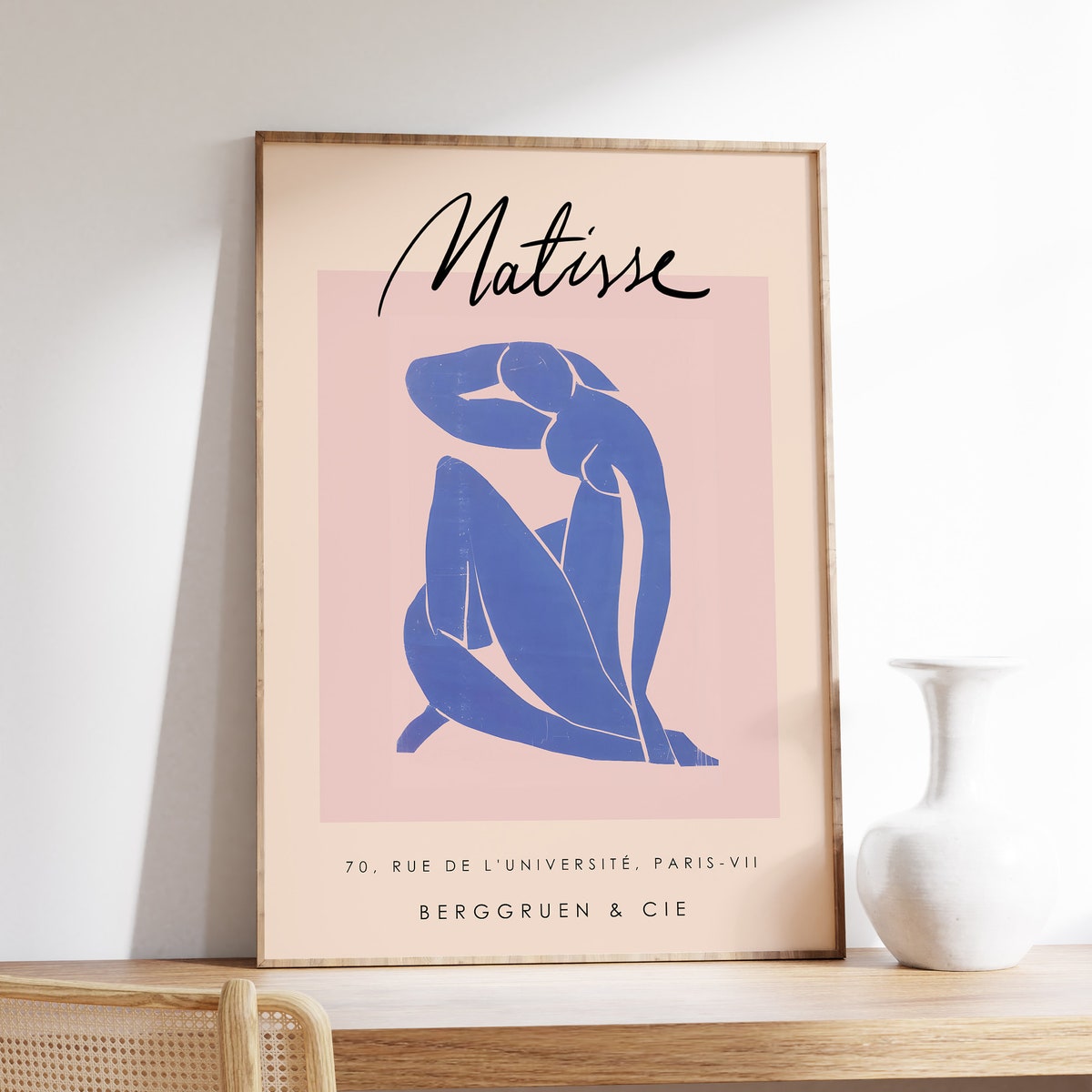
Contemporary expressions of his aesthetics, such as the popular ‘Line Art Print | Henri Matisse Art | Yoga Wall Art | Mid Century Modern | Abstract Art Print | Minimal Decor | Classic Modern Color,’ illustrate a broader cultural trend of commodifying Matisse’s modernist vocabulary for domestic settings. By branding classic motifs as design staples, these products raise questions of authenticity and authorship, transforming revolutionary ideas into interchangeable decor. This dynamic ensures that every iteration—even in mass-produced prints—echoes the spirit of his revolutionary experiments, reminding us that those silhouettes and vivid hues originate in a radical rethinking of how art interacts with human perception.