WE ARE READY TO BRING YOU TOGETHER WITH ART %60 Discount
Carl Holsøe and the Poetics of Interior Light
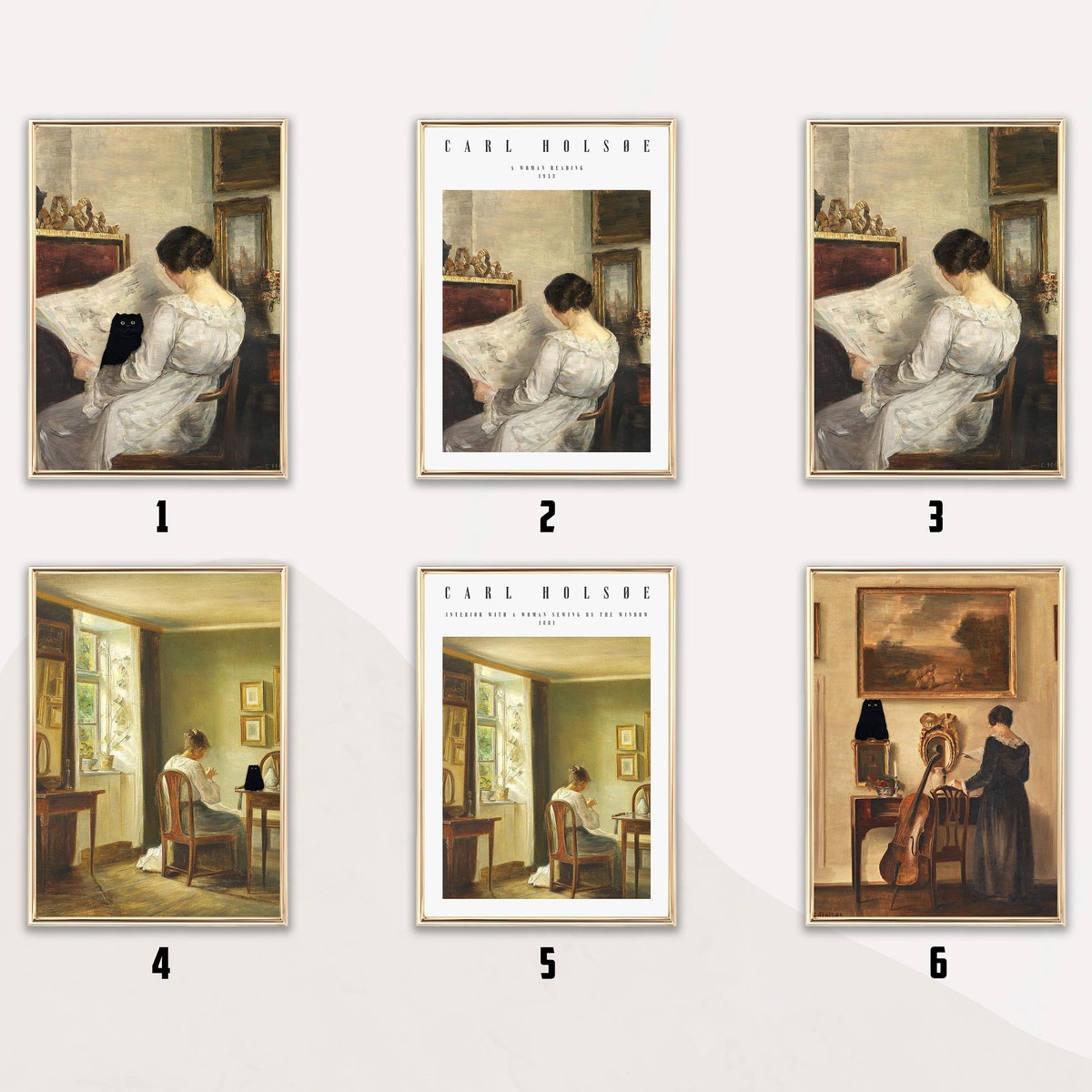
Situating Carl Holsøe’s Domestic Vision
Carl Holsøe emerged from a family in Aarhus that prized both architecture and art, a heritage that would shape his lifelong fascination with the nuances of domestic space. After arriving in Copenhagen, he honed his craft at the Royal Danish Academy of Fine Arts and later under the guidance of Peder Severin Krøyer at the Freie Kunstschule. This formal training brought him into the heart of a circle of painters committed to capturing everyday interiors with a serene clarity. His approach combined a reverence for lived experience with a restrained palette that spoke to the rhythms of middle class life in late nineteenth century Denmark.
His debut work in 1886 paid direct homage to the Dutch Golden Age tradition of interior genre painting while planting the seeds of a distinctly Nordic vision. These early canvases presented rooms that felt at once familiar and thoughtfully arranged, revealing a painter attentive to composition and mood. Holsøe’s talent soon found recognition within Copenhagen’s art institutions, where his contributions to the annual Charlottenborg exhibitions were celebrated season after season. Honors such as the Eckersberg Medal further cemented his reputation as a leading interpreter of domestic scenes.
At the same time, a network of friendships and professional alliances helped orient Holsøe’s practice toward a contemplative stillness. His affinity with Vilhelm Hammershøi and the broader Frie Studieskoler circle underscored a shared devotion to interiors over sweeping landscapes or grand historical narratives. And yet, while Hammershøi’s monochrome poise carried an enigmatic hush, Holsøe brought forward a warmer, more descriptive ethos rooted in everyday comfort. Together they defined a chapter of Danish art history that valued quiet reflection and the intimate poetry of closed rooms.
The Poetics of Light and Material
Central to Holsøe’s aesthetic is what might be called luminous stillness, a light that diffuses across surfaces to tame contrasts and imbue wood, fabric, and porcelain with a hushed vitality. The quiet glow seems to flatten shadows without erasing texture, so that a lace curtain, a gleaming tabletop, and the grain of a mahogany dresser all speak with equal eloquence. This even-handed illumination draws the viewer into a careful study of material presence, as if invited to trace the weave of upholstery or the faint pattern on a ceramic vase. Such radiant restraint underscores Holsøe’s mastery of light as both subject and sculptor of space.
Beyond illumination, the physicality of objects becomes a focal point in each carefully composed scene. Holsøe populated his interiors with the elements of middle class comfort—fine textiles folded just so, porcelain resting in the soft shadows of a cabinet, and lace drapes that sway gently at an unseen breeze. He treated each component with architectural precision, rendering hard surfaces and soft folds with equal delicacy. The result is a harmonious symphony of objects that balance one another, inviting viewers to linger and piece together the quiet routines they evoke.
Such compositional balance extends to the very layout of his rooms, where furniture lines recede with geometric clarity and decorative motifs hold a measured order. The arrangement of chairs, tables, and cabinets often follows a subtle rhythm that leads the eye deeper into the picture plane. Holsøe’s restrained palette—punctuated by occasional dark woods and soft textiles—creates a visual calm that feels ritualistic, almost ceremonial. In this regard his work bridges documentary specificity and painterly finesse, offering both a record of domestic life and a refined exploration of space itself.
Interiors as Cultural Reflection
More than mere representations of home, Holsøe’s interiors function as contemplative tableaux that meditate on routine, presence, and the graceful endurance of everyday rituals. A solitary vase on a windowsill becomes emblematic of the quiet care we take in arranging our surroundings, while the soft light suggests a timeless shape to ordinary moments. In elevating these scenes to fine art, Holsøe invites us to consider how domestic settings influence our emotional tone and form the backdrop of personal narratives. His paintings thus become invitations to slow down, reflect, and appreciate the understated beauty woven into daily life.
The formal calm of Holsøe’s work resonates with viewers who seek a sense of order and peace in an ever-accelerating world. Each interior reads as both a document of late nineteenth and early twentieth century Danish middle class life and as a universal hymn to coziness and restraint. The precision with which objects are placed hints at social values of propriety and discipline, while the warmth of the carefully observed light offers a humanity that extends beyond historical specificity. Through this dual register, Holsøe’s rooms speak across time to modern audiences attuned to the aesthetics of calm living.
Institutional recognition and a sustained exhibition presence at Charlottenborg helped secure Holsøe’s legacy within Danish art history and beyond. His work’s alignment with European currents in interior genre painting, tempered by a distinct Nordic clarity and order, underscores a cultural sensibility that prizes balance over flamboyance. Today, museums and scholars continue to view his paintings as key examples of how the everyday environment can be rendered with both documentary fidelity and poetic nuance. In Holsøe’s hands, the interior becomes a canvas for quiet endurance and the harmonious interplay of light, material, and human presence.