WE ARE READY TO BRING YOU TOGETHER WITH ART %60 Discount
Johannes Vermeer and A Young Woman Reading: Light, Silence, and Domestic Grace
Historical Context and Stylistic Vision
In the panorama of 17th century Dutch painting, Johannes Vermeer stands apart with a vision rooted in everyday reality and quiet grandeur. Living in Delft, he built a painting practice around the precise interplay of light and domestic space, painting his canvases in cool, luminous tones that evoke a serene realism. His contemporary audience saw in these interiors a reflection of middle-class life infused with grace and subtle drama. Rather than grand historical narratives, Vermeer chose moments of intimate stillness, allowing the viewer to linger on the felt texture of cloth, the glint of metal, or a face deep in thought. Over time, these everyday scenes became synonymous with the idea that the ordinary could hold profound beauty.
Vermeer’s characteristic style hinges on a meticulous composition that balances figures within horizontal spaces. Each painting unfolds like a carefully arranged tableau, where draperies, furniture, and forgotten objects form a harmonious framework around a central figure. The artist’s mastery of natural window light grants each scene a sense of warmth and clarity, yet never verges on melodrama. Faces and fabrics emerge from gentle shadows in a tone-led study of volume and color modulation. The result is a restrained drama of subtle contrasts, an invitation to observe the ordinary with a contemplative eye.
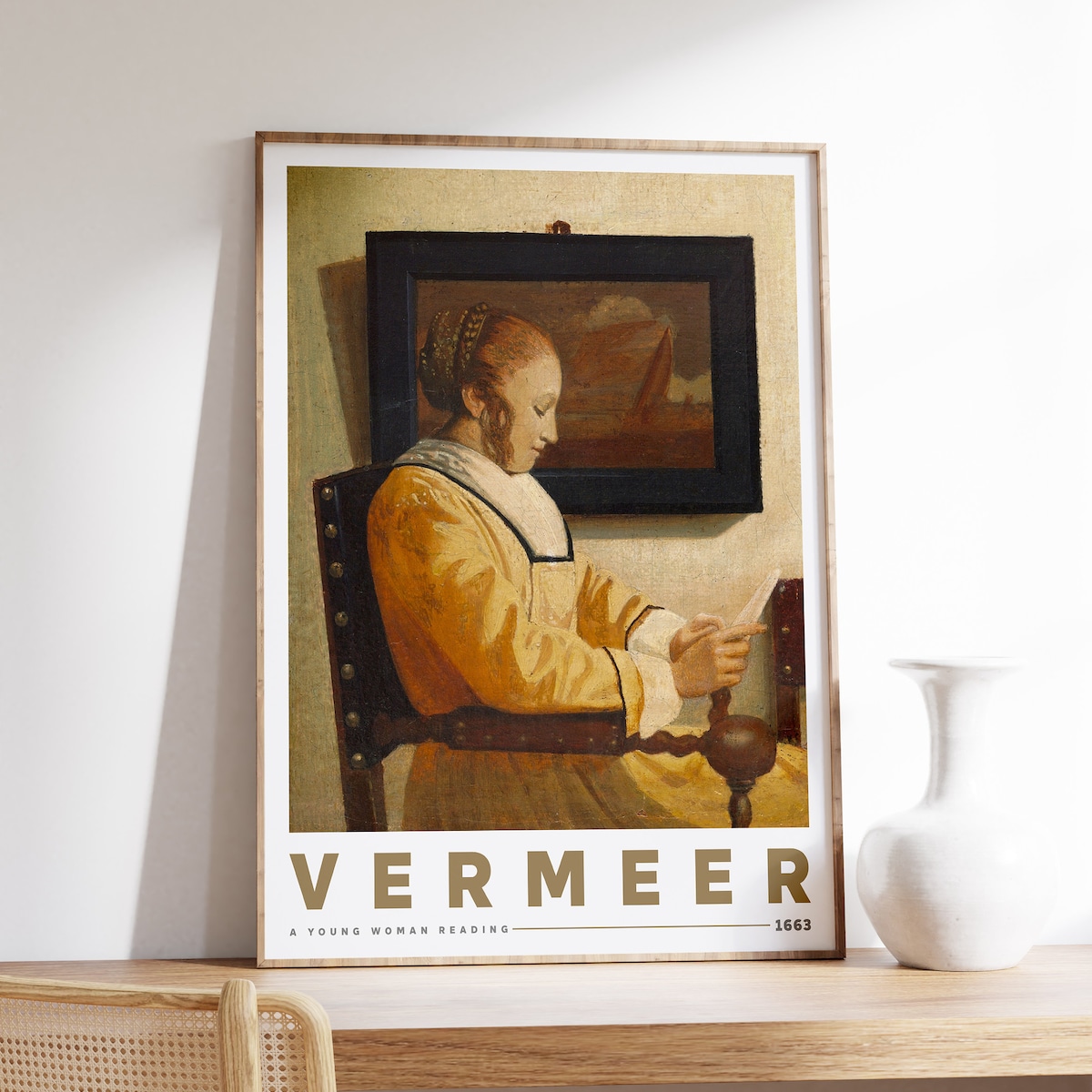
Against this backdrop, the work known as A Young Woman Reading captures Vermeer’s thematic obsessions in miniature. While the title itself may be modern or hypothetical, it points us toward a scene where an unknown sitter becomes a vessel for the painter’s exploration of quiet focus. In lieu of a famed portrait subject, the emphasis falls squarely on the act itself: deep concentration illuminated by soft daylight. This lack of biographical certainty frees the viewer to engage with the painting as a meditation on domestic calm rather than a mere likeness of an identifiable person. Through this lens, the artwork becomes a paradigmatic example of Vermeer’s aesthetic, in which the ritual of a private moment takes center stage.
Formal Qualities and Visual Nuances
The arrangement of spatial elements in A Young Woman Reading showcases Vermeer’s deft command of interior architecture. A gently horizontal configuration guides our gaze across low tables, patterned rugs, and a solitary chair, all converging on the seated figure. Positioned near a window, the woman occupies the picture’s focal point, yet the surrounding details remain poised and meaningful. The painter’s choice to keep the background sparse but deliberate – perhaps a map on the wall or a simple piece of furniture – underscores the balance between presence and absence. It is this measured restraint that imbues the scene with a sense of openness rather than clutter.
Light in this painting transcends its role as a mere illuminant to become an agent of mood and texture. The primary source, an unseen window, casts a cool, diffused glow across the woman’s profile and the folds of her garment. Rather than harsh highlights, Vermeer employs soft transitions that reveal subtle tonal shifts in skin, fabric, and wooden surfaces. The delicate play of shadow defines form without overshadowing it, creating a silent dialogue between brightness and shade. This measured illumination not only enhances realism but also frames the subject’s introspective state, inviting viewers into her tranquil world.
A closer look at the materiality in A Young Woman Reading reveals Vermeer’s exceptional sensitivity to surface qualities. The sitter’s dress, possibly of moiré silk or fine linen, is rendered with faint undulations that suggest weight and movement. Light caresses the fabric, producing gentle highlights that contrast with deeper tonal recesses. Even the polished wood of a nearby table or the subtle grain of floorboards registers with silent clarity. These textural nuances, united by tone rather than stark contrast, exemplify an aesthetic where softness prevails over drama. They remind the viewer that Vermeer’s art is as much a study of material presence as it is of human quietude.
Cultural Layers and Interpretive Richness
The act of reading in Vermeer’s painting is a quiet ritual that speaks to curiosity and introspection. Books in the 17th century were precious objects, symbols of learning and contemplation, and here they serve as a portal into the sitter’s inner life. Her gentle tilt of the head and the downward cast of her eyes communicate absorption in the text rather than awareness of an external audience. In this way, reading becomes synonymous with mental stillness, a counterpart to the painting’s physical calm. Vermeer transforms a commonplace action into a study of focus, where the mind’s engagement becomes as visible as the play of light across a page.
The woman’s attire and surrounding furnishings offer a rich record of gender roles and domestic culture in her era. Her garment, modest yet finely made, reflects a social expectation of decorum in private spaces. Furnishings such as a simple chair, a utilitarian table, and possible domestic objects like a letter or a small box anchor the scene within a household accustomed to both comfort and restraint. These elements collectively underscore the notion that the home served as a stage for female comportment and quiet pursuits. Through this visual record, Vermeer not only elevates the individual moment but also provides modern viewers with a glimpse into daily life and social customs of his time.
Beyond its historical and social references, A Young Woman Reading resonates with contemporary viewers through its portrayal of tranquil concentration. The deliberate quietness of the scene invites a pause, encouraging us to reflect on our own rituals of stillness. In Vermeer’s hands, the ordinary transforms into a timeless meditation on light, texture, and human presence. Each brushstroke guides our attention to the poetry of commonplace objects and simple gestures. By bridging past and present, the painting reassures us that meaning can be found in the unassuming rhythms of daily existence, a notion as fresh now as it was in Vermeer’s atelier.