WE ARE READY TO BRING YOU TOGETHER WITH ART %60 Discount
Winslow Homer’s Girl Picking Apple Blossoms: A Quiet Orchard Reverie
Historical Canvas and Seasonal Reverie
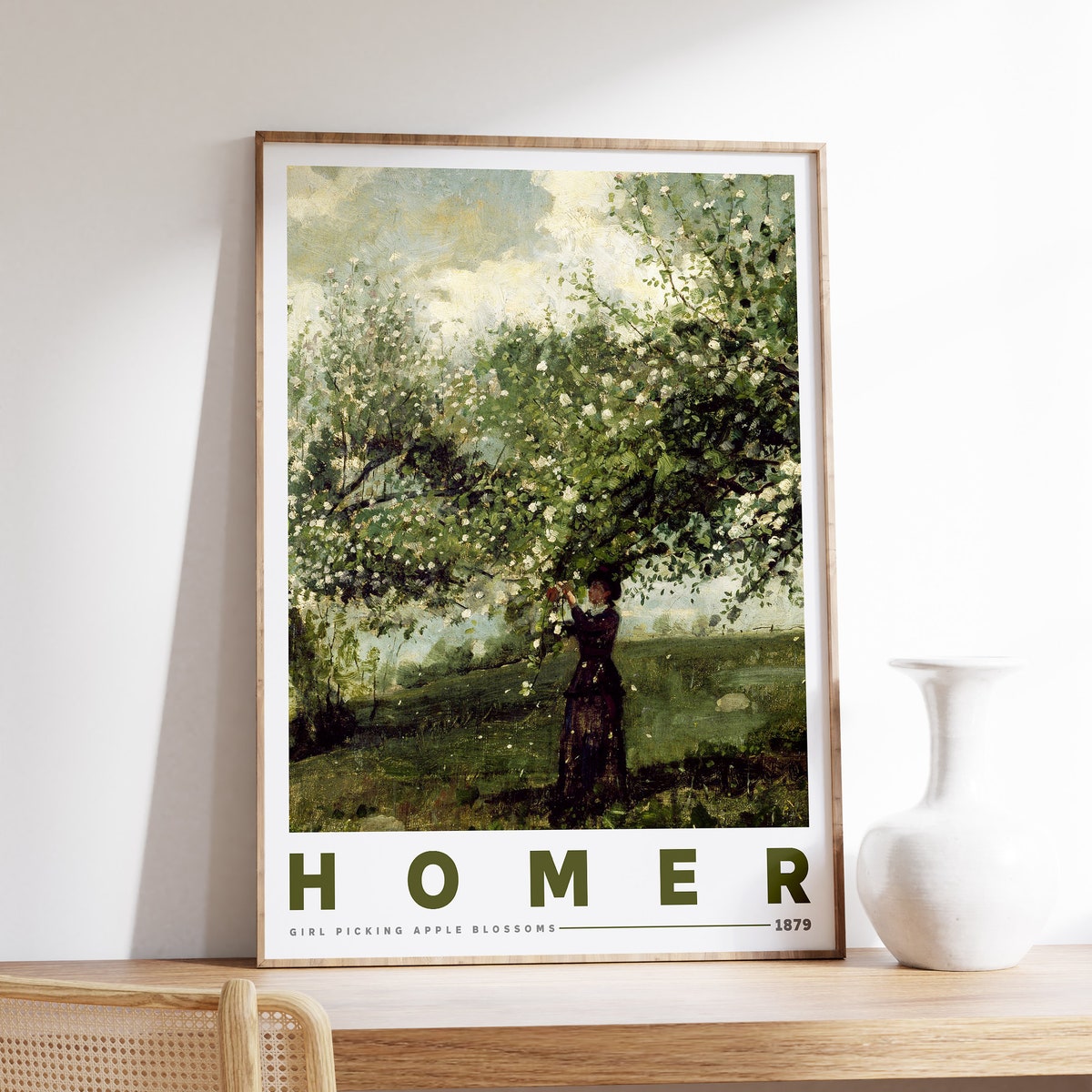
In the late summer of 1879, Winslow Homer retreated to the verdant hills of Mountainville, New York, seeking fresh inspiration amid rural orchards and open skies. It was here that he painted Girl Picking Apple Blossoms, capturing not only the blossoming season but also a moment suspended between labor and leisure. The year itself sits within a pivotal chapter of Homer’s career, as he navigated between his earlier documentary pursuits and a growing sensitivity to atmosphere. Although the title remains simple, its directness nests within a broader narrative pursuit that Homer explored throughout the 1870s. By focusing on a solitary figure at work beneath flowering branches, he transformed an everyday task into an intimate study of time, place, and the quiet dignity of agrarian life.
During this period, Homer balanced strands of Realism with an emergent impressionistic concern for light and mood. The combination reflects in his choice of subject—a young girl engaged with nature—and in the way he positioned her within a bucolic American setting. His brush evolved to record not only contours and clothing but also the fleeting interplay of sunlight, shadow, and color. This interest in atmospheric nuance signaled a maturation of style, as Homer transitioned from the more documentary realism of his earlier career to a contemplative genre approach. The result is a painting that feels both rooted in observation and imbued with poetic resonance.
Girl Picking Apple Blossoms connects seamlessly to Homer’s trajectory as a versatile interpreter of rural scenes. In the late 1870s, his oeuvre branched across landscapes, genre vignettes, and figure studies, each reflecting a commitment to portraying everyday American life. The decision to depict an unnamed girl amidst a flowering orchard speaks to his desire to humanize the rhythms of agrarian existence without sensationalism. At the same time, the focus on a seasonal ritual taps into broader cultural currents that celebrated the countryside as a locus of renewal and authenticity. This work, dated 1879, remains emblematic of a painter who fluidly moved between subject matter and found beauty in the commonplace.
Light, Form, and Painterly Technique
The choice of oil on canvas allowed Homer to convey both the solidity of tangible forms and the evaporation of light across delicate blossoms. His handling of paint captures the tactile quality of petals, the texture of the girl’s dress, and the subtle variations of grass beneath her feet. Light filters through a lattice of branches, casting soft highlights that animate leaves and fabric alike. Homer’s palette remains measured, combining earthy greens and browns with notes of pink and white that celebrate spring’s abundance. This nuanced color sensibility reflects a careful observation of nature’s fleeting moments, translated into a composition that feels at once spontaneous and deliberate.
Compositionally, the painting invites a meditative distance, placing the viewer slightly removed from the central action of gathering blossoms. This deliberate setback encourages contemplation, as one considers the posture of the figure and the gentle curve of her arm reaching skyward. The dark tones of her clothing create a subtle contrast with the luminous canopy overhead, drawing the eye upward to the profusion of flowers. Meanwhile, hints of a distant landscape and architectural forms ground the scene within a broader environment, providing depth without detracting from the primary focus. The entire arrangement embodies Homer’s mastery of balancing figure and setting in a unified visual narrative.
At close inspection, Homer’s brushwork reveals a spectrum of textural approaches, from broader strokes that suggest waving grass to refined dabs that define individual petals. These varied techniques foster a harmonious tension between clarity and atmosphere, reinforcing the immediacy of an observed moment. Shadows merge softly into lighted spaces, and edges shift from crisp outlines to dissolving borders where air and foliage intertwine. The solidity of the girl’s form anchors the composition, while the flickering play of light evokes the ephemeral quality of spring. Together, these formal elements render the orchard both a physical location and a poetic stage for human presence.
Rural Reflections and Cultural Resonance
Beyond its technical achievements, Girl Picking Apple Blossoms offers a quiet commentary on work, youth, and the seasonality of life. The simple act of gathering blossoms becomes a moment of ritual, a convergence of labor and leisure that feels almost ceremonial. Homer neither idealizes nor romanticizes the scene; instead, he acknowledges the dignity inherent in daily tasks performed within a natural setting. The young girl stands at the intersection of growth and tending, embodying both the promise of youth and the responsibilities that accompany it. Such a portrayal invites viewers to reflect on the cyclical rhythms of rural existence and the subtle beauty found in ordinary gestures.
In postbellum America, the countryside emerged as a focal point for artists seeking authenticity and national identity. Homer’s painting aligns with this cultural shift, affirming that bucolic environments could serve as fertile ground for serious artistic exploration. By documenting a fleeting spring moment, he contributed to a collective imagery that valued the rural as a counterpoint to urban expansion and industrial progress. This alignment between subject and sentiment underscores a broader American interest in preserving the essence of everyday life on canvas. Girl Picking Apple Blossoms thus resonates as both a personal reflection and a cultural statement about the worth of agrarian scenes in art.
The enduring appeal of this work lies in its harmonious blend of observation and lyricism. Homer’s balanced approach—neither strictly documentary nor whimsically decorative—creates a portrayal of spring that feels timeless. The precise yet expressive brushwork, combined with a clear focus on a solitary figure, encourages a contemplative gaze that lingers on texture, color, and mood. Ultimately, the painting elevates a modest rural moment into a visual narrative rich with meaning, reminding viewers of the quiet wonders present in nature and the dignity found in simple human tasks.