WE ARE READY TO BRING YOU TOGETHER WITH ART %60 Discount
William Morris and the Enchantment of Jasmine
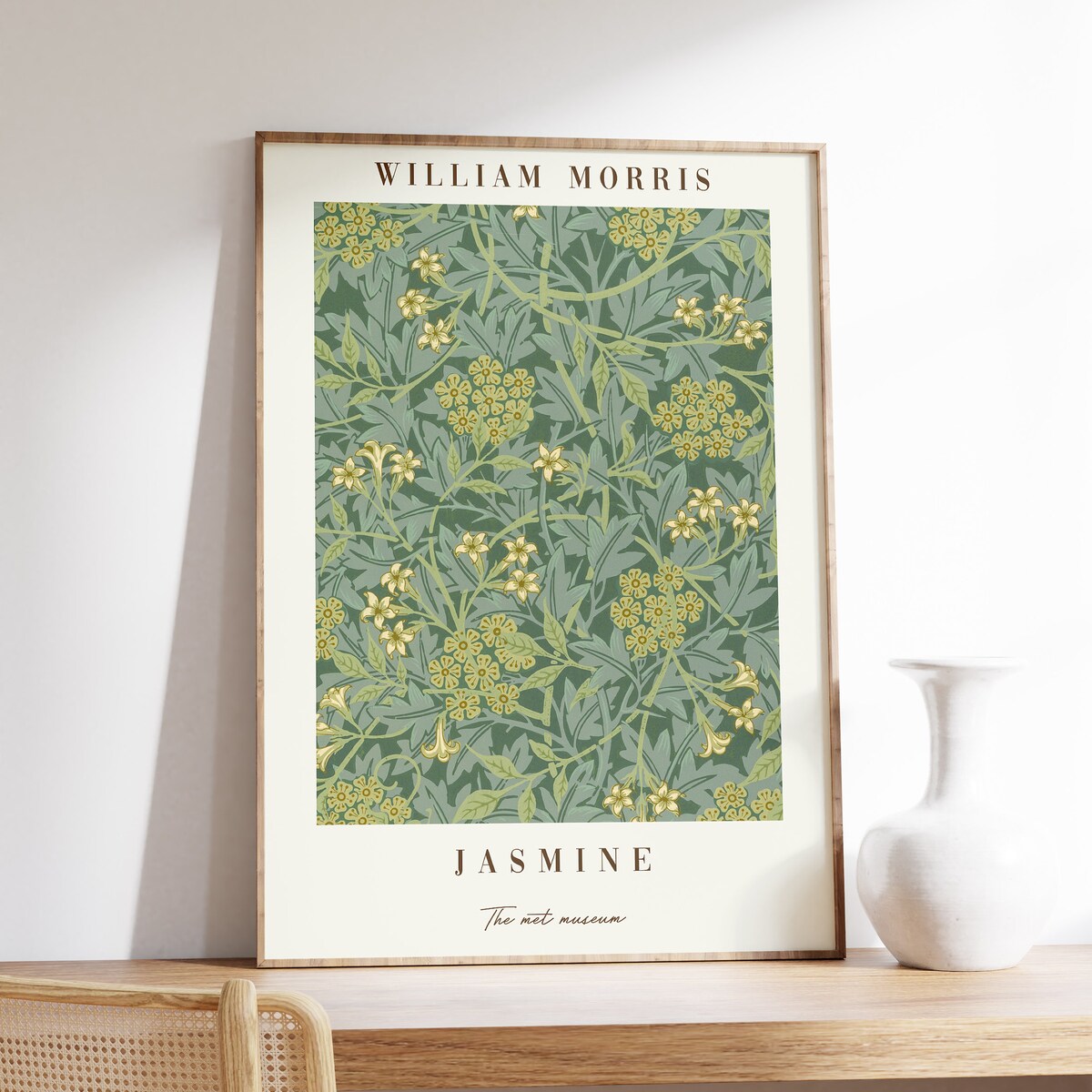
Contextual Roots of the Jasmine Poster
At the heart of the nineteenth-century design revolution stands William Morris, whose founding of Morris & Co opened a new chapter for beauty in the everyday. Grounded in the ideals of the Arts and Crafts movement, his work insisted that objects of all scales—from simple textiles to elaborate wall coverings—should bear the distinct imprint of human care and craft. Through a combination of natural motifs, intricate patterning, and a reverence for traditional techniques, Morris sought to restore harmony between the maker and the material. The recently popularized Jasmine Exhibition Poster channels these foundational principles, invoking a time when floral studies served as both artful decoration and a statement of quality.
Although Morris himself did not create a single exhibition poster in the modern promotional sense, leading institutions across Britain have long showcased his botanical designs as emblematic of his decorative philosophy. The Victoria and Albert Museum and the Birmingham Museums, among others, curate displays that pair his floral compositions with period furnishings and historic graphic materials to illustrate the full scope of his vision. In these spaces, the recurring Jasmine motif assumes a central role, embodying the seamless blend of natural inspiration and ornamental intent that defined his oeuvre. Such retrospectives deepen our understanding of a designer who viewed pattern not merely as surface decoration but as a conduit for cultural and artistic ideals.
The label 'Exhibition Poster' evokes a print conceived to promote or accompany a Morris-related display—a method consistent with how his designs circulated in period catalogues, showrooms, and art journals of his era. In the nineteenth century, such prints would travel from East London workshops to the doorsteps of patrons and scholars, democratizing access to botanical art through affordable reproduction. Each iteration preserved the rhythmic interplay of leaves and blossoms, ensuring that the vital energy of nature remained central to Morris’s decorative message. The Jasmine pattern, with its curling petals and methodical repeats, captures this dynamic fusion of organic form and compositional discipline.
Weaving Line, Color, and Texture in Jasmine
In examining the formal qualities of the Jasmine Exhibition Poster, one is struck by the seamless repeat of stylized blooms, each mirror image calibrated to sustain visual continuity across a surface. The balance of positive and negative space creates a gentle tension that guides the observer’s gaze in a deliberate, looping path, evoking the artist’s commitment to pattern as an immersive experience. Morris’s characteristic use of subtle, earthy hues complements the linear intricacy, softening the design while preserving its architectural clarity. The result is a visual harmony that transcends mere ornament, suggesting a living tapestry woven from line, hue, and proportion.
Morris’s devotion to handcraftsmanship resonates palpably in every contour of the Jasmine motif, even when encountered in modern printed form. He originally achieved these patterns through painstaking block printing techniques—mixing pigments by hand, carving wooden blocks with exacting precision, and pressing each layer with care. Although today’s reproductions may be rendered by mechanical presses, the sensibility of hands-on creation endures in the composition’s tactile legacy. Viewers of the exhibition poster might therefore imagine the warm grain of wood, the slight variation of ink across fiber, and the human touch embedded in every curve.
Over the decades the Jasmine motif has transcended its origins in fine fabrics and wall hangings to become a prized collectible and emblem of decorative heritage. Contemporary galleries and online sellers offer it under the name 'William Morris Jasmine Exhibition Poster,' acknowledging both its historical roots and its modern life as accessible art. This continued market presence illustrates how a single floral study can travel from bespoke craftsmanship to reproduction prints, circulating in homes and public spaces alike. In each context the pattern carries forward the intangible values Morris championed: dignity in making, respect for nature’s designs, and the aspiration for everyday beauty.
The Living Legacy of a Floral Study
Floral and botanical themes lie at the very core of Morris’s artistic vision, reflecting his belief in nature as the ultimate source of creative inspiration. The Jasmine pattern evokes this conviction through its meticulous geometry, where each blossom loops into the next with silent grace and unwavering regularity. This ordered rendition of organic life speaks to the Victorian pursuit of bringing nature indoors, offering a controlled reflection of wild growth within the cultivated spaces of home and public exhibit. In doing so, the motif becomes more than decoration; it serves as a cultural emblem of harmony between human artistry and natural form.
When a floral study like Jasmine moves through time and medium, it accrues layers of cultural and interpretive resonance, weaving together maker, audience, and space. Morris’s original sketches and engraved blocks function as touchstones in this ongoing conversation, reminding us that design evolves in dialogue with shifting tastes and technologies. The Exhibition Poster invites contemporary observers to situate themselves within that lineage, tracing a path from Victorian workshops to museum galleries and living-room walls. As a visual language, the pattern speaks across generations, reaffirming the power of ornament to shape identity, memory, and the built environment.
In an era defined by digital reproduction and ephemeral trends, the Jasmine Exhibition Poster stands as a testament to the lasting impact of intentional composition and craft. Its repeated botanical forms encourage a slower encounter with surface and structure, inviting the viewer to pause amid the bustle of modern life. Each curl of leaf and delicate petal fold becomes a moment of reflection, a reminder that even mass-produced prints can carry the spirit of handcrafted artistry. Ultimately, this enduring motif testifies to William Morris’s profound conviction that beauty and utility need not be separate, urging us to rediscover artfulness in everyday surroundings.