WE ARE READY TO BRING YOU TOGETHER WITH ART %60 Discount
Young Girl Reading by Jean-Honoré Fragonard: A Glimpse into Rococo Intimacy
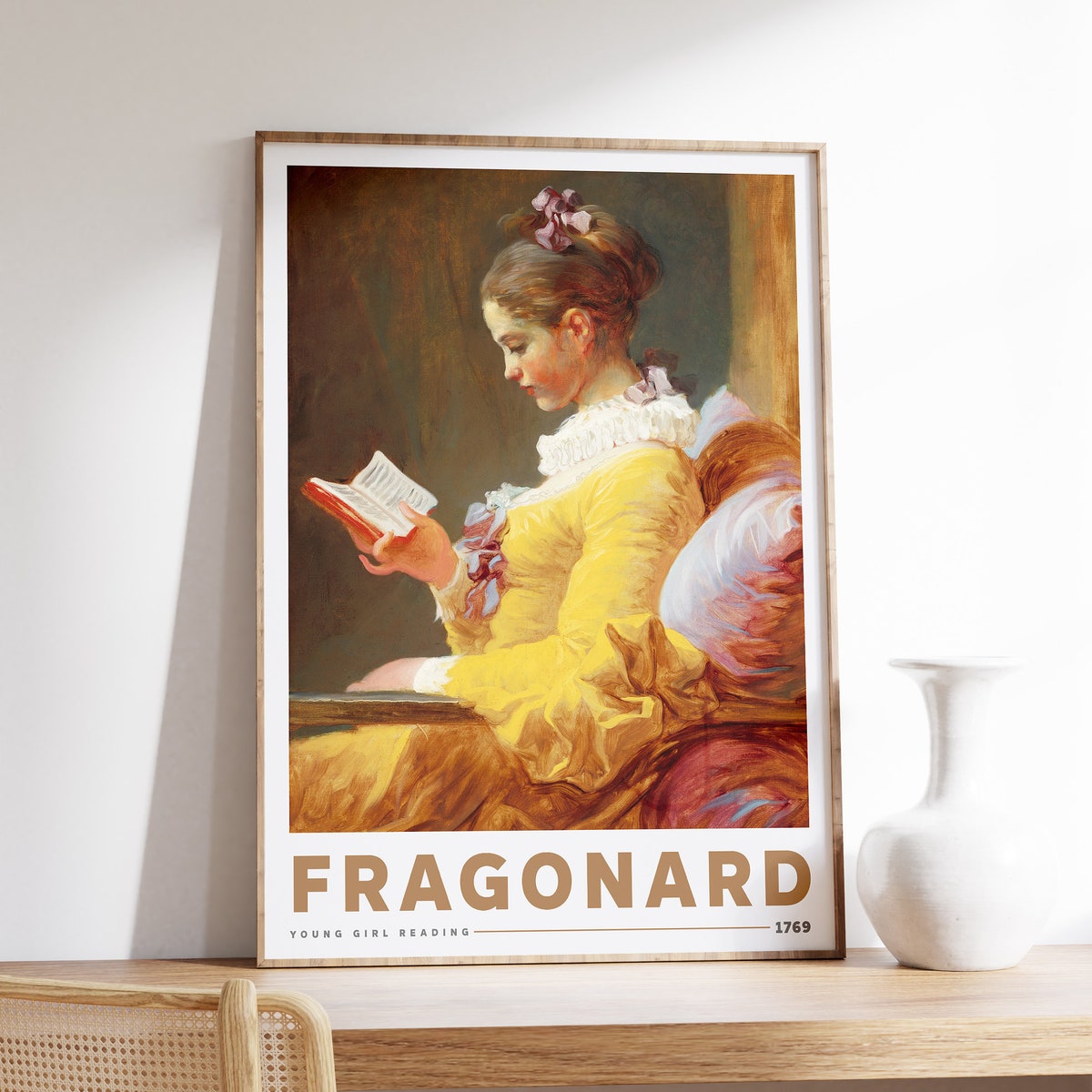
Fragonard and the Poetry of Leisure
Jean-Honoré Fragonard rose to prominence in the mid-18th century as a master of the French Rococo, drawing on his studies with François Boucher to refine a signature style. He developed what scholars now call his fantasy portrait approach, blending theatrical costume and intimate gesture in works that feel both staged and alive. In Young Girl Reading Fragonard orchestrates a scene of poised leisure that transcends any specific sitter. The anonymous subject becomes a universal figure of refinement and contemplation. Such works reveal Fragonard’s flair for capturing fleeting moments of private elegance.
After its creation around 1769 Fragonard’s small canvas entered a storied path before arriving at its current home in Washington, D.C. In 1961 Young Girl Reading was generously donated to the National Gallery of Art by Mrs Mellon Bruce to honor Andrew W. Mellon. Since then it has captured the attention of curators and visitors alike, becoming one of the museum’s most cherished icons. Exhibition catalogues and gallery essays frequently praise its luminous tonality and spirited execution. The painting encapsulates the vivacity of Rococo alongside a rare atmosphere of domestic intimacy.
Throughout his oeuvre Fragonard balanced effervescent brushwork with moments of serene reflection, and Young Girl Reading exemplifies this duality. The painting’s soft, golden illumination suffuses the interior setting, while the sitter’s calm profile underscores a theme of inward concentration. Far from the theatrical exuberance of larger salon scenes, this intimate depiction channels a more contemplative strain within Rococo art. The delicate lace collar, lilac cushion, and lemon-yellow gown work together to frame a private ritual of literacy and solace. It remains both playful in execution and profound in feeling.
Brushwork and Material Illumination
Fragonard’s handling of paint in Young Girl Reading reveals a subtle dance between swift, sweeping gestures and more delicate touches. He depicts the folds of the yellow silk gown and the flutter of purple ribbons with animated strokes that dance across the canvas. In contrast the sitter’s visage receives measured care, each soft shadow and highlight placed to capture her focus. This interplay immerses the viewer in the textures of fabric and flesh while preserving compositional harmony. The painter’s visible brushwork remains a vibrant signature of Rococo exuberance.
Measuring just over eighty by sixty-five centimeters, the painting unfolds like a private stage set against a softly lit domestic interior. Fragonard positions his sitter in strict profile, her gaze lowered toward the open book and her posture suggesting both quiet attention and graceful poise. The restrained spatial arrangement and limited props—a lilac cushion, a lace-trimmed collar, a handful of purple ribbons—focus our gaze on the act of reading itself. Subtle tonal shifts in the background walls and cushion echo the warmth of her complexion. Through such refined economy of detail the painting attains a serene intimacy.
Executed in oil on canvas, the work exemplifies Fragonard’s luminous palette, which balances warm yellows, cool purples, and gentle neutrals. Thin, translucent layers of paint create a soft glow that bathes the scene in an almost golden haze, while quicker, opaque accents provide points of visual punctuation. The subtle interplay of light and color reveals the artist’s acute sensitivity to chromatic harmony and depth. Each brushstroke contributes to an overall impression of airy grace rather than heavy material presence. This delicate alchemy of medium and technique underscores the Rococo’s celebration of color and pleasure.
Reading as Cultural Ritual
By the late 18th century reading had become emblematic of refined domestic virtue across aristocratic and bourgeois circles. In Young Girl Reading Fragonard presents literacy as both an innocent pastime and a badge of cultural sophistication. The image transforms a solitary act of page-turning into a gentle ceremony that celebrates civilized leisure. The open book stands as a quiet emblem of education and sensibility, implying that a woman’s inner life could command its own dignity. Such scenes resonated deeply in salons where intellect and grace were equally cherished.
Beyond its decorative appeal the painting marks a subtle shift toward introspection within late Rococo art. Instead of capturing lively courtly assemblies Fragonard zeroes in on individual concentration, turning the act of reading into a window onto private experience. The sitter’s profile, detached from direct engagement with the viewer, underscores a self-contained world of thought and feeling. This inward turn anticipates later artistic interest in everyday domestic scenes as serious subjects in their own right. By highlighting solitary focus, Young Girl Reading foreshadows a broader exploration of perception and mood in European art.
Although the sitter in Young Girl Reading remains unidentified, Fragonard invites each viewer to become a participant in an unspoken narrative. The lack of direct eye contact encourages us to infer the girl’s thoughts, motives, and emotional state from her posture, the soft folds of her dress, and the glow of lamp-like light. Over multiple viewings one discovers hidden pleasures—the play of shadow across the wall, the rhythmic pleats of fabric, the vibrant brushstrokes that pulse beneath smooth surfaces. This evolving encounter with the painting shows how Fragonard’s rapid technique yields a layered and enduring artistic experience.