WE ARE READY TO BRING YOU TOGETHER WITH ART %60 Discount
Winslow Homer’s Autumn: A Meditation on Seasonal Realism
Context and Concept: Homer’s Turning Point
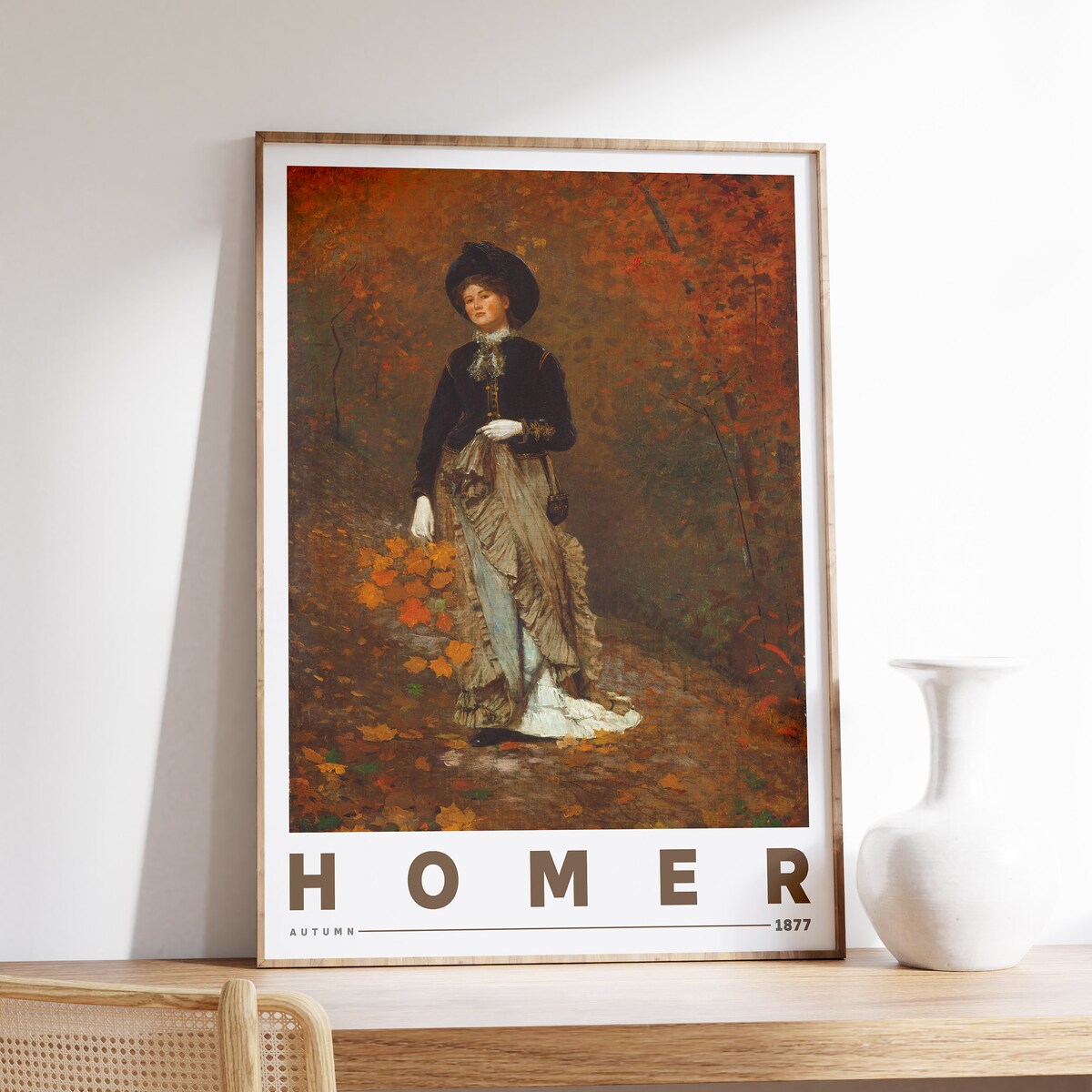
By 1877, the shifting currents of American life were mirrored in Winslow Homer’s brushstrokes as he turned his gaze from coastal vistas to the subtler drama of autumnal landscapes. In a nation negotiating the rapid pace of industrial growth and urban sprawl, Homer pursued a realism rooted in personal observation, finding in seasonal change a subject both intimate and universal. This painting emerges as a crystallization of his years exploring water and weather, an instance where the artist’s dedication to capturing nature’s fleeting moods matured into a distinctive aesthetic voice.
At the heart of Autumn lies an allegiance to nature’s cyclical patterns, presented as a quiet allegory for the passage of time. Homer does not merely replicate the blaze of red and gold leaves; he invites contemplation of the transitional space between harvest’s warmth and winter’s onset. The scene’s muted sunlight, filtering through the thinning canopy, speaks of reflection as much as visual splendor. Through this lens, the painting transcends mere depiction, crafting an experience that resonates with the viewer’s own sense of change and loss.
Homer’s pathway in this period reveals an artist invested in more than formal experiment; he sought to transform the woodland scene into a vessel for introspection. The boundaries between ground, leaf, and sky become intentionally porous, melding into a contemplative mental terrain as much as a physical one. By dissolving these thresholds, the painting asks its audience to inhabit the space between moments, to feel the weight of time’s advance in every brushstroke, and to consider the interplay between outer vistas and inner landscape.
Material Mastery and Visual Dynamics
Autumn stands as a testament to Homer’s consummate skill with watercolor, possibly enhanced by mixed techniques that layer pigment and water with delicate precision. Each brushstroke seems calibrated to convey both solidity and buoyancy, allowing moisture in the air to emerge palpably on paper. The artist’s handling of washes and glazes creates a surface that shimmers with subtle variations in tone, while thin, linear gestures map the veins of leaves and the texture of bark. This technical virtuosity anchors the painting’s atmospheric depth.
Central to the work’s evocative power is its orchestration of light and space. Homer positions the viewer at water’s edge, where the reflected tangle of branches and drifting leaves doubles the forest’s presence. The interplay of illumination and shadow underscores a feeling of gentle melancholy, as if the waning day grants a final embrace before dusk. Spatial depth is achieved not through grand panoramas but through carefully observed shifts in luminosity, inviting the eye to wander from near reflections to distant thickets.
The color scheme in Autumn maintains a poised restraint; deep crimsons and soft golds of the foliage converse with cooler undertones in the water and sky. This balanced palette enforces the painting’s measured rhythm, as each hue seems necessary rather than decorative. The gentle fading of natural tones suggests the season’s quiet retreat rather than a flamboyant display. Through these choices, Homer fashions a mood of contemplative calm, underscoring how the passage of seasons resonates as much in tone as in temperature.
Cultural Resonance and Symbolic Depth
In the cultural landscape of 19th-century America, artists like Homer responded to the unease brought by expanding cities and mechanized life by turning to pastoral subjects for solace. Autumn becomes more than a pastoral tableau; it offers a counterpoint to the steam and steel transforming the nation. By foregrounding nature’s enduring rhythms, the painting conveys a desire for harmony amid social upheaval. Viewers encountering this work in a museum or home might find themselves transported to a space resistant to the clock and the factory whistle.
The seasonal allegory at play in Autumn evokes universal themes of change and memory. Homer’s depiction of fading light and reddening leaves suggests a cycle that includes longing alongside renewal. In this allegorical reading, each leaf drifting on the water becomes a marker of personal and collective transitions. The scene serves as a mirror for the interior life, prompting reflections on how individuals weather their own turning points and losses. Nature’s rhythm here assumes a narrative weight that extends beyond mere landscape painting.
Over a century later, Autumn retains its capacity to engage viewers on multiple levels, blending aesthetic refinement with emotional resonance. It stands as a landmark in Homer’s evolution toward a realism infused with depth—where observation of a leaf’s hue can reveal as much about the human heart as about botany. The fragility and strength captured in the work continue to remind us that time’s passage is inseparable from the textures of light, color, and form. In this way, the painting invites each observer to reconnect with both nature and self.