WE ARE READY TO BRING YOU TOGETHER WITH ART %60 Discount
Albert Joseph Penot’s The Bat Woman: Shadows, Symbolism, and Seduction
Historical Resonance of a Fin-de-Siècle Vision
Albert Joseph Pénot emerged in the last decades of the nineteenth century as a French academic painter whose works often revolved around the feminine form entwined with a moody wit. The Bat Woman, created around 1890, sits firmly within the aesthetic currents that swept fin-de-siècle Europe, where symbolist echoes mingled with ornate academic technique. Pénot’s presence in salons such as the Salon des Artistes Français brought him public visibility, yet the darker undertones of his compositions set him apart from more conventional figural painters of his day. Over time his paintings would be reevaluated for their daring interplay of erudition and imagination. His inclination toward a darkly humorous aesthetic provided a distinct flavor that resonated with contemporaries seeking art that both entertained and provoked.
The painting’s production in the waning years of the century coincides with a broader preoccupation among artists seeking alternatives to realist orthodoxy. In this milieu, Pénot highlighted contrasts between light and shadow, erotic nuance and ominous undertones. The Bat Woman’s very title conjures a creature caught between worlds: neither fully human nor entirely supernatural. Audiences of the era would have recognized in her a reflection of social tensions around gender and morality, even as the work’s decorative elegance affirmed the painter’s academic credentials and his subtle flirtation with transgressive imagery. Pénot’s delicate linework contrasted with bold thematic gestures, underscoring his unique position.
Exhibited at venues such as the Salon des Artistes Français, The Bat Woman elicited both admiration for its technical skill and debate for its symbolic boldness. In subsequent decades, scholars of symbolist art and feminist critique have revisited this painting within discussions of erotic allusion and dark power. Today, many original canvases remain in private hands, limiting direct access but amplifying the painting’s aura of secrecy. Reproductions in posters and prints have become a primary means for contemporary viewers to encounter the spell of Pénot’s nocturnal vision. Although the painting seldom emerges in public exhibitions, its occasional appearance fuels scholarly interest and popular intrigue alike.
Visual Poetics and Material Drama
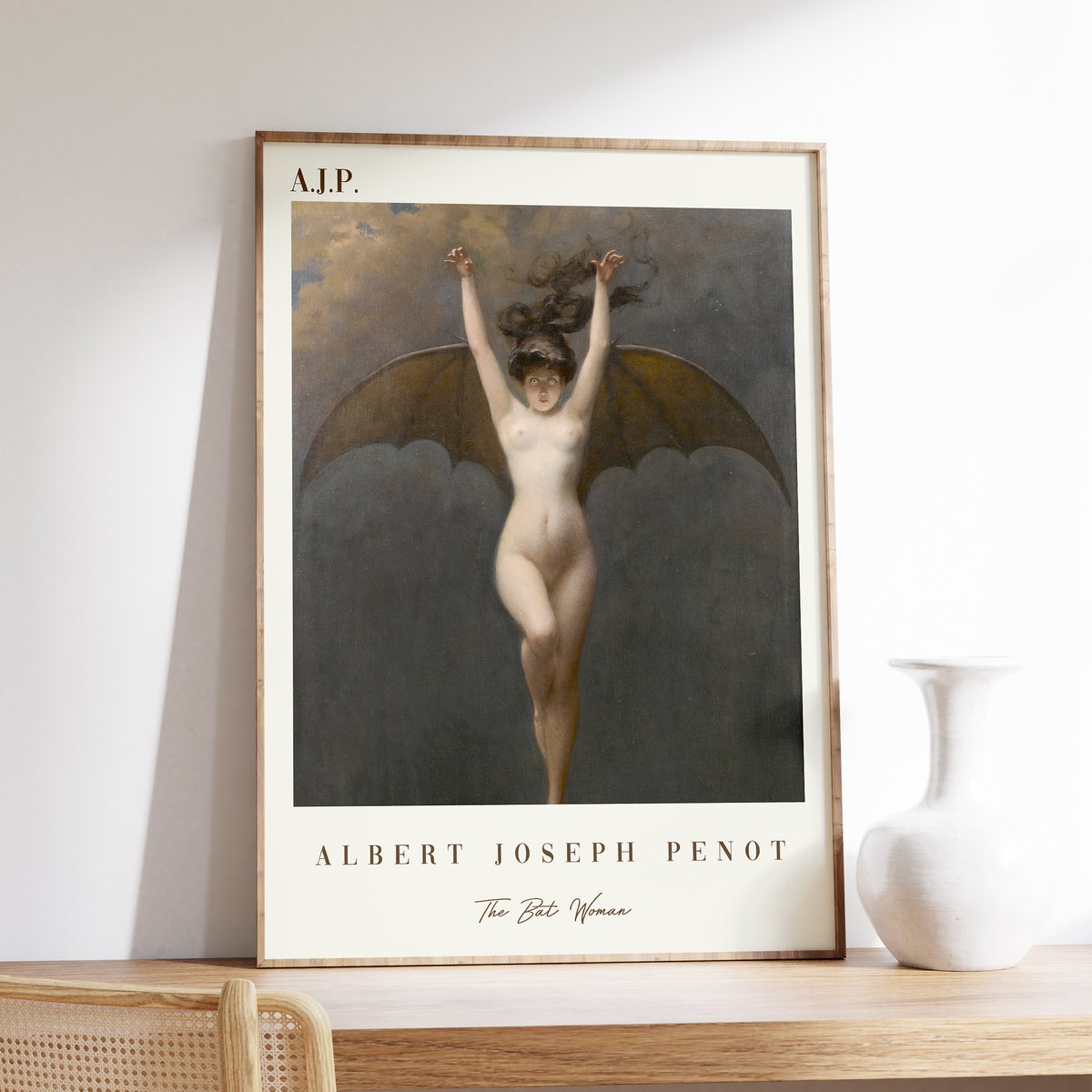
Centered in an expanse of thunderous sky, a nude female figure stretches her batlike wings with serene confidence. The stark, enveloping darkness serves as a dramatic backdrop, while shafts of light carve out the contours of her body in a homage to the chiaroscuro masters. The positioning of her limbs suggests both suspension and flight, infusing the tableau with a feeling of hushed motion. The wings themselves, delicate yet foreboding, extend beyond the human silhouette to evoke an occult symbolism that is at once alluring and alarming to the gaze. The textural subtleties of the wings hint at leathery resilience even as they convey a delicate suppleness.
Pénot orchestrates a visual poem in which airborne movement meets a sense of imminent stillness. The figure’s cool composure contrasts with the swirling storm around her, reminding viewers of the tension between elemental forces and embodied calm. This interplay of energies evokes a dreamscape where sky and flesh merge, hinting at ancient myths and phantasmagoric narratives. Each brushstroke seems calculated to heighten emotional resonance, balancing erotic charge against a pervasive air of danger that permeates every plane of the composition. This conscious juxtaposition elevates the work above mere illustration into a charged psychological tableau.
At the heart of the picture lies a meticulous attention to anatomical grace and textural nuance. Pénot’s mastery of the light-dark dialectic animates the curves of the torso, hips, and outstretched limbs, lending the scene an almost sculptural clarity. Shadows pool beneath her wings, accentuating the slender arch of the back and the gentle tilt of her head. This dramatic balance of illumination and obscurity creates an atmosphere of melancholic intensity, in which beauty and foreboding unite to form a singularly potent visual language. One can almost sense a melodic rhythm to the composition as light and shadow dance across her form.
Allegory of Freedom, Danger, and Desire
Beyond its aesthetic impact, The Bat Woman functions as an allegory of feminine power caught between liberation and threat. The combination of erotic freedom with nocturnal imagery suggests a cultural dialogue about women’s agency at a time of shifting moral codes. In embodying both seduction and danger, the figure challenges the viewer to confront ambivalent attitudes toward female desire and spiritual otherness. Her serene yet formidable presence on the canvas invites ongoing reflection on how darkness can serve as a metaphor for untamed strength. Such representation invites speculation about societal fears of emancipated femininity wrapped in mysterious symbolism.
Pénot’s decision to frame the feminine form within a mythic or phantasmagoric narrative aligns with a broader symbolist impulse to fuse sensuality and the supernatural. As a creature of liminal spaces, the Bat Woman transcends ordinary depiction to become a vehicle for exploring the tensions of her age. Her image has been embraced and reproduced in various media, from vintage exhibition posters to modern decorative prints, underscoring the enduring fascination with figures that hover at the intersection of earthly desire and transcendent mystery. These varied reproductions underscore the painting’s capacity to transcend its original temporal boundaries and maintain cultural currency.
In the twenty-first century, The Bat Woman has assumed new life through widely available reproductions that grace living spaces with a gothic ambiance. These posters and prints allow a fresh audience to engage with Pénot’s distinctive blend of ornamental academic style and shadowy allure. Especially in modern art decor, the piece serves as an aesthetic reference for those drawn to dramatic contrast and mythic undertones. In this way, the painter’s legacy finds resonance beyond its original salon context, forming a visual bridge between fin-de-siècle erotism and contemporary design sensibilities. In this way, the painting continues to inspire dialogue about how historic images can find fresh relevance in new environments.