WE ARE READY TO BRING YOU TOGETHER WITH ART %60 Discount
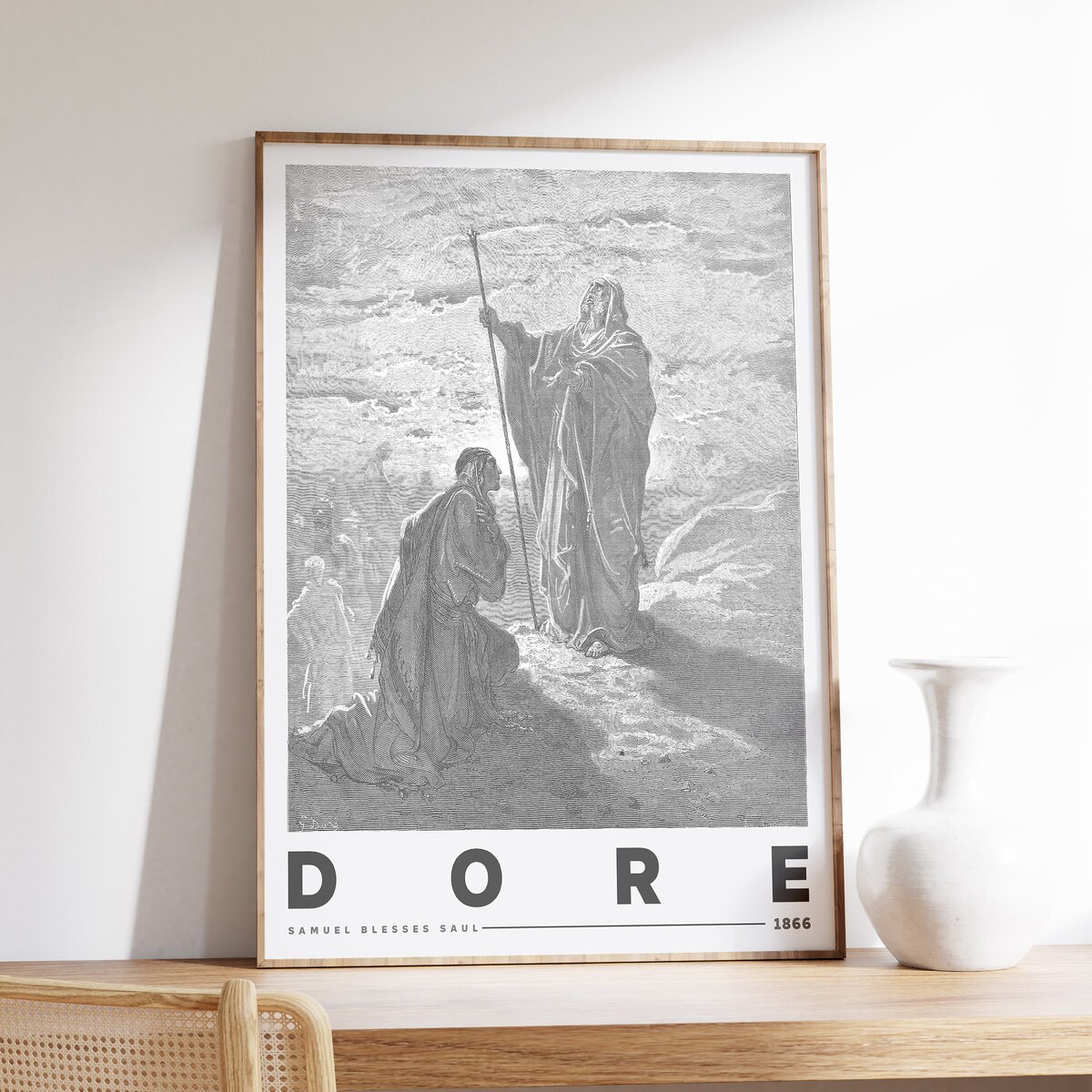
Gustave Doré's Samuel Blesses Saul: A Dark Nouveau Drawing
Origins and Vision in Mid-Century Illustration
Gustave Doré was born Paul Gustave Louis Christophe Doré in Strasbourg in 1832, emerging in an era of political and cultural ferment at the dawn of the Romantic age. From his earliest sketches, he displayed a facility for rendering complex narratives with a single flourish of the pen. As the century progressed, his ambitions grew in tandem with the appetite of a burgeoning reading public for illustrated classics. The combination of painterly ambition and printmaking technique propelled him swiftly into professional work, commanding attention through richly detailed compositions that captured the collective imagination.
Before many contemporaries had even completed formal training, Doré was commissioned to illustrate epic texts and literary masterpieces. His depictions of Dante's Inferno poured new life into the medieval vision of cosmic darkness and divine retribution. At the same time, his translations of Cervantes, Balzac, and Milton into visual form demonstrated a restless eclecticism, a willingness to traverse genres and languages in search of dramatic subject matter. These large-format editions transformed what had once been purely literary experiences into vivid visual journeys, inviting readers to dwell within each shadow and highlight with cinematic immediacy.
Within a decade, Doré's ambition found its grandest outlet in sacred storytelling. The monumental Bible editions turned his workshop into a hub of creative enterprise, where dozens of block-cutters labored to translate his energetic line work into wood engravings. This collaborative model brought his vision to an audience previously unreachable by painted canvases alone. His images, suffused with ceremonial gesture and monumental scale, crossed borders and social strata. What began as a personal quest to depict myth and legend had evolved into a cultural phenomenon, anchoring Doré's name to some of the most enduring visual conventions of piety and narrative drama.
Crafting Drama Through Line and Shadow
At the core of Doré's visual language lies an obsession with contrast and movement, an understanding that a single line can arrest attention or carry the eye into the depths of a cavernous landscape. His engravings and lithographs reveal a mastery of chiaroscuro long before the term was fully adopted by art critics. Each curl of smoke, each drape of fabric, is defined by calculated densities of black and white, invoking a palpable sense of atmosphere. The monochrome palette becomes a dramatic stage, where light and dark vie for narrative supremacy, guiding the viewer toward moments of spiritual or emotional revelation.
In the composition known as Samuel Blesses Saul, Doré orchestrates a solemn ceremony with supreme economy. The prophet Samuel, robed in flowing shadows, extends his hands in a gesture of consecration, while the young king Saul bows in reverent humility. Blank spaces around the figures amplify their emotional charge, as if the very air were drawn into the gravity of the ritual. These decisions in spatial arrangement, combined with Doré's fluid line quality, imbue the scene with a timeless dignity, transporting viewers into an ancient world of covenant and rite.
The phrase Dark Nouveau Drawing often accompanies this scene in contemporary printings, speaking not to a separate work but to a marketing sensibility that arose long after Doré's death. Such labels serve as interpretive signposts for modern audiences, suggesting a marriage of nineteenth-century engraving with art-nouveau stylings favored by twenty-first-century decorators. While the original prints circulated under biblical titles within illustrated Bibles, today's reproductions adopt evocative names to signal mood and period to collectors. This practice, though external to Doré's own catalogue, underscores the enduring commercial and aesthetic appeal of his imagery.
Enduring Resonance and Modern Reissues
Though Doré passed away in 1883, his influence never waned. The dramatic landscapes and towering forms he conceived echo in countless depictions of mythic and sacred subjects, from illustrated fantasy novels to cinematic concept art. The visual conventions he popularized—soaring cathedral interiors, chasms of shadow, and heroes caught in luminous moments of revelation—remain foundational to the way we imagine otherworldly realms. His capacity to translate moral and metaphysical drama into visual form has become a touchstone for artists seeking to evoke awe and spiritual intensity.
Critics have alternately lauded and critiqued his flamboyance, yet his images maintain a presence both in rare museum editions and in more accessible print-on-demand offerings. The appeal spans casual admirers of dramatic illustration and connoisseurs of nineteenth-century technique. As galleries and online platforms reissue his wood engravings under varied descriptive banners, they reaffirm Doré's status as a pivotal figure who bridged the gap between fine art and mass media. His workshop's collaborative model foreshadowed modern studios while his signature chiaroscuro anticipated future artistic movements.
In galleries and print catalogs alike, Samuel Blesses Saul stands as a testament to Doré's enduring magnetism. It invites reflection on how a single image, etched with unwavering precision, can communicate centuries-old narratives to each new generation. The interplay between original authorship and contemporary presentation highlights a broader story of how historic art persists in living rooms and curated collections, transforming bare walls into portals of legend and devotion.