WE ARE READY TO BRING YOU TOGETHER WITH ART %60 Discount
Winslow Homer’s Dad’s Coming Home: Echoes of Family and the Sea
Anchored in Time and Place
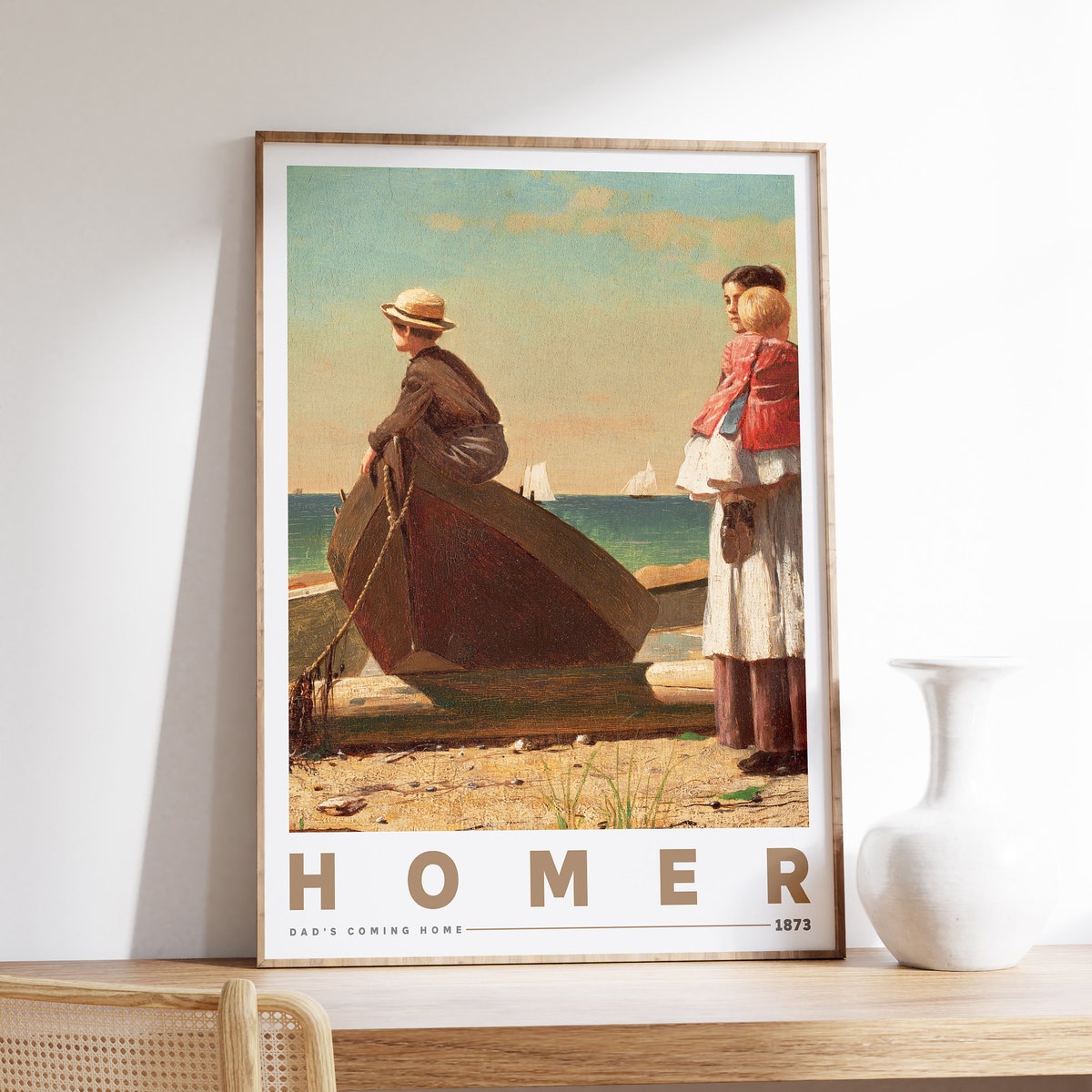
In the early 1870s the American imagination was shaped by the lingering shadows of conflict and the renewed rhythms of everyday life by the sea. Homer, born in 1836 and active until 1910, found himself drawn to the villages of Gloucester, Massachusetts, where the ebbing tide felt like a metaphor for hope returning after storm. In 1873 he created ‘Dad’s Coming!’, a wood engraving commissioned for Harper’s Weekly, that captured the heartbeat of a community on watch between land and deep waters. By choosing the engraving medium he bridged the fine arts and popular presses, reaching homes hungry for both beauty and familiarity. At a time when illustration could traverse social divides, his work resonated equally with urban readers and maritime families.
Along the craggy shores of Gloucester, summer gales in 1873 had left a mark on collective memory. News of fishermen lost at sea lent the scene a gravity that Homer could not ignore. In his central image, a small family stands as a sentinel against an uncertain horizon, embodying the fragile pact between human resolve and untamed nature. The tension between the expansive sky and the tight cluster of figures reflects the era’s fascination with sublime maritime drama and the enduring bond of kinship. This awareness of mortal risk pulses beneath every carefully engraved contour. It frames the work as both a personal tribute and a communal elegy.
Published in Harper’s Weekly, this image served a double purpose. It functioned as a topical illustration within America’s most widely read magazine, and as an aesthetic statement that spoke directly to the values of home and hearth. In an age when reproductions were beginning to shape mass taste, Homer’s wood engraving stood out for its clarity of line and emotional depth. It became an emblem of how newspaper and magazine graces could elevate quotidian scenes into enduring art. This dual role highlights the evolving relationship between art and a rapidly modernizing society.
The Poetics of Line and Light
At first glance ‘Dad’s Coming!’ arrests the eye with its bold engraving lines, each stroke precise yet imbued with a sense of fluidity. Homer’s mastery of the burin on wood allows him to evoke the restless motion of waves and wind with the same ease that he draws the tender outline of a child’s hand. The resulting monochrome delicacy, enhanced by selective shading, generates a spectrum of blues on paper, even in reproduction, suggesting a deep sea and a brooding sky. Such subtleties in engraving demand both technical skill and an eye attuned to nature’s rhythm. Every ripple and shadow is calibrated to convey an atmospheric charge, as though the page itself breathes.
Compositionally, the scene hinges on a delicate balance between open space and clustered figures. The viewer’s eye first travels to the vast expanse of sea and sky, horizons merging in a subtle visual dialogue. Then it settles on the mother and child standing near the shoreline, their posture leaning toward the unseen return. The contrast between the loose sweep of the natural world and the concentric gathering of humanity underscores the emotional core of the work, reinforcing the sense that the family stands at the intersection of fear and expectation. This structural choreography reveals Homer’s intuitive grasp of pictorial tension and narrative flow.
Homer’s use of color, or rather his suggestion of it through tonal modulation, deepens the narrative resonance. The midtones that imply the blues of water and atmosphere lend a cool undertone that hints at uncertainty, while the sharper highlights around the figures suggest warmth and domestic safety. This interplay of light and shadow does more than reproduce a coastal moment; it enacts the emotional tension between the perils of seafaring life and the sanctuary of home. Each engraved line becomes a vessel for atmosphere and sentiment. In this way, the materiality of the woodblock itself becomes an accomplice in the storytelling.
Echoes of Home and Heart
Beyond its technical brilliance, ‘Dad’s Coming!’ resonates as a testament to universal human experience. The simple act of waiting becomes laden with meaning in Homer’s hands, transforming a fleeting anticipation into a visual poem about hope and fear in equal measure. The maternal figure, steady and attentive, and the child grasping at her coat, together embody the bedrock of family affection. Their gaze, fixed on the distant horizon, captures a collective longing that transcends time, reminding us how closely emotion and environment intertwine on a windswept shoreline. In that still moment, the viewer senses both vulnerability and unwavering faith.
In the context of 1870s America, this engraving spoke directly to themes of solidarity and kinship that were woven into daily life. At a moment when newspaper and magazine prints shaped public discourse, Homer’s portrayal of a fisherman’s family offered a mirror for readers across the nation. It refracted the anxieties of coastal communities grappling with economic uncertainty and the ever-present dangers of the sea, while also affirming the unshakable bonds that sustained them. As such, the work stands as a visual archive of collective values. It reminds us that art can both document and uplift the spirit of a people.
Today, the legacy of this work endures in the collections of institutions like the Art Institute of Chicago, the National Gallery of Art, and university museums that chronicle American artistry. Its widespread acclaim underscores how Homer’s Gloucester period output achieved both popular appeal and lasting art historical significance. More than a simple newspaper illustration, the engraving remains a cultural touchstone, offering contemporary audiences a window into the emotional landscape of a bygone era, where every surf and cloud carried the promise of reunion. Its presence in major galleries attests to its enduring power to speak across generations.