WE ARE READY TO BRING YOU TOGETHER WITH ART %60 Discount
Johannes Vermeer’s Girl With the Red Hat: A Study in Intimate Light and Color
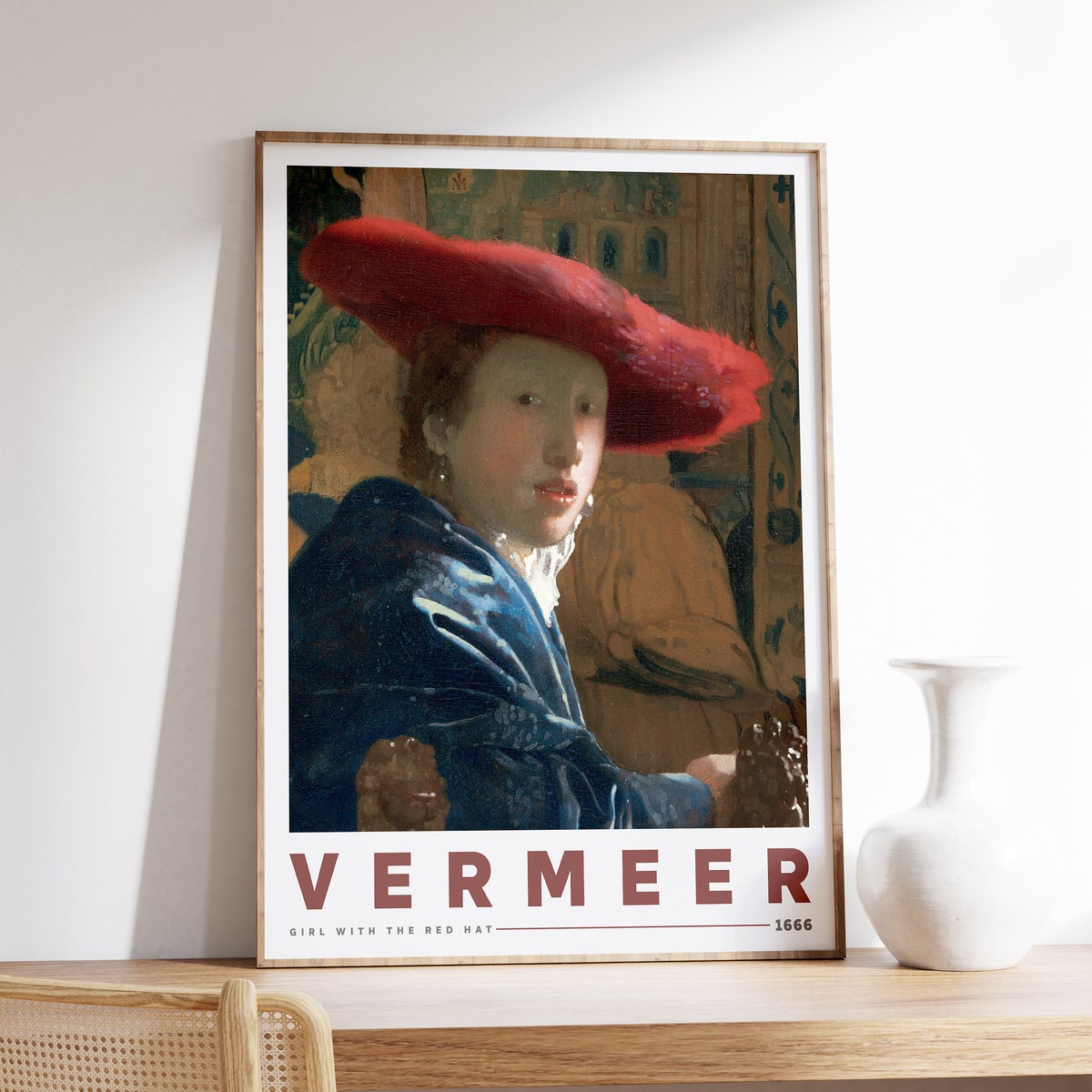
Framing the Intimate Masterpiece
The late 1660s mark a moment when Johannes Vermeer turned inward, refining his art to the scale of a whisper. Girl With the Red Hat resides on a mere 22.8 by 18 centimeter oil-on-panel, yet it resonates with the hush of a Delft interior. A young woman glances toward the canvas, her lips gently parted and her eyes poised between shyness and self-possession. Scholars recognize this image as a tronie, a character study that transcends any specific identity to probe mood and social type. In its intimate proportions, the work invites us to feel as though we have stumbled upon a private moment of subdued drama.
Unlike conventional portraits of the era, this piece does not claim to chronicle the life of a named sitter but rather to distill atmosphere. In Vermeer’s hands, the tronie becomes a laboratory for his investigations into perception, color theory, and fleeting light effects. He focuses on the ephemeral play of candlelight or daylight as it drapes across fabric and skin, cultivating a mood that hovers between realism and reverie. The painting’s lack of overt narrative frees it to explore psychological presence, allowing the viewer’s gaze to wander across deliberate juxtapositions of hue and texture. Through this approach, Vermeer’s mature style asserts itself in compositions that favor nuance over spectacle.
The central drama unfolds not in gesture but in a singular, saturated hue. The red hat, perched at a slight angle, commands attention through vibrant pigment and bold placement. It becomes the pivot around which blues, whites, and flesh tones orbit, creating a visual heartbeat in the compact frame. This chromatic decision is further reinforced by a sumptuous blue garment and a luminous lace collar, each element calibrated to reinforce the hat’s magnetic pull. In this way, Vermeer’s restraint and precision amplify the psychological charge of a simple headturn.
Art and Material Alchemy
Vermeer’s choice of a small wooden panel, rather than the more common canvas, speaks to his commitment to finish and detail. The smooth surface allows for an unprecedented delicacy of brushwork, where transitions appear seamless and each stroke remains invisible. Within the confined dimensions, textures emerge with surprising clarity, from the lace’s crisp folds to the velvety depth of the garment. Working at this scale would have demanded patient layering and constant refinement, notes scholars who have examined the surface under magnification. The result is a finish so polished that the viewer’s eye glides without interruption over flesh and fabric alike.
Color in this tronie is at once simple and complex, built from a restrained palette that nonetheless achieves rich interplay. The red hat glows with warmth, achieved through glazes that imbue the pigment with depth and luminosity. Opposite this warmth, the garment unfolds in a cool, velvet-like blue, offering visual counterpoint and reinforcing the hat’s dominance. Vermeer’s delicate handling of the pale skin tone—almost porcelain in its smoothness—rests between these chromatic poles, ensuring that the sitter’s face remains the focal point. All of these hues are punctuated by the bright white of a carefully rendered lace collar, which anchors the composition and reflects light back into the scene.
The technical brilliance of Girl With the Red Hat lies in its command of light and surface. Vermeer employed thin glazes and successive tonal modulations to render skin with an almost living translucency. The red hat’s glaze captures light differently than the matte blue robe, inviting the viewer to appreciate subtle shifts in material quality. Even the lace collar benefits from a nearly optical precision, where tiny highlights suggest folded threads catching ambient glow. Through this methodical layering, Vermeer constructs an illusionistic space that belies the panel’s modest footprint.
Symbols, Gaze, and Lasting Resonance
Beyond its painterly wonders, Girl With the Red Hat engages with deeper questions of social display and identity. Hats in seventeenth-century Delft were markers of style and status, and here the red hat becomes an emblem of the sitter’s self-presentation. It does more than accessorize: it asserts character and mood, acting as a silent commentary on fashion’s power to shape perception. Vermeer elevates an everyday object into a symbolic center, allowing the tronie to hover between decorative pleasure and psychological inquiry. The hat’s saturated hue thus transforms a simple headpiece into a narrative catalyst.
The sitter’s gaze remains one of the most compelling elements of this work, inviting a tense yet gentle interchange. Her eyes, directed just over the viewer’s shoulder, imply awareness of being observed without relinquishing her own autonomy. This deliberate ambiguity fosters a sense of immediacy and restraint, challenging the audience to navigate invitation and reserve simultaneously. Through this encounter, Vermeer underscores his fascination with the psychological effect of a steady glance in a silent room. The result is an emotionally charged stillness, where interior life and outward form meet in a charged pause.
Today, the painting’s journey through connoisseurship and museum display adds another dimension to its resonance. Housed at the National Gallery of Art in Washington, D.C., it witnesses both public admiration and scholarly scrutiny. Advances in pigment analysis, dendrochronology, and non-invasive imaging have reaffirmed its place within Vermeer’s late output, resolving earlier debates about authorship and technique. As a touchstone of Golden Age tronies, Girl With the Red Hat continues to inspire discussions about the interplay of appearance and reality. The paradox of its small scale yielding vast emotional depth ensures that every new generation returns to this luminous moment in paint in search of fresh insight.