WE ARE READY TO BRING YOU TOGETHER WITH ART %60 Discount
Channel Bass by Winslow Homer: Sunlit Depths and Quiet Tension
Historical Context and Homosassa Origins
Winslow Homer stands among the towering figures of American painting at the turn of the twentieth century. Over decades, he moved from Civil War illustrations to scenes of outdoor life that reveal a profound fascination with water, weather, and human struggle. In his later years, he embraced watercolor as a vehicle for atmospheric depth and stripped-down clarity, experimenting boldly with fluid pigments on white wove paper. This technique allowed him to capture both the minute textures of scale and plant life and the grand sweep of sunlit seas. Channel Bass arrives in this mature phase as a distilled example of his enduring commitment to marine imagery. It resonates with the quiet intensity that defines so much of his final creative vision.
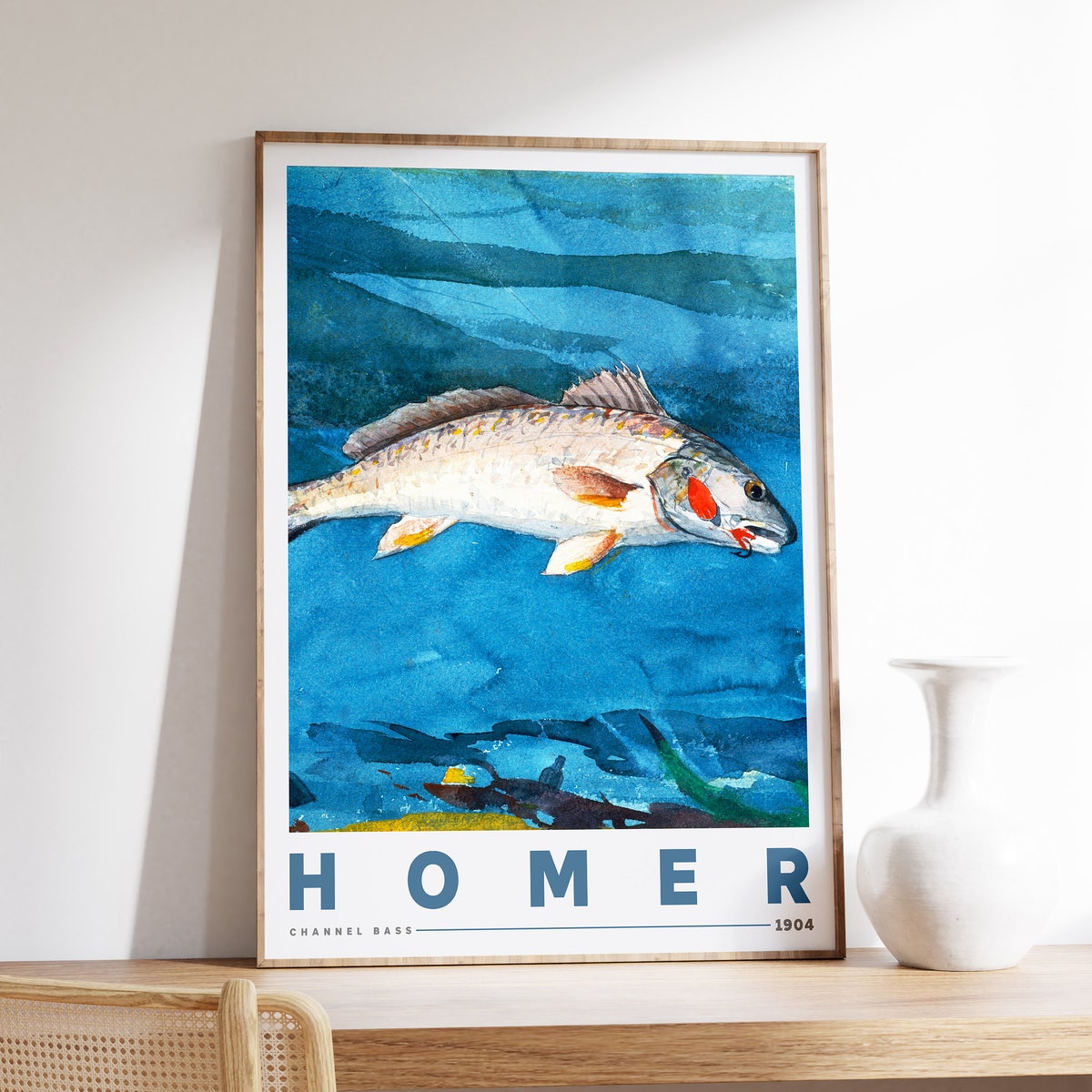
In January 1904, Homer traveled to Homosassa on Florida’s Gulf Coast, drawn by its crystalline rivers and the vibrancy of tropical light. There he embarked on a series of watercolors that stand among his last and most experimental works. The series became a canvas for his fascination with refracted light, underwater vegetation, and the living brilliance of the tropics. Among these compositions, Channel Bass holds a special place, presenting a single fish as both subject and symbol. Its depiction conjures the precise moment when surface beauty gives way to an implied undercurrent of struggle. Institutional records confirm the work’s medium as watercolor and graphite on wove paper and cement its date in the winter of 1904. This tension reveals Homer’s late-career preoccupations with nature’s grandeur and the fragility of life.
The painting’s title, Channel Bass, anchors it within a lineage of maritime investigation that Homer pursued to the end of his life. He viewed fishing scenes not merely as genre subjects but as challenges to the painter’s perceptual nerve. In Channel Bass, the fish floats in clear water as though suspended in time, each quivering scale a testament to Homer’s acute observation. Recorded in the portfolio of the Metropolitan Museum of Art, Channel Bass benefits from scholarly attention that underscores its place within a pivotal chapter of Homer’s trajectory. Yet there is a subtle hint of unease in the fish’s posture and the open space around it, suggesting that tranquility and peril are inseparable in the sea. Through this interplay, the painting becomes a meditation on survival, craft, and the artist’s own mortality. It speaks to the precarious balance between human enterprise and the relentless force of the natural world.
Technique, Color, and Material Layering
At the heart of Channel Bass lies Homer’s innovative use of watercolor and graphite on white wove paper, a medium he exploited for its blend of spontaneity and control. By laying down thin washes of blue and green, he established an underlayer of shifting currents and sunlit reflections. Over this he drew subtle graphite lines to define the bass’s form, using precise underdrawings to guide areas of intense color and delicate transparency. His glazing techniques allowed individual layers of pigment to shine through each other, creating a luminous depth that feels almost three-dimensional. This careful choreography of washes and line work exemplifies Homer’s dedication to technical experimentation in his final years. It also underscores his belief that watercolor could achieve a clarity and presence rivaling oil painting.
The painting invites the viewer to linger in the precise arrangement of hues and textures. The scales of the channel bass glint with a golden sheen that Homer himself likened to a $20 gold piece, an analogy that captures both the material brilliance of the fish and its almost precious quality. Surrounding water takes on lapis-like tones where light filters through subtle plant forms, and anywhere the paper remains exposed the brightness of untouched white paper suggests shards of sunlight. Negative space around the fish dramatizes its isolation, encouraging the eye to move across the composition without distraction. Homer's metaphor of the golden gleam underscores his engagement with value and beauty as intertwined concepts in nature's design. Each brushstroke appears simultaneously economical and richly suggestive, a testament to Homer’s mastery of restraint and emphasis.
Through this fusion of method and vision, Channel Bass becomes more than a study of a captured fish; it unfolds as an examination of perception itself. Homer choreographs light, water, and materiality to underscore the boundary between what the eye sees and what lies just beyond the surface. The momentary stillness of the fish in clear shallows draws attention to the transient nature of observation, as if time has paused to reveal both beauty and tension. The painting’s disciplined negative space dramatizes the fish’s isolation, reinforcing the formal interplay of presence and absence. This approach aligns with scholarly readings that cast Homer’s Homosassa watercolors as meditations on endurance and the interplay between depth and surface. In each watercolor from this period, he sought to translate natural phenomena into images vibrating with both lyricism and empirical scrutiny. Channel Bass thus emerges as a quintessential example of his mature style, where technique and content intertwine in an evocative union.
Symbolism, Vulnerability, and Lasting Resonance
Beyond its technical feats, Channel Bass carries a potent symbolic resonance that extends into questions of life, death, and human vulnerability. The fish itself embodies a moment of suspended being, its stillness suggesting the fragile threshold between freedom and capture. By focusing on a solitary marine creature, Homer invites contemplation of mortality, as if this single subject embodies the countless lives at sea subject to unseen forces. This symbolic depth is amplified by the fish’s suspended posture and the careful embroidery of light across its form. The tension between the bass’s serene beauty and the undercurrent of strain amplifies this existential dimension. It reminds viewers that the act of fishing is as much a confrontation with death as it is a celebration of skill and survival.
In the broader context of American maritime art, Homer’s Channel Bass resonates with a lineage of artists who privileged immediacy of sensation over romanticized seascapes. His commitment to capturing the subtleties of light refracted through water and the anxiety inherent in the natural world marked a shift toward a more observational, almost cinematic mode of painting. The Homosassa watercolors, including Channel Bass, are often highlighted in exhibition histories for this shift, demonstrating Homer’s direct response to changing outdoor conditions and his restless pursuit of veracity in color and form. Curators often highlight this piece to illustrate Homer’s pivot toward direct outdoor observation and the unadorned drama of everyday moments. This period positions direct observation as a critical tool for conveying raw emotional tone. In doing so, he expanded the vocabulary of marine painting to encompass delicate shades of mood and a deeper immersion into the elemental.
Ultimately, Channel Bass stands as a touchstone of Homer’s late career, where technical mastery and existential inquiry converge on a single, still moment. The painting encapsulates his lifelong dialogue with water as both a visual subject and a metaphor for the unknown depths of human experience. Each layer of translucent pigment, each calculated brushstroke, becomes part of a larger meditation on vitality, skill, and the artist’s own closeness to the end of a storied life. The work’s presence in major collections, with precise dating and documentation, affirms its role as a vital specimen of his final creative explorations. The narrative of Channel Bass continues to resonate, inviting new generations to ponder the delicate threshold between life lived in stillness and the relentless motion of the sea. In this singular image, viewers can sense the hush of sunlit waters and the echo of deeper currents that lie just out of view. Channel Bass thus remains an enduring testament to Homer’s power to translate the everyday act of fishing into a profound reflection on light, life, and time.