WE ARE READY TO BRING YOU TOGETHER WITH ART %60 Discount
Winslow Homer’s The Four-Leaf Clover: An Intimate Study in Light and Life
Contextualizing Homer’s Quiet Turn
Winslow Homer emerged in the mid-19th century as a defining voice in American art. His early work showcased a remarkable sensitivity to light and atmospheric nuance across everyday landscapes. In contrast to the sweeping historical and maritime scenes that later dominate his legacy, he began to focus on smaller, more intimate narratives. This evolving perspective set the stage for a new kind of American realism centered on ordinary life. His brush elegantly captured the interplay of natural and human elements, enriching each scene with palpable authenticity.
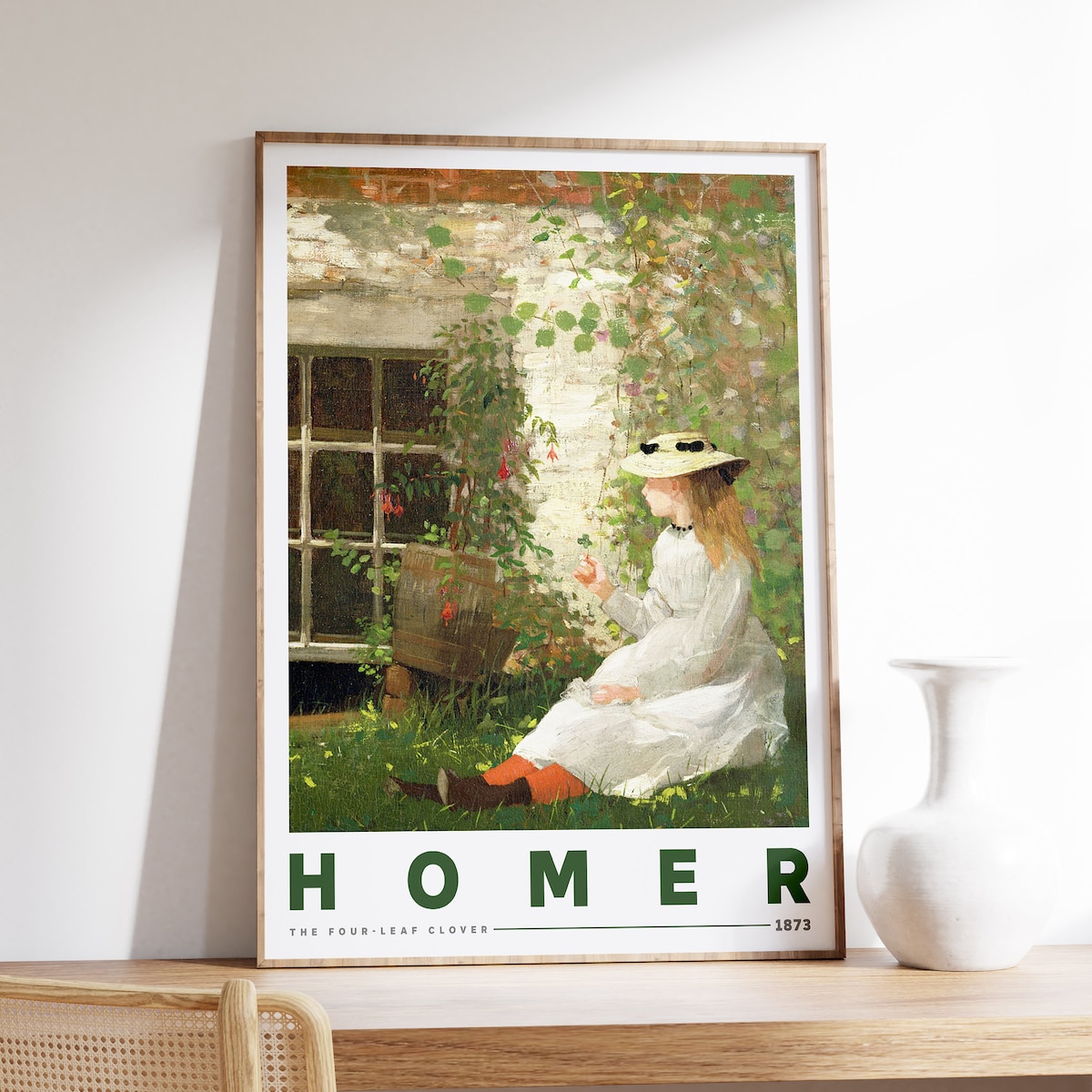
The year 1873 marked a clear shift in Homer’s practice, as he moved away from illustrated storytelling toward contemplative genre studies. In The Four-Leaf Clover the focus turns inward, presenting a single figure engaged in quiet introspection rather than a grand visual drama. That simplicity nonetheless carries layered meaning, suggesting that depth resides in small moments as much as in epic events. The understated tableau of a rural garden thus speaks volumes about the artist’s maturing vision. This period of transition would become a hallmark of Homer’s early mature works.
By choosing a humble garden setting and a child’s private reverie, Homer signaled his investment in everyday human experiences. He treated such fleeting scenes with the same seriousness formerly reserved for mythic and maritime subjects. The Four-Leaf Clover emerged as a testament to his belief that ordinary life could yield extraordinary insights. In doing so, he broadened the scope of American painting to include the quiet dignity of domestic moments. This conceptual framing would influence countless genre artists who saw new depth in simplicity.
The painting’s provenance echoes its thematic resonance, weaving through private collections before finding a permanent home. Bequeathed by Robert H. Tannahill to the Detroit Institute of Arts, it became part of a prestigious public collection. Each change of ownership reflects persistent admiration for Homer’s versatile skill across various subjects. Its eventual placement in Detroit underscores how institutions valued this early mature style alongside its more monumental counterparts. Through this journey, The Four-Leaf Clover gained layers of meaning tied to its guardians and audiences.
The Canvas, Color, and Light
Executed in oil on canvas, The Four-Leaf Clover spans approximately 36.2 by 51.8 centimeters, embracing a modest or intimate scale. That size invites viewers to step closer, forging a sense of personal connection with the scene. The artist’s signature, Homer 1873, discreetly placed in the lower left, serves as a chronological anchor. It also reflects his growing confidence in asserting a distinct style during this Gloucester-to-Detroit arc. Such details transform the canvas into a carefully calibrated window onto a singular moment.
At the painting’s center sits a young girl, absorbed in examining a four-leaf clover between her fingertips. She occupies a sunlit patch of garden, while behind her, a brick wall overgrown with vines offers textural contrast. A nearby window reveals nothing beyond but suggests boundaries between interior and exterior life. With measured composition, Homer directs attention seamlessly from the child’s rapt expression to the natural elements then back again. This balancing act of structural and organic forms anchors the viewer’s gaze.
Color plays a vital role in conveying both mood and realism throughout the piece. Warm hues in the girl’s simple attire and sunlit skin glow against the cooler blues and greens of foliage and shadow. Homer applies these contrasts with subtle precision, avoiding harsh delineations in favor of softly blended transitions. Such handling accentuates the tactile sense of leaves and fabric, inviting tactile memory. Through this palette, he bridges the divide between objective representation and emotional resonance.
Light itself becomes a dynamic participant in the narrative, dancing across surfaces and animating the figure. Gentle shafts of sunlight spill over the child’s form, carving out delicate highlights and soft shadows. This interplay suggests a moment frozen in time, as if nature itself hesitates to proceed. Homer’s attention to luminosity aligns with realist currents emerging in both American and European circles. It underscores his mastery in capturing fleeting atmospheric effects with unwavering delicacy.
Simple Objects, Profound Themes
In The Four-Leaf Clover, an everyday object becomes a catalyst for meditation on chance and hope. The rare clover, delicately held by a child’s fingers, transforms into an emblem of possibility. By centering this small act, the painting highlights the quiet joys woven into daily life. Each viewer can sense a familiar spark of wonder, evoking personal memories of discovery. Homer’s portrayal thus elevates the simple to the sublime.
Beyond its immediate charm, the scene unfolds layers of introspection and remembrance. The solitary act of finding a four-leaf clover prompts reflections on how moments of serendipity shape our inner narratives. In this gesture, time appears suspended, inviting us to dwell on what it means to truly observe. Homer seems to ask whether we might reclaim these intervals of attentive presence in our own lives. His gentle portrayal offers no answers, only the invitation to look closely.
By choosing an unassuming domestic vignette, the work champions everyday life as an enduring source of artistic inspiration. Homer’s early mature style set a precedent for later realists who found profundity in the ordinary. He demonstrated that authenticity could trump theatricality without diminishing emotional power. Such a commitment to verisimilitude helped forge new paths in American art, connecting individual experience to broader cultural currents. The Four-Leaf Clover stands as a defining example of this quietly revolutionary approach.
Decades later, the painting’s resonance remains undiminished, reminding us why brief encounters with nature matter. Its blend of intimacy and universal theme continues to draw art lovers into its subdued narrative. Homer’s work encourages viewers to pause and savor the textures of light, foliage, and human curiosity. In doing so, it reaffirms the value of stillness in an often hurried world. This enduring pull towards reflection ensures that a simple garden scene can forever speak to the heart.