WE ARE READY TO BRING YOU TOGETHER WITH ART %60 Discount
Egon Schiele: Anatomy of Tension and Truth
A Provocateur in Context
Egon Schiele emerged as a defining presence within the fervent world of Austrian Expressionism in the early twentieth century. Born in Tulln an der Donau in 1890, he entered the Viennese art scene with remarkable agility and soon gravitated toward the Vienna Secession. While he shared the Secessionists’ commitment to innovative form, he also charted a fiercely individual path, exploring line, gesture, and contour in ways that felt deeply personal. Over the course of his brief but prolific career, his oeuvre would encompass portraits, self-portraits, nudes, landscapes, and urban scenes, yet it is the tense figures and stark environments that became hallmarks of his signature style.
Schiele’s reputation as a provocateur rested on an unflinching willingness to confront taboo subjects and unearth the raw recesses of human vulnerability. His nude studies and self-portraits are marked by an austere honesty about sexuality, aging, desire, and power, rendered without the artifice of idealization. In these works, he placed the exposed flesh of the body against rhythmic, often sparse backgrounds that turned each figure into a stage for psychological drama. Even the grim aftermath of World War I could not dampen his restlessness; he continued to probe themes of mortality, alienation, eroticism, and existential anxiety until his untimely death in 1918.
Rather than seeking to glorify or console, Schiele’s practice aligned with a modernist project aimed at betrayal of truth through direct depiction. His self-portraits stand as unguarded confessions, free of vanity and mindless decorum, inviting viewers to contend with the very act of self-examination. His delicate negotiations between masculine and feminine energies, between the visible form and the inner emotions it carries, foreshadow later experiments in psychological portraiture and abstraction. As a figure on the cusp of a changing Europe, he leveraged the austere space around his sitters as an expressive element equal in weight to the figures themselves.
The Language of Line and Form
At the heart of Schiele’s visual impact lies a masterful command of line. He distilled complex bodies into skeletal, sinuous outlines that hover over flat or minimally shaded planes, creating an electric tension that feels almost tangible. This preference for pure contour over heavy modeling generates a sense of immediacy, as if each mark were a live wire sparking with emotion. The result is a charged moment captured on paper or canvas, compelling viewers to lean in and participate in the silent drama of bone and skin.
In his portraits, the line does more than trace form—it delineates psyche. Every angular shoulder, every twisted limb, and every sharp gaze becomes a portal into the sitter’s inner life—whether it be a silent scream of introspection, a hardened mask of defiance, or a candid stare that borders on the confrontational. By stripping away extraneous detail, Schiele forces our attention onto the interplay of posture, gesture, and the charged space that surrounds the body. The emotional cadence of each figure emerges from these bare-bones compositions, leaving nothing to soften the impact of their presence.
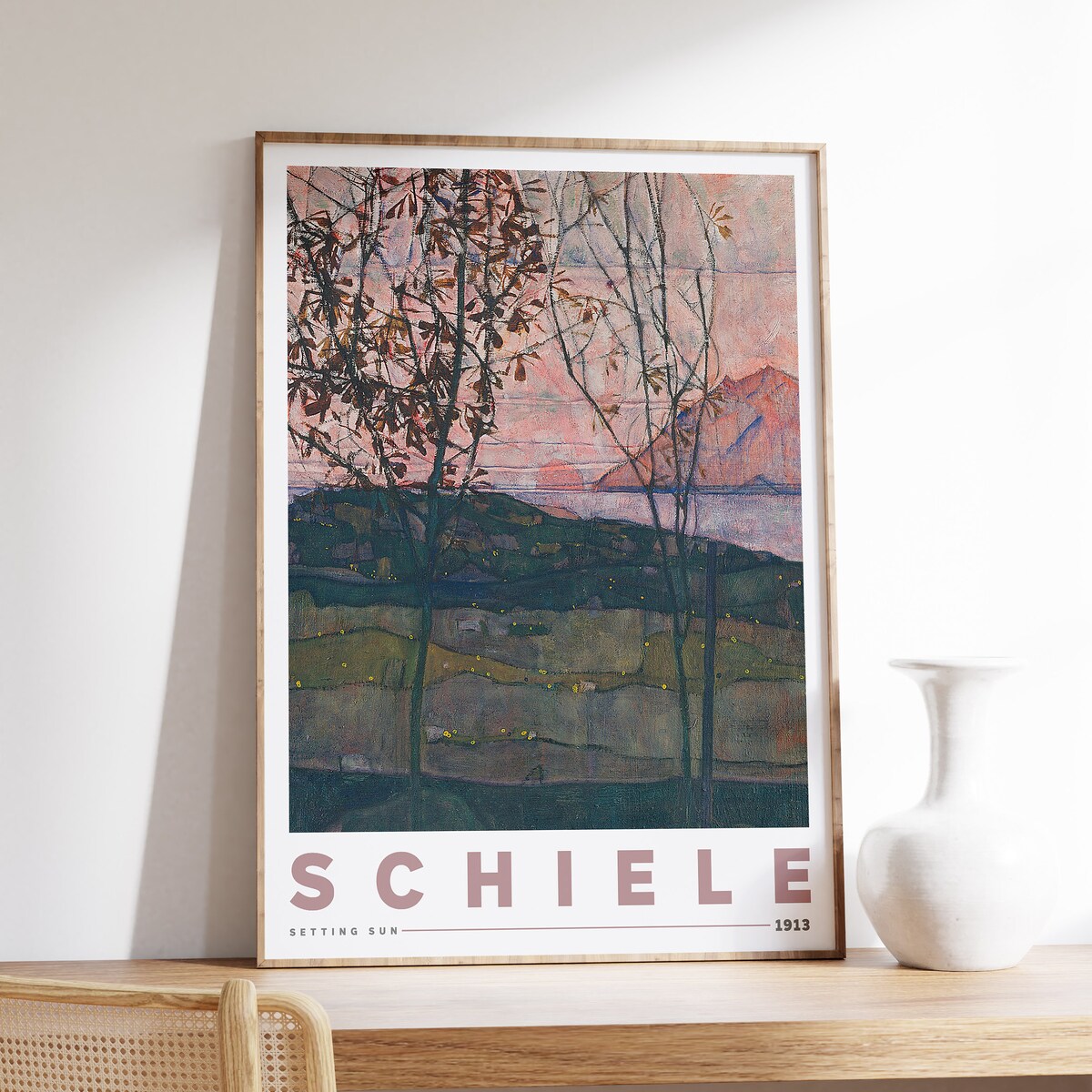
Though less lauded than his portraits, Schiele’s landscapes reveal the same surgical precision. Austrian countrysides and urban outskirts are rendered through the same spare vocabulary of line and reduced color, producing scenes that feel psychological as much as geographical. These landscapes compress dense emotional narratives into compact vistas, echoing what contemporary design might call maximalist scenery or eclectic decor. Yet rather than drowning the viewer in ornamental detail, Schiele channels intensity through tight composition and the tension he forges between figure and ground.
Beyond Decoration: The Image as Encounter
When translated into modern interiors, works by Egon Schiele resist the passive role of mere decoration. The phrase ‘Exhibition Print’ hints at the contemporary practice of converting gallery art into mass-produced wall objects, yet Schiele’s images refuse to smooth over their own psychological density. Instead, they demand engagement, provoking moods of unease, introspection, or even defiance within the space they occupy. A singular self-portrait or nude rendered in his unmistakable line can interrupt an otherwise harmonious decor, asserting its own uncompromising narrative.
This tension between aesthetic harmony and intellectual challenge lies at the core of Schiele’s ongoing relevance. Placing one of his prints into a room offers more than a visual focal point: it ignites a dialogue between comfort and confrontation, between the desire for beauty and the impulse to question it. Contemporary collectors who pursue modern wall art or quirky decor can find in Schiele a powerful counterpoint to design’s usual appetite for seamless integration. His stark forms and unsettling environments remind viewers that art has the capacity to provoke thought as well as please the eye.
Ultimately, the enduring pull of Schiele’s work stems from its fusion of technical prowess and moral inquiry. His command of proportion, composition, and the minimal means of line serve an expressive agenda: to treat the body as a site of truth, pain, and desire. His interiors and landscapes, stripped to their essentials, echo that inwardness with every spare detail. In a world often hungry for comfort and distraction, Egon Schiele remains a touchstone for art that challenges ease and invites us into an unvarnished encounter with the human condition.