WE ARE READY TO BRING YOU TOGETHER WITH ART %60 Discount
Odilon Redon’s Pegasus and the Hydra: Myth, Shadow, and Psyche
Historical and Stylistic Framing
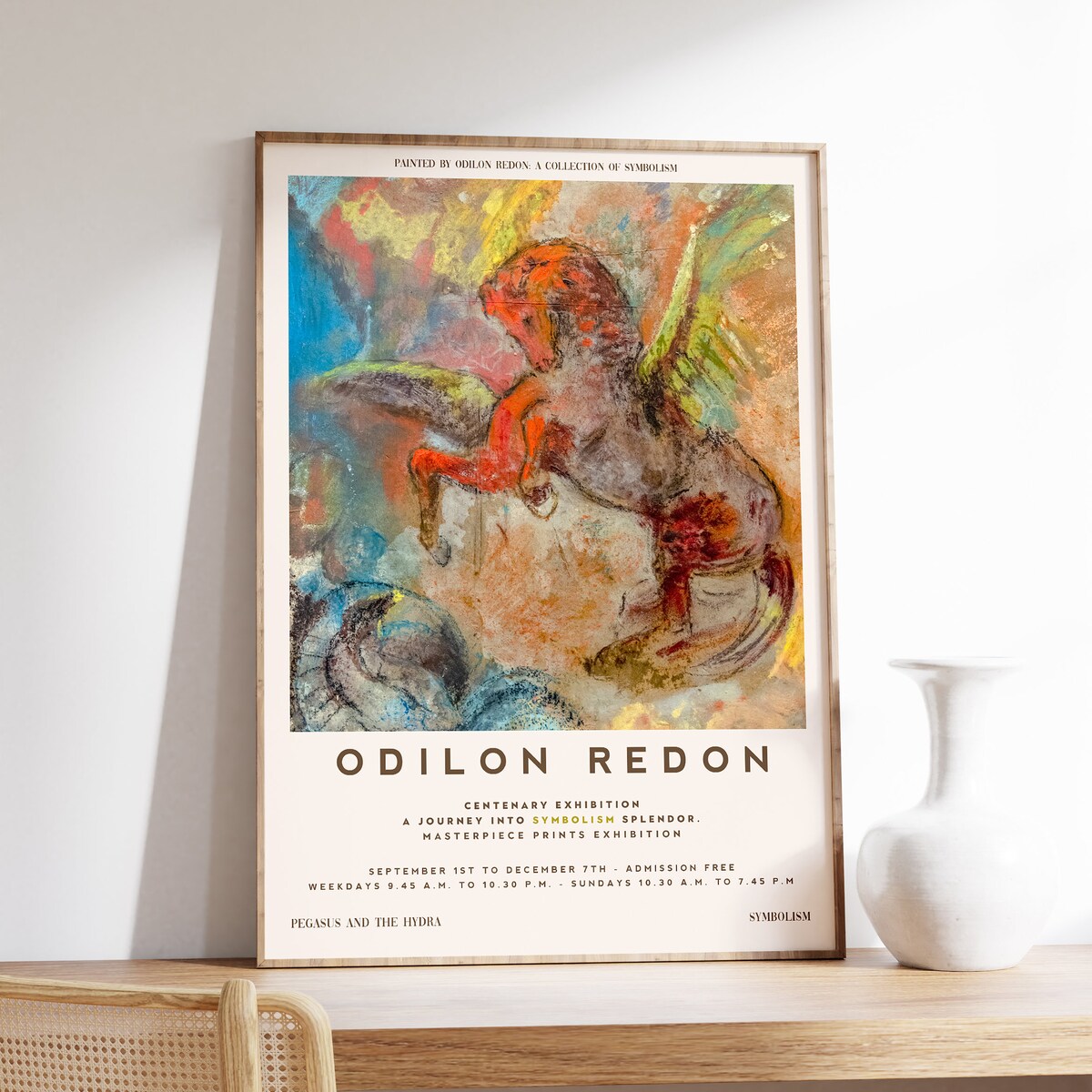
Odilon Redon has been celebrated as a leading figure of the Symbolist movement and his works often merge the poetic with the enigmatic. In his late period he delved deeply into the world of myth to articulate emotions that elude literal representation. The 1907 composition Pegasus and the Hydra exemplifies this turn to allegory in both subject and form. Through this work Redon channels dreamlike images into something at once beautiful and unsettling. His approach refrains from direct representation, favoring an evocative ambiguity that recalls the depths of the unconscious. Viewers are left to navigate the space between figuration and fantasy, discovering personal resonance in its mysterious forms.
Pegasus and the Hydra stands as a vivid example of Redon’s lifelong fascination with mythological narratives and fantastical motifs. The legendary winged horse and multi-headed serpent engage in a struggle that transcends mere storytelling, evoking the tension between creation and chaos. This tension reflects Redon’s enduring interest in the interplay of beauty, danger, and the unconscious. His choice of such subject matter underscores a late-symbolist preoccupation with emotion and inner life. The piece emerges as a nocturnal vision, deliberately untethered from literal narrative. Such emphasis on psychological mood situates Redon within a lineage of artists who valued introspection over factual depiction.
Within Redon’s broader oeuvre recurring mythic figures like Pegasus serve as touchstones for poetic inspiration and divine creativity. His career traces a path from monochrome noir pastels into rich, chromatic explorations, bridging the 1890s drawing traditions with early twentieth-century experiments in color and form. Critics have noted how this trajectory culminates in symbolically dense works that celebrate imagination rather than realism. Pegasus and the Hydra resonates as a synthesis of these interests in psychology and mythology. Art-historical sources often highlight this period as the peak of Redon’s symbolist vision. Institutional records frame it as a touchstone for understanding the transformative power of myth in visual poetry.
Formal Alchemy of Shadow and Silhouette
In Pegasus and the Hydra Redon’s mastery of line and silhouette becomes a conduit for atmosphere and emotion. The crisp contours of the figures stand out against a subtle, almost ethereal background that dissolves into tonal shades. This approach allows form to emerge and recede in a dreamlike manner, inviting the viewer to contemplate rather than to read a narrative. His controlled use of shadow imbues the scene with a contemplative nocturnal cadence. The muted transitions between dark and light embody a tonal harmony that feels both intimate and otherworldly. This subtle orchestration of hue and shade invites prolonged visual meditation.
Redon’s application of contour and shaded tonality operates like visual poetry, where the boundaries of form blur to suggest psychic depth. The placement of Pegasus in battle with the Hydra is not rendered with anatomical precision, but with an emphasis on dynamic gesture and mood. Each curve and silhouette seems charged with symbolic weight, turning a mythic tableau into a mirror of inner impulses. The resulting ambiguity speaks directly to the Symbolist aim of evoking rather than explaining. Rather than illustrate a specific moment in legend, Redon constructs a scene that seems to float between waking and dreaming. The resulting image operates less as a fixed story than as an open-ended symbol.
The interplay of positive and negative space in this work externalizes states of fantasy, fear, and wonder without recourse to literal detail. Redon’s atmospheric tonality creates a sense of boundless space, as if the scene unfolds in the recesses of dream consciousness. Silhouette and shadow become psychological instruments, guiding emotional response rather than offering a concrete storyline. In this formal alchemy, mythic subject matter transmutes into visual meditations on the unseen. His use of atmospheric veil echoes interior states more than the external world. This method aligns with the symbolist impulse to externalize intangible feelings through visual means.
Symbolic Resonance and Interpretive Depth
Symbolically, Pegasus and the Hydra enacts a profound metaphor for the creative struggle itself, with the winged horse representing divine inspiration and the many-headed serpent embodying irrational threat. This dynamic captures the artist’s awareness of the fragile balance between aspiration and chaos. By situating the struggle in a timeless, abstracted space, Redon invites reflection on the universal tensions of artistic endeavor. The mythic imagery thus gains a psychological poignancy that extends beyond its classical roots. This duality between aspiration and chaos reflects broader symbolist concerns with transformation and ambiguity. Redon’s deployment of allegory thus resonates across multiple dimensions of meaning.
Redon’s reliance on legendary motifs functions as a framework for exploring the metamorphosis of meaning, inviting viewers into a realm of introspection and spiritual inquiry. Far from mere illustration, each detail becomes a visual poem that speaks to the subconscious. The allegorical power of myth allows for multiple layers of interpretation, mirroring the complexities of inner experience. This quality secures Redon’s place among artists who sought to expand the language of representation. Myth in Redon’s palette becomes a catalyst for spiritual inquiry, prompting viewers to contemplate inner mysteries. Each glance reveals new layers, reinforcing the painting’s capacity for renewal in interpretation.
The dreamlike boundary between reality and imagination in Pegasus and the Hydra remains open to the viewer’s own associations and emotions. Rather than provide answers, Redon’s composition prompts a personal dialogue with the painting’s spectral forms. Its enduring appeal in museum catalogs and art histories attests to the lasting resonance of his Symbolist iconography. Through works like this Redon continues to blur the limits between the visible and the unseen, inviting us to traverse the landscape of the subconscious. The enduring power of these blurred boundaries continues to inspire contemporary conversations about the nature of perception. In this way the work remains alive in the collective imagination long after its creation.