WE ARE READY TO BRING YOU TOGETHER WITH ART %60 Discount
Peter Paul Rubens’s The Fall of Man: A Baroque Meditation
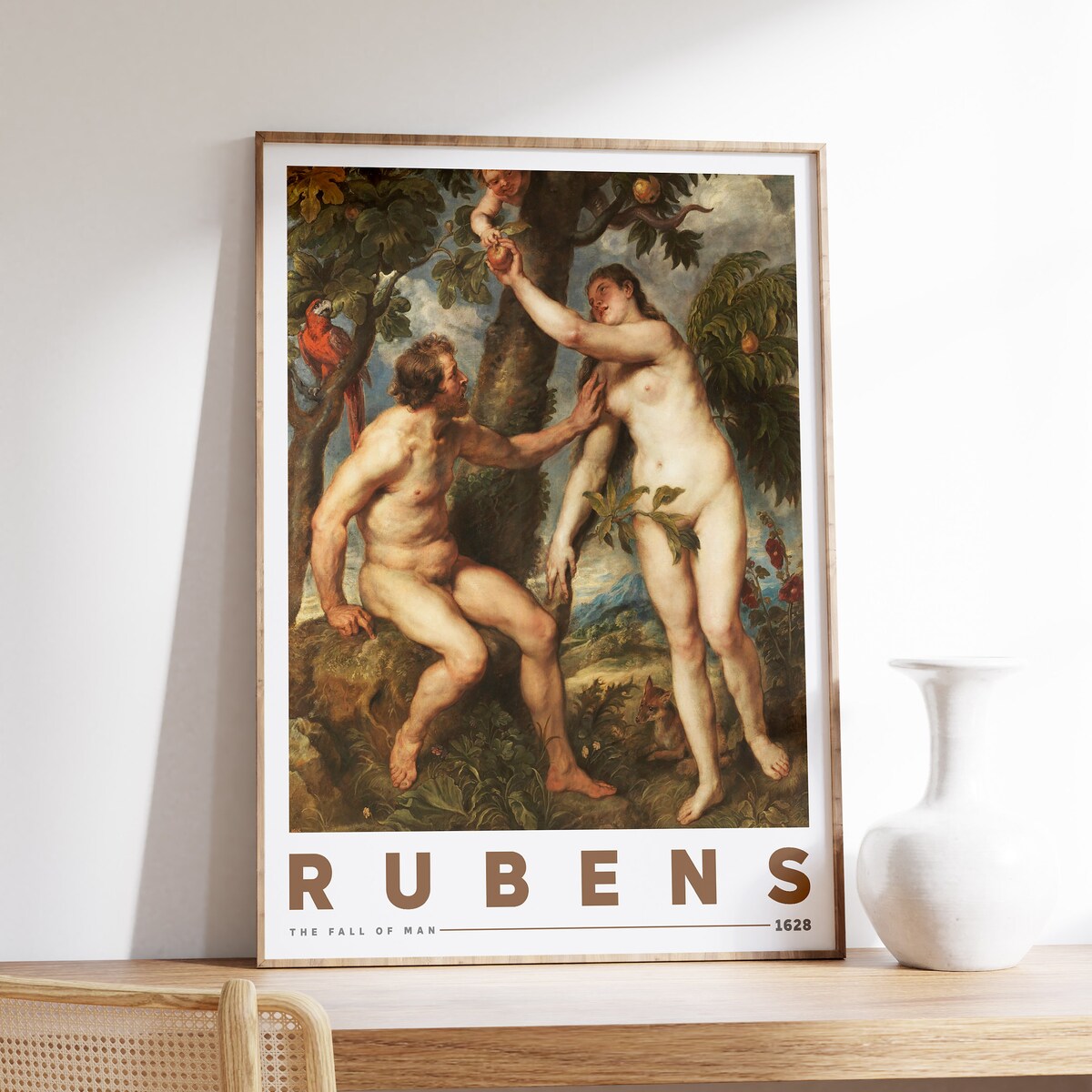
A Baroque Vision Shaped by Diplomacy
Rubens painted The Fall of Man in 1628–1629 during his early mature period following his diplomatic mission to Madrid. Commissioned amid the peace negotiations of the Dutch Revolt, this painting transcends a simple assignment and takes on a personal resonance. Liberated from strict patronage demands, Rubens infused the canvas with a synthesis of baroque drama, classical gesture, and attentive observation of nature. The experience of moving within court circles in Madrid clearly influenced his approach, lending the scene a charged tension. This moment in his career underscores how diplomatic ventures shaped Rubens’s artistic vision.
At the core of this work lies Rubens’s engagement with Titian’s model. He studied the Venetian master’s own Fall of Man, then boldly reinterpreted its composition, imbuing it with a more assertive visual rhetoric. Pronounced diagonals guide the eye from Eve’s inward glance across Adam’s contemplative posture, then onward into the lush foliage. In place of Titian’s subtler gestures, Rubens introduced muscular anatomy that heightens the narrative tension. His refined coloristic clarity further distinguishes this version, granting both figures and environment a luminous, sensorial presence. This dialogue with the Italianate tradition illustrates Rubens’s ability to absorb a master’s composition while stamping it with his own vivid Baroque vigor.
The Fall of Man exemplifies Rubens’s broader ambition to fuse Italian grandeur with Northern clarity. Every element—from the ornate vegetation to the charged interaction of the figures—testifies to his gift for translating epic narratives into visceral imagery. Its scale and painterly bravura matched the tastes of courtly patrons seeking both spiritual resonance and visual spectacle. Simultaneously, its emotionally accessible storytelling welcomed a wider audience of collectors beyond the courts. Through this work, Rubens affirmed his distinct brand of Flemish Baroque painting that could traverse borders while retaining unmistakable vigor.
Anatomy of a Diagonal Drama
Rubens organizes the canvas around a decisive diagonal that springs from the lower left and ascends across Eve’s measured arch, pausing at Adam’s contemplative pose before dissolving into the luxuriant greenery. This dynamic axis enlivens the scene, converting Eden from a static backdrop into an arena of narrative propulsion. His figures possess a sculptural weight, their muscular torsos and articulations conveying emotional stakes that reach beyond facial expression. The interplay of lines and forms guides the viewer through the drama, inviting an almost physical engagement with the moment captured. As a result, the composition feels both orchestrated and naturally unfolding.
Light plays a critical role in animating this biblical tableau. Rubens employs luminous highlights and deep shadows to sculpt flesh and fabric, creating a tactile experience of volume and space. His coloristic precision bathes the figures in warmth, while the surrounding flora shimmers with verdant vitality. A rigorous approach to tonal contrasts underscores the painting’s tension, balancing the sacred subject with tangible corporeality. This meticulous interplay of light and color invites a prolonged gaze, rewarding close inspection with ever-unfolding detail.
Intriguing animal life further enriches the composition’s immersive quality. A vibrant parrot, its plumage echoing the scene’s sumptuous tones, perches in the foreground like a silent witness to the unfolding transgression. Other creatures, discreetly nestled among the leaves, testify to Rubens’s fascination with the natural world and its symbolic potential. Through a lush, almost tactile rendering of Eden’s flora and fauna, the artist transforms paradise into a living environment teeming with potential beauty and peril. This tribute to nature’s abundance amplifies the poignancy of the impending Fall.
Temptation, Tenderness, and Theological Nuance
In this portrayal of the ancestral couple, iconography and emotion are intimately entwined. Eve emerges as both instigator and victim, her poised gesture capturing the fragile threshold between innocence and culpability. Adam’s contrapposto stance conveys a sense of resigned awareness, foreshadowing the cosmic rupture to come. Rubens accentuates this interplay through careful positioning and gaze, reminding viewers that the moment of choice carries both spiritual weight and human immediacy. Such an approach speaks to Rubens’s deep engagement with the moral dimensions of biblical narrative.
Beyond its spiritual resonance, The Fall of Man also reflects the artist’s adept navigation of patronage networks. Created during a period when Rubens regularly supplied monumental history paintings to courtly collections, it fulfills expectations for grandeur and moral gravity. Its eventual acquisition by Spanish patrons and placement in the Museo del Prado underscore the cross-cultural exchange at the heart of seventeenth-century art. As a devotional image and an object of aesthetic marvel, the painting bridges Northern and Southern sensibilities in a single, unified vision. Rubens’s workshop processes facilitated this dissemination, ensuring his Baroque ideals reached audiences across Europe.
The painting’s reception and scholarly lineage reveal the evolving practices of connoisseurship. Over time, debates about Titian’s influence, Rubens’s own innovations, and precise workshop contributions have shaped its critical standing. Technical analyses—ranging from pigment studies to stylistic comparisons—have confirmed its attribution and illuminated Rubens’s methods. Contemporary perceptual research further suggests that subtle cues in face and posture direct our attention in deliberate ways. Through these converging lines of inquiry, The Fall of Man remains a vital testament to the enduring resonance of Rubens’s baroque vocabulary.