WE ARE READY TO BRING YOU TOGETHER WITH ART %60 Discount
Gustave Doré’s Cain and Abel Offering Their Sacrifices: A Romantic Embodiment of Divine Judgment
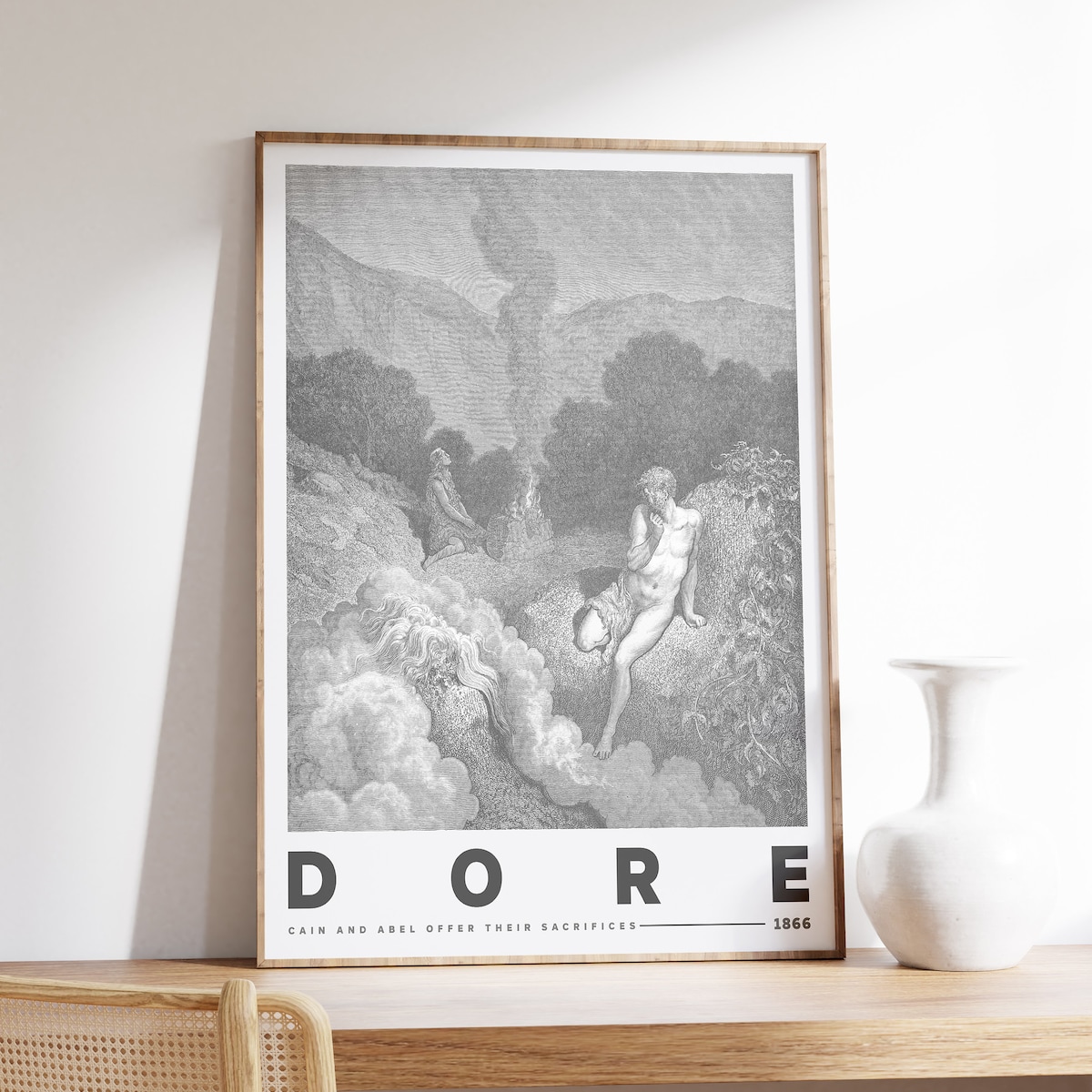
Origins and Context of Doré’s Biblical Vision
Gustave Doré emerged in the mid-nineteenth century as a towering figure in the realm of illustrated print culture. His dedication to the Holy Bible project during the 1860s resulted in a pantheon of engravings that aligned scriptural drama with Romantic fervor. Within that monumental initiative, his depiction of Cain and Abel finds its place among dozens of plates that anchor biblical text with visual intensity. Through this image, he sought not merely to narrate a chapter of Genesis but to imbue it with the weight of moral consequence and emotional depth. His sweeping narratives not only brought biblical tales to a broader readership but also helped define the aesthetics of an era that valued moral illustration. Doré’s capacity to intertwine narrative breadth with fine engraving detail secured his reputation among publishers who sought grandeur in accessible formats. As each new volume appeared, readers found themselves immersed in a world where text and image reinforced one another’s power.
Romanticism’s insistence on grandeur and moral clarity resonates throughout Doré’s work, and nowhere is this more evident than in the rendering of the first fratricide. By situating the brothers at the threshold of sacrifice, Doré amplifies the stakes of divine favor and human jealousy. The engraving leans on theatrical interplay of light and shadow to signal the tension between piety and anger. It is a dramatic stage in which Abel’s reverence and Cain’s inner turmoil are carved with almost operatic flair. The palpable tension that Doré carves into every face amplifies the sense of moral gravity, inviting observers to reckon with their own impulses toward envy and piety. His stylized use of light pulses like a beacon of divine scrutiny, illuminating some figures while casting others into foreboding gloom. This interplay creates an almost cinematic moment frozen in monochrome, yet bursting with ominous possibility.
At a time when wood engraving was the medium of choice for mass-market books, Doré’s workshop perfected a method of translating complex line work into reproducible plates. Each print could carry his vision into countless homes, shaping public perception of sacred stories far beyond the walls of the church. The traction of these images in both Europe and America helped cement a singular iconography for biblical scenes. Doré’s Cain and Abel thus became part of a shared visual language that bridged literacy, piety, and aesthetic ambition. In an age before mechanical reproduction, these engravings represented a pinnacle of artisanal collaboration, with Doré’s sketches handed to skilled engravers for faithful translation into block form. The final prints, whether bound in luxurious editions or included in more modest pamphlets, reached an audience that spanned from devout churchgoers to the literate middle class with a growing appetite for illustrated narratives. As such, Doré’s imagery functioned as both art and instruction, weaving together commerce, devotion, and literary culture.
Formal, Visual, and Material Analysis
Doré’s choice of wood engraving endowed Cain and Abel with a striking chiaroscuro that cuts across the scene with crystalline precision. The density of black ink contrasts sharply with negative space, lending depth to the figures and a weightiness to the narrative. Through finely incised lines and cross-hatching, textures emerge in fabrics, foliage, and rocky ground, creating a dynamic tableau of suspense. This technique underscores how his tools did more than replicate forms—they conveyed emotional undercurrents that words alone could not achieve. Unlike earlier methods, wood engraving permitted subtle tonal variation that steel or copper plates often failed to achieve with such crispness. Doré exploited the inherent contrast between wood grain and ink saturation, carving away material to guide the flow of light and shadow with daring precision. These decisions reflect an acute understanding of printmaking’s potential to evoke atmosphere even within the strict confines of black-and-white imagery.
In the composition, Abel stands in a tranquil posture, his offering a scene of stillness rendered in soft, glowing light. Opposite him, Cain is drawn with furrowed brow and tense shoulders, a visual harbinger of jealousy and rejection. Doré orchestrates a diagonal thrust from the earth to the sky, directing the viewer’s gaze toward the unseen divine presence. These compositional choices crystallize the moral bifurcation at the heart of the Genesis narrative, guiding our emotional response with every etched stroke. The positioning of the figures within a rugged landscape hints at their isolation from one another, reinforcing the narrative gulf that separates favor from rejection. Doré’s balance of human forms against vast, ominous skies instills a sense of cosmic scale that underlines the stakes of their offerings. Each turn of a line seems composed to maintain tension, never allowing the eye to rest on a purely decorative flourish but instead drawing it back to the moral center of the scene.
Smoke rises from Abel’s sacrifice like a silent herald of divine acceptance, while the sky above Cain remains shrouded in ominous shadow. Such atmospheric flourishes serve as symbolic punctuation marks, reinforcing the drama of acceptance and rejection. Doré’s tonal gradations—from the deepest ebony to the lightest grey—permit a dramatic sweep without losing legibility at the scale of a printed page. It is a testament to his mastery that these subtle shifts in shading can carry the full weight of moral drama. The subtle plumes of smoke become carriers of meaning, each wisp etched meticulously to suggest movement toward an unseen hand of fate. The dark sky above Cain, rendered in dense layers of cross-hatching, feels charged with potential violence, a silent witness to the tragedy to come. Doré demonstrates a rare sensitivity to atmospheric effect within the limits of engraving, using every grain of wood to conjure an emotional state.
Cultural, Symbolic, and Interpretive Implications
More than an illustration, Doré’s engraving operates as a cultural artifact that reveals nineteenth-century attitudes toward violence, judgment, and piety. Its circulation as a print for private devotion and public display blurred the lines between art object and religious teaching tool. Over time, this image lodged itself in the collective imagination, influencing later artists and collectors who encountered it in books, galleries, or online collections. The persistence of Doré’s iconography speaks to its ability to distill complex theological themes into a single, arresting composition. In private homes, these prints served as silent companions to prayer, prompting reflection on the dangers of envy and the virtues of humility. In public exhibitions and salon walls, they offered viewers a gateway into an art practice that mingled sacred subject matter with high aesthetic aspiration. Collectors prized the plates for their detailed execution, and their inclusion in catalogs ensured Doré’s reach extended into emerging markets for clerical literature and decorative arts.
At its thematic core, the scene of Cain and Abel crystallizes questions of moral causality that are still ripe for reflection. Doré invites viewers to contemplate the human cost of envy alongside the rewards of faithful offering. The psychological tension etched in the brothers’ faces transcends its scriptural origin, speaking to a universal drama of rejection and divine favor. Through this lens, the engraving becomes a mirror held up to the viewer’s own moral landscape. The stark dichotomy between the brothers underscores themes of justice and consequence that resonate far beyond biblical scholarship. Doré’s portrayal invites an intimate dialogue between the observer and the scriptural narrative, prompting questions about human agency when faced with divine decree. This capacity to transcend a specific religious context and evoke a broader human story reflects Doré’s ambition to speak to the emotional core of his audience.
In contemporary discourse, scholars and enthusiasts often place this work alongside Doré’s other biblical plates to trace continuities in style and substance. Comparisons highlight his unerring emphasis on expressive faces, dramatic diagonals, and a somber palette designed to evoke solemnity and awe. Even as later interpreters revisit the Cain and Abel story, they must reckon with the foundational visual grammar established through Doré’s expansive Bible illustration cycle. His ability to fuse allegory with palpable emotion ensures that this engraving remains a potent example of print-ready narrative art. Today, researchers examine these plates in museum catalogs and online collections, tracing the engraving’s stylistic hallmarks and its impact on subsequent artists working in ink and print. Discussions often highlight Doré’s pioneering use of dramatic diagonals that propel the eye and shape narrative tension. The image’s reproducibility allowed it to persist in postcards, calendars, and even stained glass designs, testifying to its adaptability across media.