WE ARE READY TO BRING YOU TOGETHER WITH ART %60 Discount
Exploring Henri Rousseau’s The Dream: Jungle Fantasies and Dreamscapes
Historical and Stylistic Framing
Henri Rousseau stands apart in modern art history as a self-taught painter whose work defied easy categorisation and earned him the labels primitive or naïve in the eyes of his contemporaries. His later jungle scenes, led by the vast canvas of The Dream, reveal an artist operating beyond academic training while engaging in an unspoken dialogue with the evolving currents of his time. This dramatic shift into lush, imaginary landscapes was the culmination of a lifelong fascination with observed nature, theatrical storytelling, and the allure of the unknown. The Dream itself remains a unique testament to his rare ability to blend meticulous craftsmanship with boundless imaginative energy.
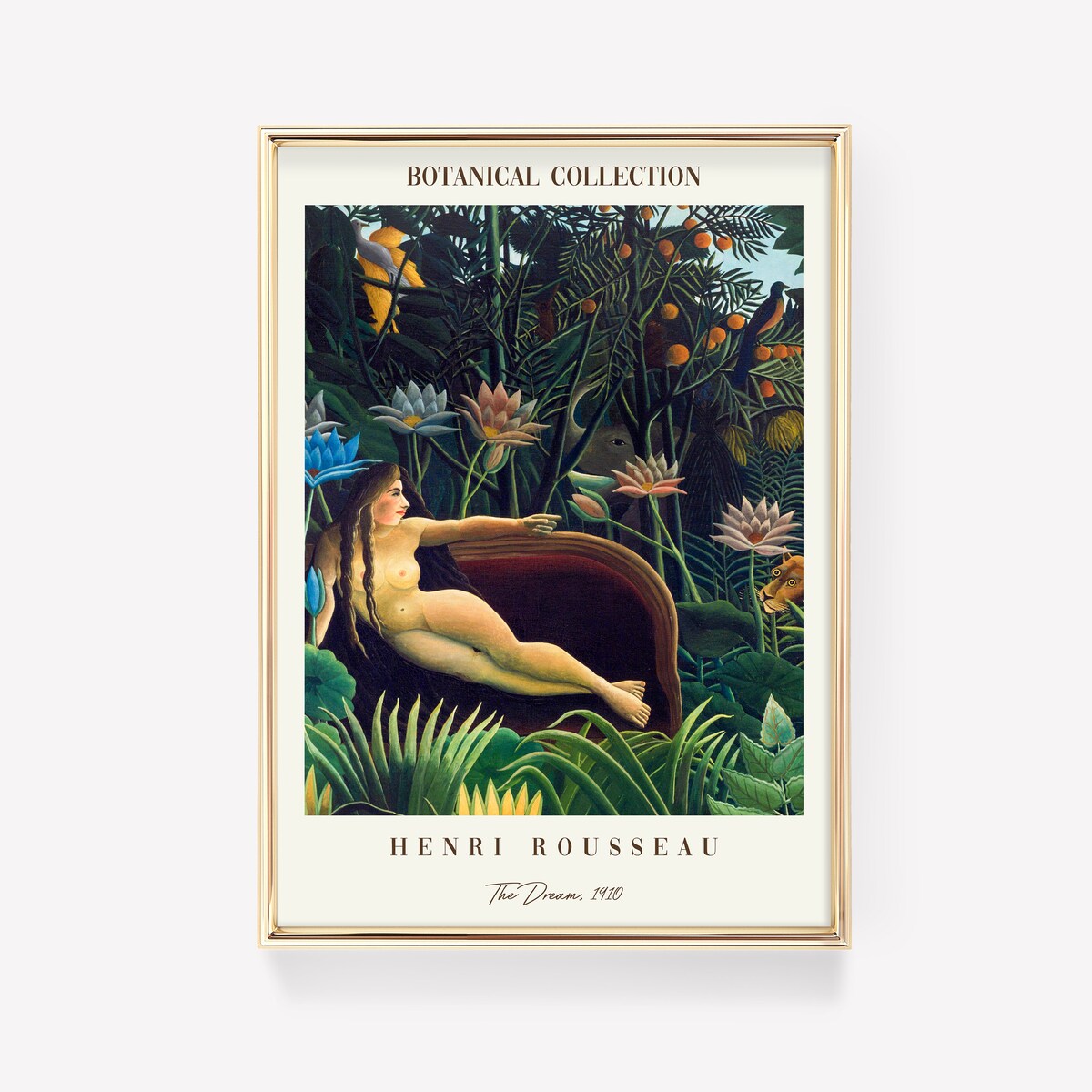
Although Rousseau had no formal academic grounding and never attended an atelier, The Dream demonstrates a sophisticated dialogue with contemporary art practices and emerging modernist currents. The painting pairs a sensually posed nude reclining on a sumptuous crimson sofa with a dense tableau of exotic flora and fauna, collapsing the comforts of domestic life with the spectacle of untamed nature. This deliberate juxtaposition of flattened depth and precise botanical detail gives the work a theatrical quality that both enchants and unsettles its audience. Such bold compositional choices and daring color harmonies signal a nuanced understanding of spatial rhythm, narrative potential, and the emotional power of visual contrast.
When it debuted at the Salon des Indépendants in 1910, The Dream initially drew mixed responses, as critics and viewers wrestled with its imaginative leap and apparent technical bravura. In time, however, this expansive canvas secured Rousseau’s reputation as a visionary precursor to the Surrealist and Symbolist interest in the subconscious. As his last completed work, it became a cornerstone for avant-garde creators drawn to dreamscapes and imaginative realism. Today, The Dream commands center stage in museum collections and scholarly discourse, where it continually provokes fresh debate and admiration.
Visual and Material Analysis
Rousseau’s vision unfolds through his distinctive flattening of perspective, which grants equal importance to every element on the canvas rather than privileging a single focal point. Leaves, vines, and fronds intertwine in sinuous patterns, their meticulously rendered veins and contours revealing an almost schematic precision. Amid this verdant labyrinth, lions, elephants, serpents, and exotic birds share the stage with a solitary human figure, creating a tableau that feels both intimate and uncanny. The careful balance of scale between figure and flora reinforces the dreamlike suspension of natural laws and invites the viewer into an otherworldly domain.
Color becomes a central actor in this nighttime scene, as lush emerald greens and deep sapphire blues contrast vividly with the rich warmth of a plush red sofa. Moonlight seems to drift through the foliage in soft silvery shafts, guiding the eye and heightening the palpable sense of nocturnal wonder. This carefully orchestrated lighting underscores the magic of the nocturnal universe while hinting at latent danger lurking just beyond the illuminated paths. The resulting composition feels choreographed, as if every tone, texture, and shadow were part of an elaborate stage direction.
Rousseau found inspiration in the era’s botanical conservatories and natural history exhibits, translating observed specimens into stylized forms that emphasize outline, pattern, and color contrast over classical depth. By incorporating these influences, he forged a visual lexicon that marries disciplined observation with a vivid schematic clarity unique to his practice. The Dream stands as the ultimate proof of concept for this approach, combining a precise botanical eye with the unbridled freedom of imaginative invention. The painting resonates as both a testament to technical rigor and a celebration of unfettered creative impulse.
Symbolic Resonances and Cultural Impact
At the heart of The Dream lies the figure of Yadwiga, a Polish acquaintance whose relaxed pose evokes echoes of both classical nudes and modern interpretations of the reclining form. Rousseau accompanied his painting with a brief inscription, guiding viewers to consider the scene as a crafted reverie rather than a literal tropical excursion. This invitation to view the work as a mediated dream underscores a psychological journey from intimate Parisian interiors to an imagined, almost mythic jungle. In that shift, the artist creates a space for exploration of desire, fantasy, and the abiding human impulse to escape into the unknown.
There is a marked tension in The Dream between sensual allure and underlying precariousness, as luxuriant foliage and vibrant blooms coexist with shadowy hints of latent threat. The natural world in this canvas both shelters and challenges the dreamer, weaving a fragile dialogue between safety and danger. This delicate balance of pleasure and unease marks Rousseau’s mature style and sustains the enduring mystique of the work. The painting’s potency emerges from its capacity to hold these conflicting currents in vibrant equilibrium.
Over the last century, The Dream has become a vital touchstone in debates over primitivism, orientalism, and the politics of visual representation. Its remarkable ambiguity allows for multifaceted readings, from celebrations of color and form to critiques of exoticism and colonial imagination. Institutions like the Museum of Modern Art preserve it as a cornerstone in discussions about the limits of representation and the power of the unconscious. In its lush narrative abundance, The Dream continues to invite fresh interpretation and reaffirms Rousseau’s singular contribution to the evolution of modern art.