WE ARE READY TO BRING YOU TOGETHER WITH ART %60 Discount
Winslow Homer’s Shore and Surf, Nassau: Light, Wind, and the Sea
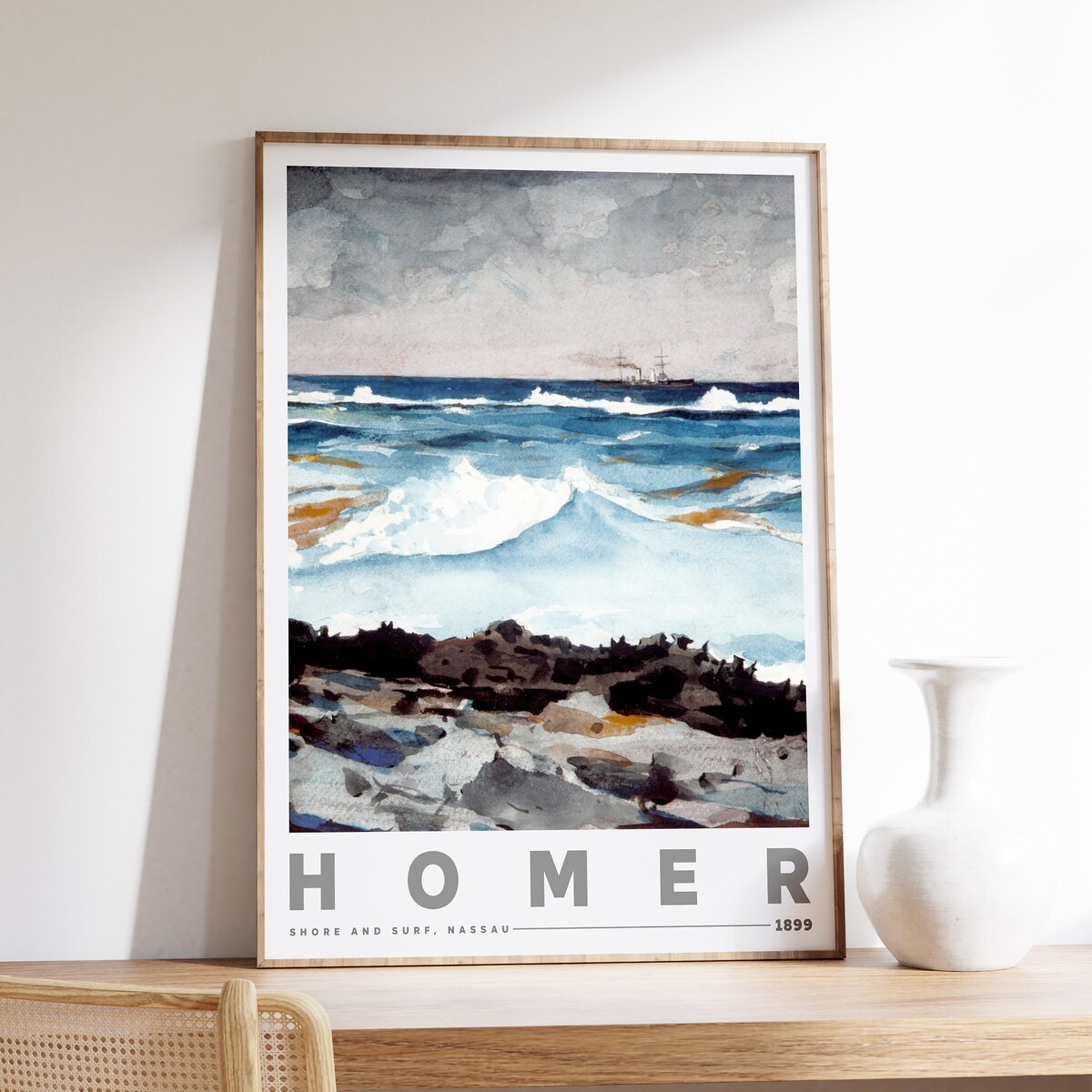
A Bahamian Sojourn Amid the Sea and Sky
At the close of the 19th century, Winslow Homer embarked on an excursion to the Bahamas during the winter months of 1898–1899. His arrival in Nassau marked a turning point in his oeuvre, inspiring a series of seascapes defined by a newfound tempestuousness. Rather than sentimental genre scenes, Homer immersed himself in the authentic interplay of light, wind, and water. It was in this marine-rich environment that he cultivated the dynamic mood that distinguishes Shore and Surf, Nassau.
Homer’s gaze shifted toward weather as a primary subject rather than a backdrop. In the Bahamas, sunlight filters through humid air and collides with sudden storms, an atmosphere that Homer sought to capture on paper. The blend of sky and sea assumed a theatrical quality, suggesting forces beyond human control. Shore and Surf, Nassau emerges from this context as an authentic expression of nature’s unpredictability and a declaration of Homer's mastery over mood.
Later in his career, Homer had already stepped away from narrative-driven genre scenes in favor of studies rooted in observation. This transition allowed him to focus on the raw energy of the sea and the subtle rhythms of wind and wave. Rather than illustrating a maritime tale, he constructed silent dramas through composition and tonal contrast. Shore and Surf, Nassau reflects this approach, inviting viewers to witness an unfolding moment rather than a staged anecdote.
Although Shore and Surf, Nassau currently resides in a major museum collection and is cataloged among its watercolor holdings, it is not always on public display. Its designation in the Metropolitan Museum’s archive underscores its value as part of Homer’s Bahamian legacy. Yet its absence from the gallery space only deepens its mystique, as scholars and enthusiasts turn to published documentation to explore its subtle nuances. This work remains open to interpretation through reproductions and catalog entries.
Watercolor, Graphite, and the Poetics of Medium
Homer selected watercolor complemented by graphite on off-white wove paper as his means of expression in Shore and Surf, Nassau. The delicacy of water-based pigment allowed him to render thin layers of translucent color while the graphite underdrawing lent precision to his forms. This marriage of media enabled a sense of immediacy, as if each brushstroke were shaped by the very breezes and tides he depicted. The paper’s texture enhanced both the fluid washes and the crisp lines.
A palette of delicate blues, green-tinged aquas, and pearl-gray highlights evokes the shifting depths and translucence of tropical waters. Homer built layers of diluted pigment to suggest both depth and surface agitation. Around the surf, foam-lit crests emerge through deft brushwork, capturing a moment between collapse and rebound. Each wave seems charged with latent energy, as though the viewer could feel its motion flicker across the paper.
The composition places the rhythmic surge of waves in the foreground, while the distant horizon remains flat and calm. Homer uses tonal variation to direct the eye from the churning shore toward the meeting of sea and sky. Shadows beneath swell formations anchor the viewer’s gaze before it moves to the subtle gradient of color where water touches air. This careful orchestration transforms an ordinary beach into a stage for elemental forces.
One intriguing detail is the small red hurricane flag planted near the shoreline, an understated yet potent historical reference. Nautical weather flags once communicated urgent information to mariners and beachgoers, warning of storms on the horizon. Homer’s inclusion of this symbol underscores his sensitivity to maritime realities, anchoring the work in a lived experience rather than a purely aesthetic recreation. It stands as a muted herald of the imminent tumult beyond the frame.
The Sea’s Quiet Drama and Sublime Resonance
Homer’s approach in this late work sidesteps overt drama yet resonates with emotional charge. In Shore and Surf, Nassau, the scene unfolds as a whispered drama, where the restless sea conveys tension without human figures. Composition and atmosphere carry the narrative, inviting contemplative engagement rather than sensational spectacle. The painting’s calm surface belies latent energy, creating a dialogue between tension and repose.
This mature synthesis of technical precision and contemplative emotion cements Homer’s reputation as a master of American marine painting. Every wash and graphite mark is purposeful, reflecting his confidence in translating nature’s subtleties onto paper. There is a quiet equilibrium in his handling of contrasting elements—air and water, light and shadow—that evokes the sublime in everyday scenes. Such measured balance rewards repeated study.
Beyond its aesthetic brilliance, Shore and Surf, Nassau navigates the boundary between serenity and threat. The distant horizon appears deceptively calm, while darker tones gather overhead, hinting at an imminent squall. This tension invites viewers to consider nature’s dual character: as both sanctuary and potential peril. Homer seems to revel in the ambiguity, presenting a scene rich in emotional undercurrents rather than straightforward storytelling.
Though not always on view, this watercolor continues to resonate with contemporary audiences. Its catalog presence in a major museum affirms its importance within Homer’s Bahamian explorations. Through digital reproductions and scholarly discussion, Shore and Surf, Nassau lives on as a testament to the painter’s late-career preoccupation with the sublime forces of nature. It prompts reflection on the fragile boundary between human observation and elemental grandeur.