WE ARE READY TO BRING YOU TOGETHER WITH ART %60 Discount
Winslow Homer's The Gulf Stream: Confronting the Sea's Edge
Mapping a Late-Career Vision
At the close of the 19th century Winslow Homer turned his gaze toward the warm currents of the Caribbean and Atlantic in a sustained exploration of maritime drama and human endurance. The Gulf Stream emerged in 1899 from studies made during a winter sojourn in Nassau and evolved through months of refinement after its debut at the Pennsylvania Academy of the Fine Arts. His late-career focus on themes of life, death, and resilience crystallized in this canvas, where observational precision merged with a deep conceptual inquiry. Homer's choice to revisit elements such as the vessel's broken form and the distant horizon speaks to a deliberate compositional pursuit rather than a singular flash of inspiration. In tracing this path from preparatory watercolors to the final oil monument, we witness an artist wrestling with existential questions about vulnerability beneath nature's immense forces. This mature synthesis of detail and subtle allegory marked a turning point in the narrative of American marine painting.
Over more than a decade, Homer gathered sketches and watercolors that charted shifting tides, storm-lit skies, and the play of light on restless waters across Florida, Cuba, and the Bahamas. Each study functioned as a building block in an evolving visual lexicon, informing not just the drama of The Gulf Stream but also the moral ambiguity that underlies its story. Rather than simply replicating a singular scene, Homer orchestrated a dynamic dialogue between field observation and painterly invention, allowing color and form to hint at larger existential concerns. The artist's approach refused simple explanation, insisting that some aspects of the scene elude literal description and instead engage the viewer's inference. In this way, the painting captures both a precise documentary impulse and a modernist willingness to embrace uncertainty. The result is a work that stands at the intersection of realism and open-ended allegory.
When The Gulf Stream reached exhibition in Philadelphia in 1900, it arrived as the product of successive revisions, each informed by critical reception and Homer's own evolving judgment. The relationship between the brooding oil canvas and its related watercolors reveals an artist deeply committed to viewing his composition as a living entity, one capable of growth and transformation. By refusing to lock the painting into a single version, Homer demonstrated that creative process and narrative tension were inseparable. Museum and curatorial catalogs underscore how these related field studies contributed to the painting's monumental status, emphasizing its roots in careful observation rather than spontaneous invention. This spirited studio practice lends The Gulf Stream its layered complexity, inviting repeated returns and fresh insights. In many ways, the painting became both a culmination of past investigations and a springboard for ongoing dialogues about the sea's moral dimensions.
Form, Color, and Motion in Turbulent Waters
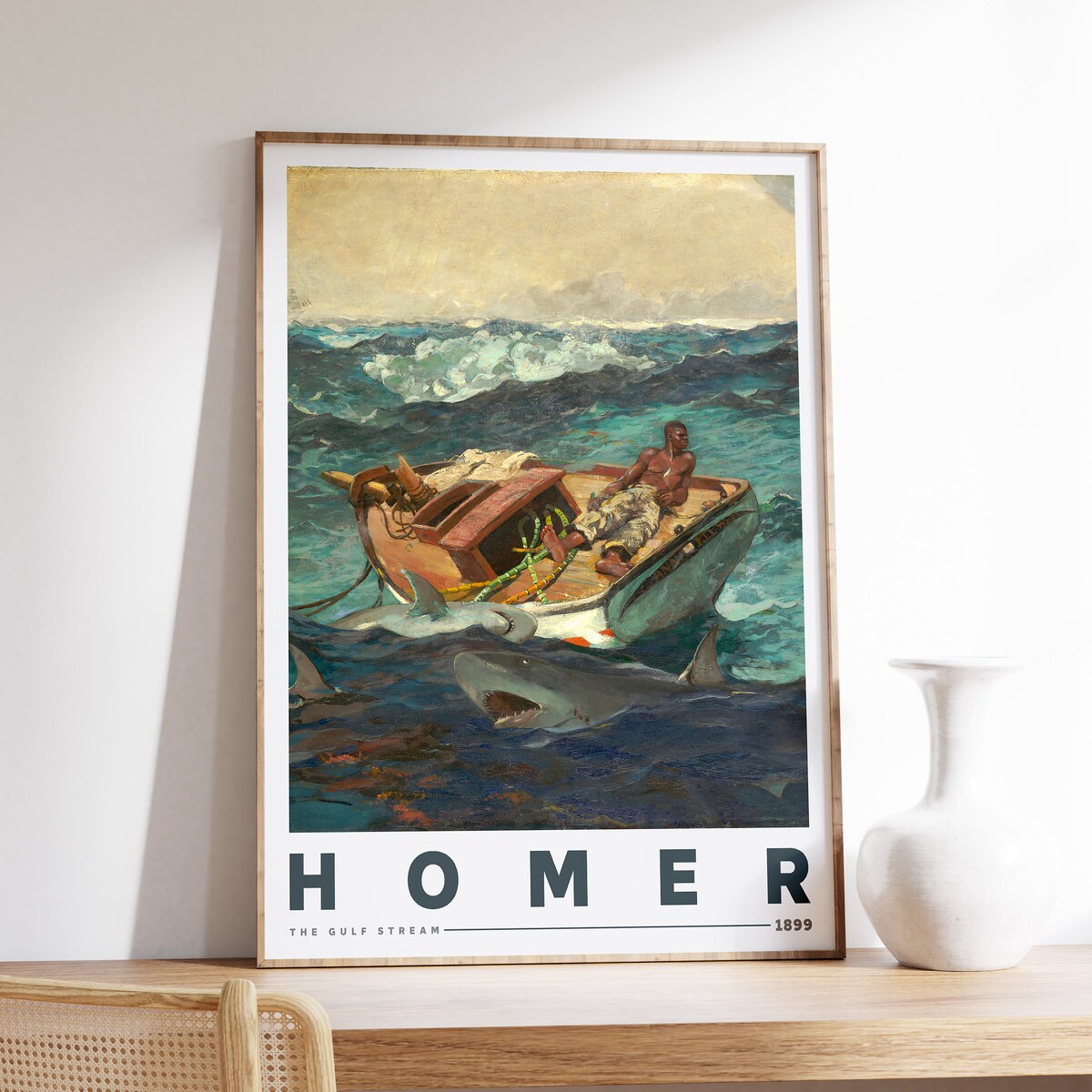
At the visual core of The Gulf Stream is a solitary figure adrift on a capsized boat, its broken mast serving as a stark emblem of sudden catastrophe. Homer's decision to render the vessel at an angular tilt thrusts the viewer into the fray, while the circling forms of approaching sharks reinforce an atmosphere of relentless peril. The horizon cuts across the canvas with almost cinematic precision, creating a taut frame in which sky and sea seem locked in silent contest. Turbid blues and greens swirl around the boat, their saturation shifting from cool depths to warm undercurrents that both attract and warn. Each hue carries emotional weight, inviting viewers to sense both the sea's beauty and its latent violence. This orchestration of color and composition exemplifies the painter's ability to convey narrative urgency without resorting to grand gestures.
The painting's surface is alive with textures that speak to Homer's mastery of oil on canvas. Thick impasto highlights the crests of waves, while leaner passages suggest the sea's foaming transparency. Brushstrokes vary from sweeping arcs to taut, stippled dabs, tracing the water's restless undulations and the vessel's fractured geometry in equal measure. Light strikes the scene unevenly, illuminating parts of the hull and leaving others in shadow, a technique that intensifies the sense of inescapable uncertainty. Shark fins slice silently from obscuring darkness, their presence suggested through minimal detail yet brimming with implied menace. In this interplay of tactile surface and spectral forms, Homer balances realism and expressiveness to evoke a moment of suspended dread.
Moreover, the stark contrast between the sky's luminous expanse and the sea's brooding depths underscores the painting's emotional charge, forging a silent yet powerful tension. The low, unflinching horizon frames the drama like a stage, while the solitary mariner occupies a visual fulcrum that holds the scene's narrative weight. Homer's angular composition and judicious use of negative space allow every element—boat, figure, sharks, and horizon—to resonate with equal intensity. Such formal decisions reflect his engagement with late 19th-century American realism and signal a broader turn toward modernist phrasing in marine art. By orchestrating structural rhythm and chromatic drama, the painting achieves a dynamic immediacy that rivals any theatrical production. Viewers find themselves not merely observing but participating in an unfolding story of survival and suspense.
Allegory, Ambiguity, and Enduring Resonance
From the moment we confront The Gulf Stream, the mariner's isolation becomes a conduit for our own contemplation of vulnerability in the face of nature's vast indifference. The absence of descriptive labels or captions invites a spectrum of interpretive possibilities, from a stark meditation on human frailty to a study of stoic resilience. Is this a heroic struggle for survival, or an allegory of abandonment and surrender to forces beyond comprehension? The broken boat and the lurking menace below refuse easy answers, crafting a moral ambiguity that remains compelling and unsettling. Each viewer is drawn into a personal dialogue with the scene, projecting fears, hopes, and narratives onto its restless surface. This open-ended quality has cemented the painting's place as a touchstone for questions about humanity's precarious position at sea.
Certain scholars have turned to the painting's social and racial dimensions, noting the central figure's identity as a Black man and the resonances this carries in America's postbellum era. Within this frame, the image becomes a potent commentary on labor, abandonment, and the precarious conditions faced by seafarers of color. The swirling currents, the fractured vessel, and the circling sharks can each be read as metaphors for systemic peril and unseen dangers that shaped the lives of many. Yet Homer himself resisted any single allegorical reading, insisting that some elements must remain uncapturable by words alone. It is this tension between formal precision and interpretive openness that invites ongoing dialogue about representation, spectatorship, and the broader cultural moment. Through its layered ambiguity, the painting remains both historically grounded and hauntingly universal.
Across debates of formal innovation, moral inquiry, and cultural resonance, The Gulf Stream endures as a seminal work in the narrative of American art. Its creation from field studies to a monumental oil canvas exemplifies a studio practice marked by reflection, revision, and a willingness to embrace uncertainty. The painting's layered textures, dynamic composition, and haunting color palette elicit not only a visceral reaction but also invite sustained reflection on resilience, destiny, and our relationship with the natural world. By oscillating between precise documentary detail and open-ended allegory, Homer opened a space where multiple truths can coexist, each refracted by individual experience. Its enduring presence in museum collections around the world attests to its capacity to engage viewers across generations. In the restless waves and fragile vessel, we continue to find both ourselves and the boundless sea.