WE ARE READY TO BRING YOU TOGETHER WITH ART %60 Discount
Egon Schiele’s Seated Woman, Back View (1917): Tension and Vulnerability
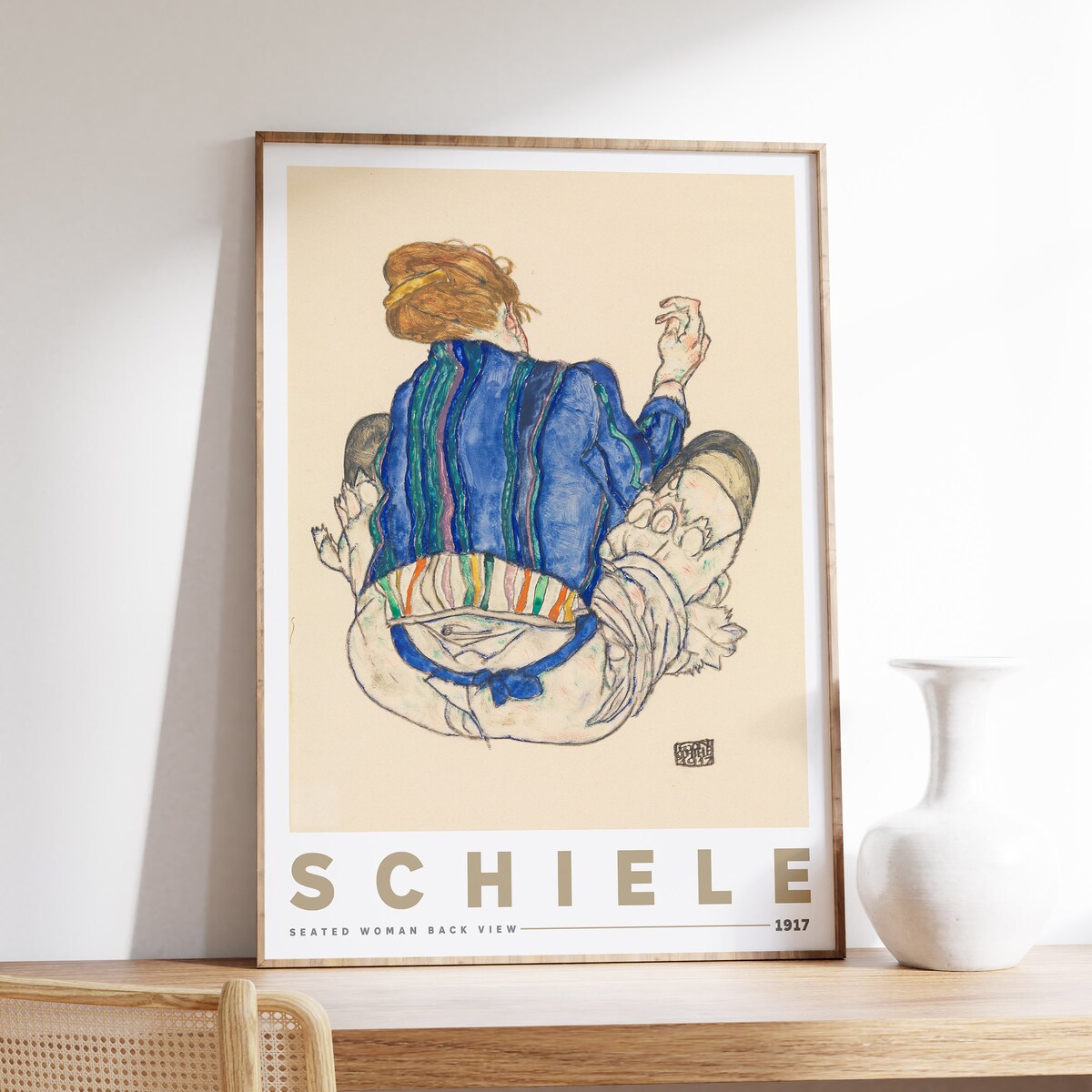
A Snapshot of Schiele’s Brief Expressionist Journey
In 1917 Egon Schiele had already carved a place within Austrian Expressionism through a string of works defined by stark emotional force and daring form. Despite his early death at twenty-eight, his output remained remarkably prolific, and Seated Woman, Back View emerges as a testament to the intensity of that final creative season. The drawing’s genesis coincides with a time of personal change for Schiele: two years after marrying Edith Harms, he turned to a model whose presence would fuse intimacy with his artistic probing. Through this view of his wife, the artist channels an interplay of affection and raw psychological insight. Hundreds of chalk and pigment studies inform the tension in the lines, bridging personal bond and expressive intent.
Here the choice to present a figure from behind transforms the portrait into an exploration of posture as language. Without a glimpse of facial detail, every curve of shoulder and spine stands in for emotion, and each diagonal or sweeping mark assumes the weight of unspoken thought. Schiele’s focus on gesture transcends mere representation, inviting the viewer to inhabit the quiet space beside the sitter. The bearing of the model becomes a vessel for psychological immediacy, and the omission of a face intensifies the dramatic charge that emanates from her poised form. In this way, the composition invites reflection on how bodies speak when words fall silent.
This drawing resides in public-domain collections of major museums, where its stark economy of means belies a generosity of expressive power. Though modest in scale, at roughly forty-six by thirty centimeters, it commands attention through austerity of composition and singular emotional resonance. Art historians and critics often cite this work when exploring Schiele’s negotiation of sexuality, social expectation, and artistic form. The piece underscores the tension that courses through his oeuvre: a push and pull between societal decorum and a candid embrace of erotic vitality. It is precisely this nuance in Schiele’s practice that continues to animate scholarly debate about the boundaries of propriety and the possibilities of uninhibited self-expression.
Materials, Lines, and the Language of Gesture
Measured at approximately forty-six point four by twenty-nine point eight centimeters, Seated Woman, Back View springs to life on paper through a synergy of watercolor, gouache, and graphite. The delicate grain of the support interacts with the fluid pigments, guiding the artist’s hand as he builds up areas of tone and shadow. Gouache lends moments of opaque brightness while the transparent wash of watercolor bathes the figure in subtle shifts of hue. Graphite lines, at once assured and tentative, carve the contours that hold the composition together. This material orchestration underscores Schiele’s mastery of surface, texture, and the delicate dance between pigment and paper.
Color in this work is selective yet potent: a striped jacket in vibrant tones punctuates the upper torso, juxtaposed against a white-striped shirt that recalls domestic tranquility. The deliberate contrast between the garment’s crisp patterns and the model’s bare limbs heightens a sense of exposure and concealment. Below the waist, Schiele drapes more provocative clothing, suggesting a tension between the private and the public, the visible and the hidden. Patterns become agents of mood, alternating between inviting warmth and elusive mystery. Each application of pigment feels calibrated to intensify the silent dialogue of fabric against flesh.
Line functions as both construct and revelation within Seated Woman, Back View. Bold, dark strokes outline the spine’s arch and shoulder blades, while subtler, fleeting marks trace musculature and skin folds. The gradations in line weight animate the figure, conveying movement even in stillness. Schiele’s hand hovers between restraint and abandon, evidencing a profound confidence in how a single mark can convey vulnerability. In these contours, the sitter’s emotional presence resonates long after the eye’s first encounter, inviting renewed scrutiny of the space between paper and impression.
Between Social Decorum and Erotic Suggestion
At the heart of Schiele’s Seated Woman, Back View resides a tension between societal norms and quiet eroticism. The partly dressed interior admits a glimpse of intimacy, yet it remains tempered by the sober discipline of line and wash. This duality captures the uneasy balance that characterizes many of Schiele’s works, where vulnerability becomes an expressive force. The figure’s modest pose avoids melodrama, yet her attire prompts a charged undercurrent of suggestion. Viewers oscillate between respect for decorum and an awareness of latent passion, a dynamic that continues to fascinate.
The stark delineation of flesh framed by carefully applied garments projects a sense of nakedness that transcends mere physical exposure. Through the interplay of pigment and paper, Schiele conjures a psychological landscape in which the sitter’s back becomes a site of introspection. Every shade and line contributes to the mood: the tension of muscles, the quietude of skin, the rhythmic patterns of fabric. It is in this convergence that vulnerability transforms into agency, as the sitter’s posture asserts both delicacy and strength. The work thus functions as an invitation to contemplate the narratives that reside within unspoken gestures.
More than a century after its creation, Seated Woman, Back View continues to provoke reflection on the boundaries of artistic representation. Scholars revisit this drawing when examining issues of sexuality and psychological depth, noting how Schiele’s vision anticipated later explorations of the self. Its public domain status has made it accessible to a new generation of viewers and makers, further underscoring its enduring resonance. The raw honesty of this back view speaks to the artist’s ability to distill complex emotions into the simplest of forms. In Schiele’s hands, line and gesture converge to reveal the profound human impulse to reveal and conceal in equal measure.