WE ARE READY TO BRING YOU TOGETHER WITH ART %60 Discount
Dancer On Stage by Edgar Degas: The Poetics of Ballet Behind the Curtain
Historical and Conceptual Frame
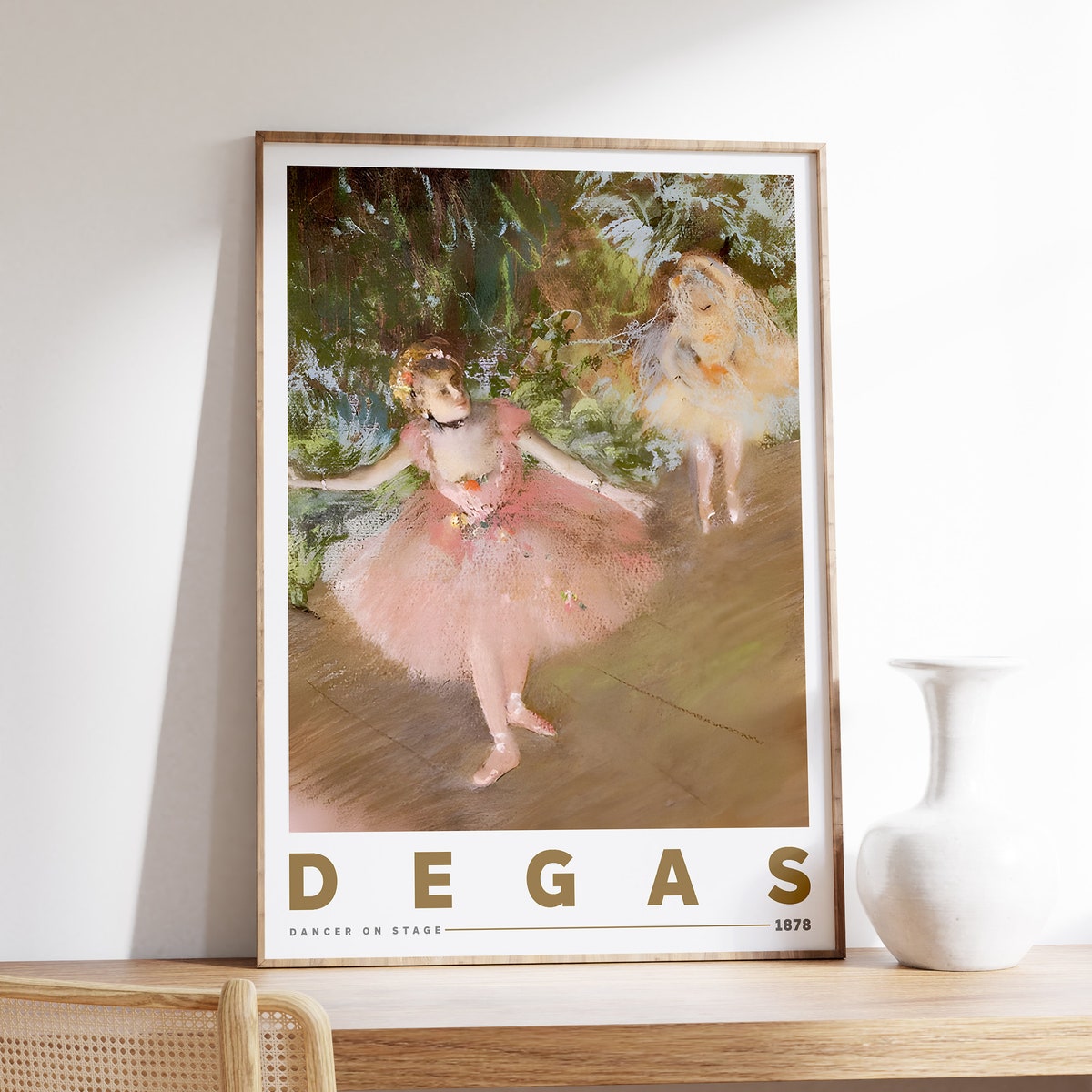
Throughout the later decades of the nineteenth century, Edgar Degas immersed himself in the world of the Paris Opéra, returning again and again to the ballet as a subject. In works like Dancer On Stage by Edgar Degas, he shifted his gaze from grand performances to the quieter rituals of preparation. This fascination spanned from the 1860s into the 1890s and marked a decisive evolution in his approach. Instead of celebrating a final display, he sought the intimate rehearsals and the labor that arbitrates between sweat and poise. By doing so, he reframed the stage as a site of latent potential rather than completed triumph.
Dancer On Stage exemplifies a mature phase in Degas’s career, one defined by a rigorous study of movement, light, and the human form in transition. Critics and admirers have dubbed him the painter of dancers, a moniker that speaks to his sustained inquiry into posture and the subtle gestures that convey inner states. In this painting, each angled arm and poised foot registers as a psychological cue, hinting at the efforts that underlie an effortless performance. Degas’s attention to the fleeting moment of stillness reveals his interpretive ambition, an ambition that balances naturalistic detail with a geometric sensitivity to line and silhouette. The result is a composition that feels both rigorously observed and quietly poetic.
Alongside his intensified focus on backstage moments, Degas engaged in an experimental rhythm across his oeuvre, alternating between intimate studies and more fully realized canvases. In Dancer On Stage, the frame captures a paused fragment of time, hovering between rehearsal and spectacle. The arrangement of figures and the careful calibration of space evoke a sense of choreography beyond the dancers themselves, as though the composition itself breathes and shifts. This dynamic interplay reflects his pursuit of a nuanced visual language capable of conveying both physical exertion and sculptural grace. By prioritizing the generative hush before performance, Degas foregrounds the generative energy often overlooked in classic ballet imagery.
Formal and Visual Analysis
One of the most arresting qualities of the painting lies in the way stage light sculpts the dancers’ bodies, carving out contours of muscle and fabric with laser precision. Degas’s rendering of illumination shows an acute sensitivity to artificial lighting, as beams from above and from the wings catch tutus and limbs in a chiaroscuro interplay. These patches of brightness become volumes of energy that pulse against deeper shadows, suggesting movement even in stillness. The interplay of light and dark transforms the dancers into living sculptures, every curve and angle emphasized. In this study, light is not mere decoration but an active participant in the drama on display.
Executed in oil on canvas, Dancer On Stage exhibits the hallmark traits of Degas’s late-era technique: a cool observational distance paired with compositional clarity. Each brushstroke seems measured, yet the overall effect is alive with tension, as if the scene could resume motion at any instant. The precision in capturing shifting weight and angular limbs bespeaks his near-scientific approach to anatomy and posture. At the same time, Degas allows for loosely brushed passages that evoke the glow of backstage haze and the ephemeral nature of movement. This blend of meticulous observation and painterly freedom situates the work at the intersection of realism and impression.
Degas’s eye for geometry reveals itself in the careful arrangement of lines and silhouettes, where diagonal limbs meet vertical struts of the stage set. Each figure is poised in a deliberate posture, forming triangular compositions that guide the viewer’s gaze across the canvas. The crisp delineation of tutus against the dim backdrop amplifies the sense of space, while subtle shifts in perspective create a feeling of depth and immediacy. These formal choices lend the painting a cinematic quality, as though we have stepped into a frozen frame of a larger performance. Through this architecture of shapes, Degas invites us to contemplate the tension between stillness and motion inherent in dance.
Cultural and Symbolic Resonance
Beyond its formal achievements, Dancer On Stage resonates as a meditation on the rhythms of modern life and the labor woven into every artistic achievement. Degas’s focus on rehearsal spaces and backstage corridors illuminates the unseen exertions that precede public display. In doing so, he transforms ballet into a microcosm of broader social dynamics, where discipline and repetition give rise to fleeting moments of beauty. His portrayal of dancers at work reminds us that mastery unfolds in countless private moments rather than in the applause of the audience. This near-clinical yet empathetic perspective elevates the backstage realm to the status of a stage in its own right.
The painter sidesteps the melodrama of triumph and instead lingers on the hushed tension before the curtain lifts, offering a candid counterpoint to the idealized bravura long celebrated in performance imagery. Here, the atmosphere is thick with anticipation: bodies are rehearsing, mirrors reflect subtle corrections, and the slightest breath seems charged with intent. Degas captures this breathless pause with all of its contradictions, blending intimate observation with spatial clarity. The result is an image that feels both personal and universal, a portrait of dedication that speaks to the human cost of perfection. In every compressed gesture, there is a story of aspiration and self-discipline.
In its final register, the painting invites reflection on the politics of representation and the visibility of work behind the spectacle. By highlighting the backstage environment, Degas encourages viewers to consider what is seen and what remains hidden in any performance. This dual focus on individual physicality and atmospheric conditions aligns with his belief that true insight lies in transitional moments rather than in the polished finale. Through a careful calibration of light, form, and space, Dancer On Stage becomes a testament to the resilience of human endeavor and the poetry of unseen effort. It stands as one of his most exacting studies on how movement, light, and will converge to shape our perception of modern life.