WE ARE READY TO BRING YOU TOGETHER WITH ART %60 Discount
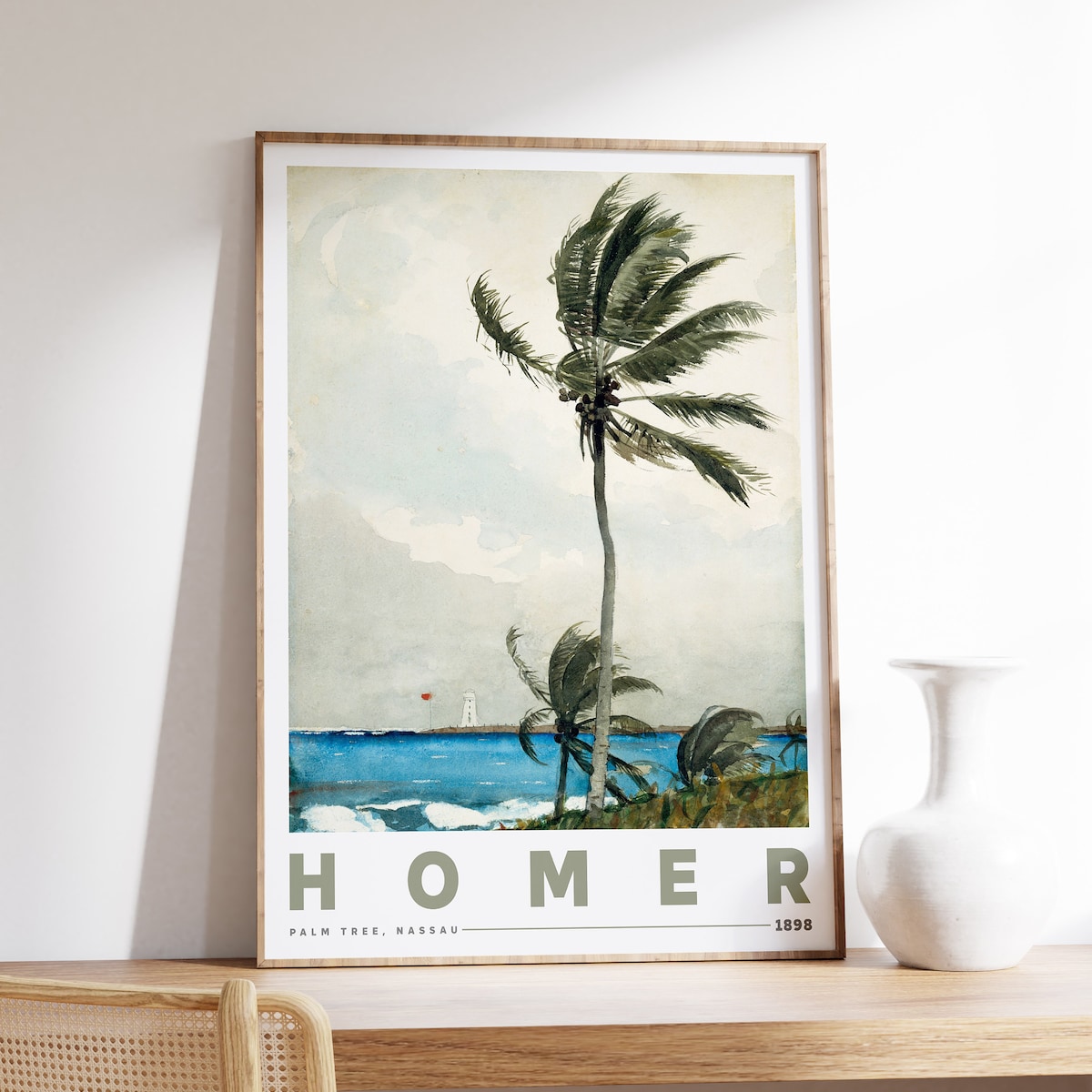
Winslow Homer’s Palm Tree, Nassau: A Tropical Drama in Watercolor
Historical Horizons of a Tropical Vision
In the closing years of the nineteenth century Winslow Homer ventured beyond familiar shores to the Bahamas, drawn by the promise of tropical light and the unpredictable drama of weather systems. His time in Nassau opened a new chapter in his career, as he wrestled with the challenge of capturing ephemeral gusts and shifting clouds on paper. The result was a series of watercolors that embrace a sensibility both observational and inventive, translating meteorological impulses into delicate compositions. Among these works, Palm Tree, Nassau emerges as a keystone, marking a turning point where atmospheric nuance became the subject itself.
Painted in 1898, this watercolor and graphite on wove paper belongs to a period when Homer’s curiosity turned decisively toward storm-driven narratives rather than conventional maritime idylls. He traded the calm bustle of coastal harbors for the elemental tension between land, sea, and sky, seeking moments when nature’s forces threatened equilibrium. The tall palm at the center of this study stands not merely as a botanical feature, but as a sentinel caught in the breath of tropical winds. Its prominent trunk and arching fronds anchor the composition, offering a vertical counterpoint to the horizontal sweep of sea and sky.
Palm Tree, Nassau is often discussed alongside other Bahamian works like Shore and Surf, Nassau, yet it holds its own through the simplicity of its design and the intensity of its atmospheric drama. Homer’s choice to isolate a single tree against a restless backdrop signaled his intent to make nature the protagonist. Rather than treat weather as scenery, he elevated it to a dramatic agent in its own right. In this way, his Nassau watercolors presage the hurricane-inflected scenes that would later become emblematic of his late seascapes.
Material Mastery and Visual Drama
A close look at the technique reveals Homer’s deft command of watercolor merged with the precision of graphite. The paper’s off-white tone peeks through the pigments, lending a luminous quality to the sky and sea. His brushwork in Palm Tree, Nassau is brisk yet controlled, suggesting wind and motion with minimal strokes. The resulting surface shimmers with life, as if the sea breeze itself has ruffled the pigment.
The painting’s vertical format sets the stage for a dynamic dialogue between the solitary palm and the surrounding elements. Homer’s use of color is both restrained and vivid: gentle blues and grays for the sky give depth to a scene that is anything but static, while the greens of the palm convey resilience amid atmospheric unrest. A striking red pennant flutters near the tree’s crown, a discreet yet potent symbol of tropical storms. This flash of red becomes a visual signal, inviting viewers to imagine the rising tensions of an approaching squall.
Graphite lines underscore the palm’s structure, tracing the ridges of its trunk and the angles of its leaves with deliberate clarity. This subtle combination of drawing and paint reveals Homer’s late-career pursuit of formal clarity, tempered by his fascination with changing light. The broad strokes in the sky and sea contrast with the fine linear work in the tree, creating a tension that mirrors the very subject he depicts. Through this interplay, the viewer senses both the fragility and the force at play in a tropical landscape.
The Poetry of Weather and Perception
Beyond its formal achievements, Palm Tree, Nassau invites contemplation of how weather shapes our experience of place. Homer seemed obsessed with the emotional charge of meteorological phenomena, as though a wind-whipped cloud or a sudden squall held narrative potential. In isolating a single palm beneath a roiling sky, he distilled a universal drama of suspense and calm. This concentrated focus transforms an ordinary landscape into a moment of heightened awareness.
The red flag or pennant in the composition carries symbolic weight, often read by scholars as an homage to the signals used at coastal outposts to warn of storms. By integrating this discreet marker, Homer added a subtle narrative thread, suggesting the ever-present risk of nature’s fury. The palm tree itself stands as a testament to resilience, its form bending but not breaking under unseen forces. Viewer and tree alike become witnesses to an unfolding tension, united by shared exposure to the elements.
In the sweep of Homer’s oeuvre, his Nassau period has garnered renewed interest for its embrace of light, color, and sensory immediacy. Palm Tree, Nassau encapsulates his ability to weave natural phenomena into studies that are at once rigorous and evocative. The painting resonates with contemporary audiences because it captures a universal fascination with weather’s power to shape mood, memory, and meaning. In this way, Homer’s tree transcends its tropical setting, speaking to the perpetual dialogue between form, light, and the capricious hand of nature.