Bruegel - The Tower of Babel (1563): The Painting Behind the Spiral
If you searched 'Bruegel - The Tower of Babel', this is the painting. A near-square panel, roughly 114 by 155 centimetres of oil on oak wood, painted in Antwerp around 1563 by Pieter Bruegel the Elder. The composition is dominated by a single enormous tower under construction: a spiraling stone ramp that climbs through eight finished levels and disappears upward into a ninth still being cut from the bedrock outcrop the tower is built on. Thousands of tiny figures swarm the structure. At the base, the king Nimrod arrives with his court and a row of stonemasons kneels to receive him. At the top, the highest finished tier disappears into a low ceiling of clouds. The painting reads as a single architectural object placed at the centre of a panoramic Flemish landscape.

Bruegel painted two versions of the subject within a few years of each other. The one shown above is the larger Vienna panel of 1563, the canonical 'Great' Tower of Babel and the one almost every visitor and reproduction reaches for. A second, smaller version (the 'Little' Tower of Babel) was painted around 1568 and now sits in a Dutch collection; it shows the same spiraling tower with a darker palette and no figure of Nimrod. The 1563 panel is the painting in print here.
What the painting shows
The subject is the story from the eleventh chapter of Genesis: after the flood, the descendants of Noah migrate east, settle on the plain of Shinar, and decide to build a tower 'whose top may reach unto heaven' so as not to be scattered across the earth. God, watching, decides to confuse the builders' language so they can no longer understand each other. Construction stops. The unfinished tower stays unfinished. The peoples scatter to the edges of the world, each speaking a separate tongue. Bruegel paints the moment just before the confusion: construction is still in progress, but a small group of clouds has already gathered at the upper-right corner and the king at the base is being met by a kneeling court whose body language reads as ill-omened. The painting is therefore not a scene of catastrophe; it is a scene of arrogance about to be interrupted.
Bruegel structures the tower as a single ramped spiral around a central core, with each tier visibly older and more weathered toward the bottom and the upper tiers still raw stone. The construction process is shown in extraordinary detail. Cranes lift dressed blocks from the base. Workers carry baskets of mortar up the ramp. Hoists lower scaffolding around the central drum. A row of arches at the front has not yet been faced with cut stone and the rough rubble core shows through. Bruegel had visited Rome about a decade earlier (around 1552-1554) and the Colosseum's stacked-arch elevation is the visual model: the same ring of arches, repeated and stretched into a spiral. The tower is therefore both biblical Babylon and contemporary Antwerp's nightmare of building Rome over again.
At the bottom-left, Nimrod, the legendary king who ordered the tower built, arrives on foot in royal robes with a small retinue and a sceptre. A line of about a dozen stonemasons kneels in front of him in a row, hats off. The encounter takes up almost no space on the panel but the whole composition is balanced around it: Nimrod and the kneeling masons sit at the painting's lower-left vanishing point. The rest of the panel (the city, the harbour, the distant countryside, the small village in the lower-right corner) is built around that single ground-level human exchange. The tower may be huge but the painting is also about a man and a row of workers in front of him.
How the painting was made
The Tower of Babel is oil on oak panel: thin layers of oil-bound pigment painted on a smooth chalk-and-glue ground laid over Baltic oak. Oak panel was the standard support for Antwerp and Flemish painters of the sixteenth century, displacing the older tempera-on-poplar Italian tradition; Bruegel inherited the panel-painting workshop technique directly from his teacher Pieter Coecke van Aelst. Oak holds detail better than canvas, takes oil paint without warping, and allows the painter to build up small areas (a tower window, a tiny figure, a single horse) in a few thin passes of high-saturation pigment.
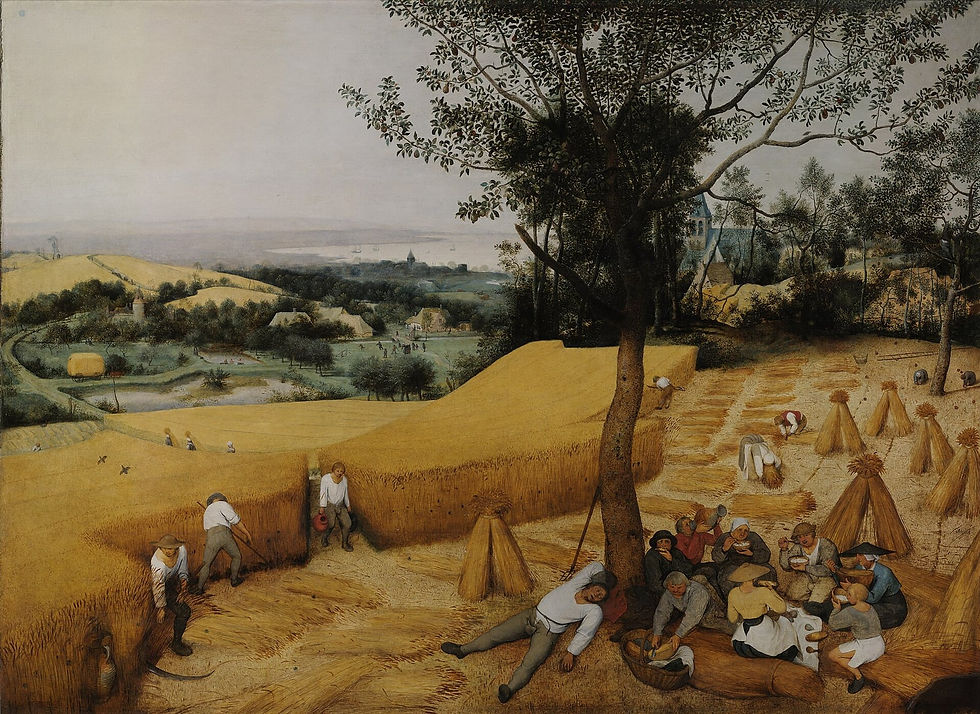
The Harvesters, shown above, was painted two years after the Tower of Babel and is the natural narrative pair within Bruegel's mature output. Both panels are roughly the same size (about 115-120 cm tall by 155-165 cm wide), both are oil on oak, both centre a single human activity (tower construction; wheat harvest) inside a vast panoramic Flemish landscape that recedes through fields, villages, harbours, and waterways to a distant blue horizon. The Harvesters is from Bruegel's six-panel Seasons cycle of 1565, of which five panels survive; it represents the late summer / early autumn months and is the most iconic landscape in the cycle. The two paintings hung together create the same effect as Bruegel's whole mature programme: tiny human acts inside an enormous world.
Reference scans now used for fine-print reproductions of both paintings are taken from the late-twentieth-century post-restoration master photographs in publicly accessible digital archives. The Tower of Babel's restoration restored the muted ochres of the tower stone, the deep mineral blue of the harbour water at the lower-right, and the soft golden haze of the Antwerp-style sky behind the cloud-line at the top.
Why a tower
The Tower of Babel was an unusually loaded subject in 1563. Antwerp was at that point one of the largest and richest cities in Europe, with a population of around 100,000 (only Paris and Naples were larger), a flood of foreign merchants speaking dozens of languages on its docks, and an ongoing building boom in the new town hall, the Bourse, the cathedral spire, and the city walls. The biblical Babel was an obvious mirror: a single huge construction project, undertaken by a city of mixed tongues, on the assumption that organized human labour could reach indefinitely upward. The painting works simultaneously as a Genesis illustration and as a contemporary Antwerp commentary, and it was commissioned and bought by Antwerp merchants who could read both layers at once.
The biblical reading is the official one: pride, divine intervention, the scattering of the peoples. The contemporary reading is harder to pin down but it is clearly there. Bruegel's tower is built well, with care, by skilled workers who are visibly proud of it. The painter does not show them as caricatures or sinners. He shows them as the same Flemish builders he could see at work on the Antwerp cathedral spire from his studio window. Whatever moral the painting was meant to deliver, the painter sympathises with the labour.
Bruegel in 1563
Pieter Bruegel the Elder was in his mid-thirties when he painted The Tower of Babel. He had trained in Antwerp with Pieter Coecke van Aelst, had spent about a year travelling through France and Italy in the early 1550s (returning across the Alps, which gave him the panoramic mountain horizons that anchor most of his later landscapes), and was at this point working in Brussels for a wealthy Antwerp merchant collector named Niclaes Jonghelinck. Jonghelinck owned sixteen Bruegel paintings by 1566, including this Tower of Babel and (later) all six Seasons panels. The 1563 panel was therefore not a public altarpiece or a churchgoing image; it was a domestic commission for a private collector's house, designed to be looked at close up and pored over for an hour at a time.
Bruegel died in 1569, around forty years old, of an illness whose exact nature is now unknown. He left a small body of work (about forty-five surviving panels), an enormous influence on later Flemish landscape and genre painting (his sons Pieter the Younger and Jan made copies and original works in his manner for the next several decades), and the Tower of Babel as one of the most reproduced Genesis paintings in Western art.
Available as a fine print
The Tower of Babel is available as an archival fine print in the ZocineArtDesign shop. Each print is colour-matched against the post-restoration reference (the muted ochres of the tower stone brought back; the soft golden haze of the Antwerp sky read against modern archival paper) and printed at scale on a heavy archival stock. View the listing here.
Direct link: zocineartdesign.etsy.com/listing/1096167092
How to hang this print
The Tower of Babel is a near-square panel with a complex centre-of-gravity sitting slightly above the midline (the upper finished tiers of the tower) and a deep recession into landscape distance. The hanging logic follows that strong central architectural axis.
Wall colour: warm off-white, soft cream, or a pale putty grey. The muted ochres of the tower stone sit beautifully against any warm light wall and the sky's golden haze reads true. Avoid pure cold white (which fights the warm ochre palette) and avoid deep dark walls (which swallow the tower's stonework detail).
Frame: a slim natural-wood frame (oak, walnut) with a wide cream mat, or a thin warm-gold frame without a mat. The painting was originally hung in a domestic merchant interior in Brussels and reads best framed as a sympathetic object rather than a museum lockup. Avoid heavy black gallery frames; they read as too modern for the panel's warm palette.
Light: soft warm daylight from any direction, or a low warm picture light from above. The painting has no single dramatic light source; the tower is lit as if by mid-afternoon sun coming from the upper-left. A directional picture light from that angle reinforces the painter's own choice. Avoid harsh centred spotlights, which flatten the spiraling depth of the tower.
Pairing: The Tower of Babel pairs naturally with The Harvesters (shown above) at matching frame size. Both are panoramic Flemish landscape panels by Bruegel from the same two-year working period, both at the same scale, both with the same horizon-line recession. The two read as a single argument across a wall about labour and landscape. The painting also pairs well with later Northern landscape painters (sixteenth and seventeenth century) at smaller scale below it or to the side.
Room: living room above a long sofa, study above a deep desk, library above a built-in bookshelf, dining room above a long sideboard. The painting wants horizontal furniture beneath it and a viewing distance of at least two metres so the spiraling tower reads as a single sweep and the thousand tiny figures stay visible. The Tower of Babel is a slow-look painting; it rewards a chair across the room.
Key takeaways
The Tower of Babel is an oil-on-oak-panel painting by Pieter Bruegel the Elder, made in Brussels in 1563 for the Antwerp merchant collector Niclaes Jonghelinck.
It is roughly 114 by 155 centimetres and shows the biblical tower of Genesis 11 under construction, with King Nimrod arriving at the base and thousands of tiny workers swarming the upper tiers.
Bruegel based the tower's spiral-arch construction on the Roman Colosseum, which he had seen in person a decade earlier on his Italian travels.
The painting reads simultaneously as biblical illustration and as contemporary Antwerp commentary on the city's building boom and its mixed-language merchant population.
As a fine print it works best in a thin natural-wood or warm-gold frame on a warm off-white wall, ideally paired with The Harvesters from Bruegel's Seasons cycle.
Frequently asked
Is the painting really by Bruegel?
Yes. The attribution to Pieter Bruegel the Elder is signed and dated on the panel itself ('BRVEGEL.FE.M.CCCCC.LXIII', meaning Bruegel made it, 1563) and has been continuous since. The panel was painted for Niclaes Jonghelinck in Brussels, listed in his 1566 inventory, and traced through subsequent collections without an attribution gap. The painting is one of the foundational documented Bruegels and there has never been a serious doubt about authorship.
Where is the original kept?
The original 1563 panel is on permanent public display in a Viennese state collection in Austria. The smaller 1568 'Little Tower of Babel' is in a Dutch collection in Rotterdam. Most reproductions, including the fine print from the ZocineArtDesign shop, are based on the post-restoration reference scans of the 1563 Vienna panel.
Why pair Tower of Babel with The Harvesters?
Because they are the two largest and most panoramic surviving panels of Bruegel's mature period (1563 and 1565), painted within two years of each other, both for the same Antwerp merchant collector, both at roughly the same scale (about 115 x 160 cm), both oil on oak, both panoramic Flemish landscapes that recede to a distant horizon, both centred on a single human activity (tower-building; wheat-harvesting). Hung together they read as a single argument about labour and landscape inside Bruegel's mature programme.
→ Bring The Tower of Babel home: zocineartdesign.etsy.com/listing/1096167092
Browse the full archive of fine prints at zocineartdesign.etsy.com.


Comments