The Dark Academia Library Wall: Seven Paintings for the Reader of Dostoyevsky, Wilde, Poe, Shelley, and Brontë
Dark Academia is the TikTok-coded subculture organised around Western Gothic and Romantic literature — Dostoyevsky's Brothers Karamazov, Wilde's Dorian Gray, Mary Shelley's Frankenstein, Edgar Allan Poe's tales, the Brontë sisters' Wuthering Heights and Jane Eyre, the late-nineteenth-century library the aesthetic-revival of 2020-26 has rediscovered. The seven paintings below build the wall for that specific library. Each painting was selected because it answers one register the canon opens and keeps reopening: the Gothic nightmare, the Russian moral cellar, the gilded surface concealing decay, the scientific overreach that ends in ice, the funereal melancholy of Poe's late tales, the Yorkshire-moor abbey ruin Mr Rochester walks past on a rainy March afternoon, the academy's specific erotic-melancholic mood the Caravaggio reading-of-the-Beautiful-Boy keeps inheriting. The painting on the wall and the books on the shelf should agree on which century the room is occupying. Dark Academia builds the room around the agreement.

1. Fuseli, The Nightmare (1781) → the Gothic reader's general statement
Fuseli's Nightmare is the Dark Academia library's cover image. A sleeping woman in a white nightdress lies thrown back across a red-curtained bed with one arm trailing the floor; an incubus crouches on her chest; a wide-eyed horse-head pushes through the curtain at the rear. The 1781 canvas, exhibited at the Royal Academy and immediately notorious, is the founding image of the entire Gothic-Romantic visual tradition — every nineteenth-century novel cover, every Hammer-Horror set, every contemporary Dark Academia mood-board is downstream of this painting. The painting reads at distance as red-and-cream theatre and rewards close looking with a specific recursive nightmare-logic: the dreamer cannot wake, the incubus has been there too long, the horse arrived from somewhere outside the dream and refuses to leave. Print at 60 × 75 cm horizontal, frame in dark walnut, mount above the reading desk in the home-library. The Fuseli is the strongest single painting for the Dark Academia wall — the reader who knows the canon recognises it instantly and the reader who is new to the canon learns it from this painting first.
2. Goya, Saturn Devouring His Son (c. 1820-23) → Dostoyevsky, Brothers Karamazov
Goya's Saturn is the wall painting for the reader of Dostoyevsky's Brothers Karamazov. The c. 1820-23 Black Painting depicts the Titan Saturn devouring the dismembered body of his own son to prevent the prophesied overthrow — the painting and the Karamazov novel share a single subject: a father destroying his sons in the cellar in advance of a punishment the father both fears and invents. Fyodor Karamazov is Saturn rendered in late-imperial Russian register; the four sons are the dismembered limbs in different stages of consumption. Print at 50 × 90 cm vertical, frame in black-stained ash, mount above the reading chair in the corner. The Goya should not be hung in any room where small children eat dinner; it belongs in the reading-corner of an adult-occupied home-library.

3. Klimt, Portrait of Adele Bloch-Bauer I (1907) → Wilde, The Picture of Dorian Gray
Klimt's gold-saturated portrait is the wall painting for the Wilde reader. Both works share a single thesis: a gilded surface conceals an interior the surface is desperately working to deny. The 138 × 138 cm canvas, painted between 1903 and 1907 across four years of obsessive surface-decoration, renders Adele in a position of opulence — gold-leaf background, gold-embroidered dress, gold throne, eyes turned slightly to the right with a held, almost-suppressed expression. The reader who has finished Wilde's Dorian Gray knows what the surface is hiding. Print at 80 × 80 cm square, frame in slim gold-leaf European oak (matching the painting's own register), mount in the library above the desk or beside the bookshelf. The Klimt is the strongest wall pairing for the late-Wilde reader who has read the novel for what it actually is.

4. Friedrich, The Sea of Ice (1823-24) → Mary Shelley, Frankenstein
Friedrich's Sea of Ice is the wall painting for the Shelley reader. The 1823-24 canvas depicts the wreck of a polar exploration ship crushed by an enormous heave of sea-ice slabs — the masts of the wrecked ship protrude almost invisibly from the right edge, dwarfed by the geological event that has destroyed it. The painting is the strongest Western visual statement of the scientific Promethean overreach that ends in ice. Shelley's Frankenstein opens and closes in the Arctic ice precisely because the ice is where the scientific overreach receives its judgement — Victor Frankenstein's ambition is the wrecked ship and the polar geography is the universe's reply. Both works share the same chronological setting (the early-1800s Arctic exploration boom) and the same thesis (the Promethean hand will be broken by the Promethean landscape). Print at 80 × 120 cm horizontal, frame in dark walnut, mount in the library above the reading shelf or in the hallway leading into the library.

5. Böcklin, Isle of the Dead (1880-86) → Edgar Allan Poe, late tales
Böcklin's Isle of the Dead is the wall painting for the Poe reader. A pale-coated figure in a small black boat approaches a vertical limestone island ringed with funereal cypress trees; the painting is rendered five separate times across 1880-86 in five small variations, each in subtly different evening light. The painting reads as the visual companion to Poe's late funereal tales — Ligeia, The Fall of the House of Usher, Annabel Lee — all of which depict the same scene from a different angle: a boat approaches an island, a figure in black contemplates a beloved-dead, the cypress trees do not move. Both works refuse the Romantic-resolution that the beloved-dead can be brought back. Print at 60 × 80 cm horizontal, frame in dark walnut with a narrow black-cloth mount, mount in the reading nook or in the bedroom above the dresser. The Böcklin is the painting Poe readers tend to remember on first viewing without immediately knowing why.

6. Friedrich, Abbey in the Oakwood (1809-10) → Brontë sisters, Wuthering Heights + Jane Eyre
Friedrich's Abbey in the Oakwood is the wall painting for the Brontë reader. The painting depicts a ruined Gothic abbey at the centre of a snow-dusted oak-grove cemetery, monks in black habits processing toward the doorway with a coffin under the late winter twilight. The painting is the strongest Northern-European image of the romantic-Gothic Yorkshire register — the ruined abbey on the moor that Mr Rochester walks past on the rainy March afternoon, the cemetery where Heathcliff and Catherine eventually rest. The Brontës were reading German Romantic literature in translation during the years they were writing Wuthering Heights and Jane Eyre; the visual register of Friedrich's abbey is the same visual register their novels build into prose. Print at 80 × 110 cm horizontal, frame in dark walnut with a wide cream-cotton mount, mount above the reading chair in the library. The Friedrich is for the Brontë reader who returns to the novels for the landscape rather than for the romance.

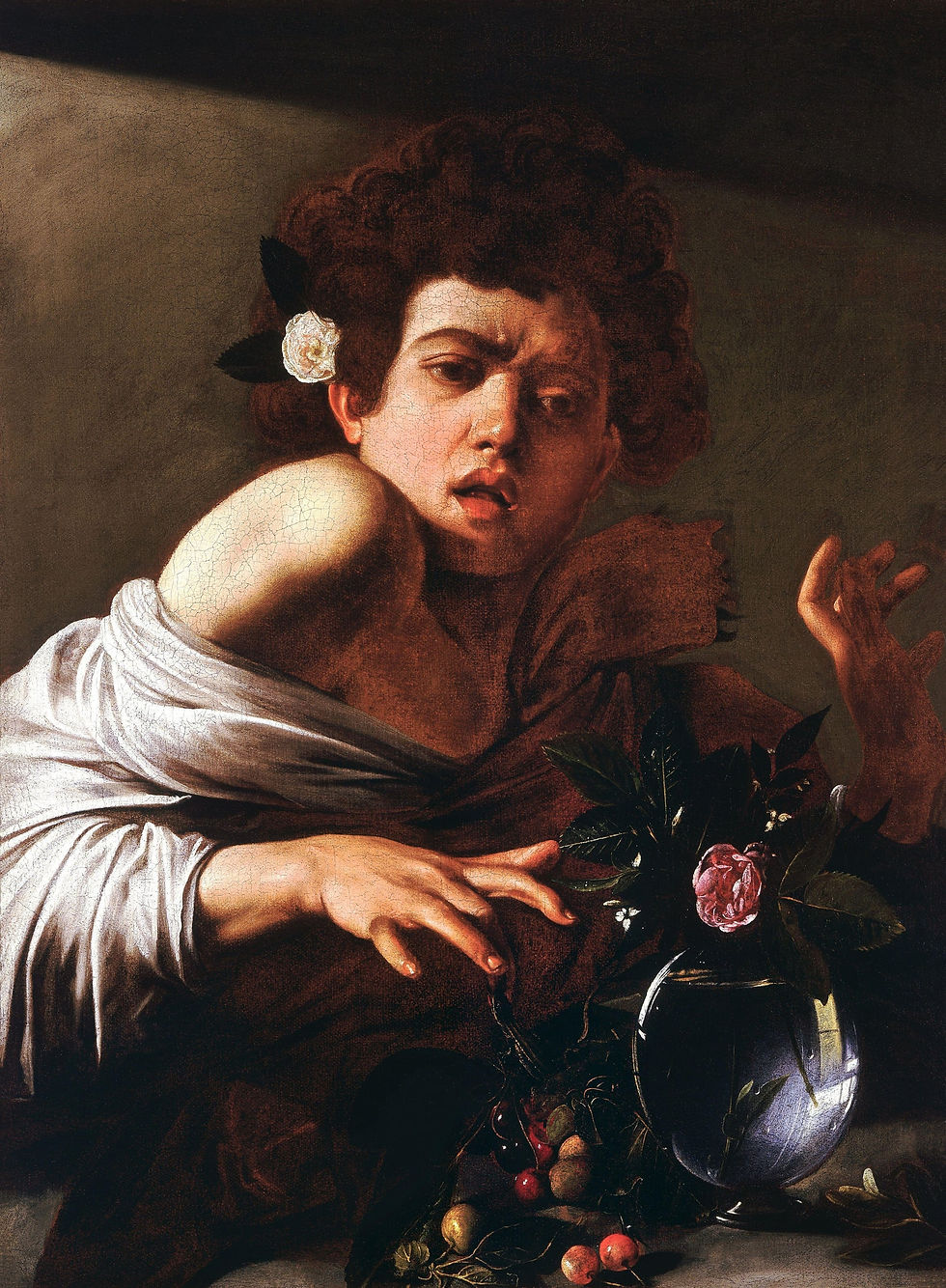
7. Caravaggio, Boy Bitten by a Lizard (c. 1593-94) → the academy's erotic-melancholic register
Caravaggio's Boy Bitten by a Lizard is the wall painting for the specific Dark Academia mood that does not have a single literary source. A pale-skinned, red-lipped, sleep-haired boy of about sixteen reaches across a dark table toward a cluster of cherries and pulled-petal roses; a small green lizard concealed in the petals has just bitten his middle finger; the boy's face is caught in the half-second between sensation and recognition. The painting reads as the founding Western image of the academy's erotic-melancholic register — the beautiful boy, the cabinet of objects, the small bite that wakes the body up. Caravaggio painted the canvas in his early twenties when he was establishing himself in Rome; the painting is the first major Western statement of the specific mood the Dark Academia reader keeps returning to — beauty that hurts, beauty that pretends it does not hurt, beauty that requires a small interruption to be felt at all. Print at 50 × 60 cm vertical, frame in dark walnut, mount above the small writing desk in the home-library. The Caravaggio is the wall painting that signals to the visitor that the reader has read the whole canon and now reads for what it actually contains.
How to build the Dark Academia library room around the paintings
Three rules govern the Dark Academia library room. First: WALL COLOUR. Default to a deep colour, not a neutral. Specifically: a deep moss-green (Farrow & Ball Studio Green or equivalent), a dark teal-blue (F&B Hague Blue or equivalent), or a near-black warm-brown (F&B Tanner's Brown). White walls are wrong for this room — the Gothic paintings need a dark wall to hold them. Second: LIGHTING. Lamps only, no overhead. 2400-2700K warm-white temperature, ideally with a small dedicated picture-light on each painting. Library reading happens in lamplight; the Gothic register requires lamplight; the paintings need it. Third: FRAME MATERIAL. Dark walnut as the dominant default — every painting in this series takes walnut except the Klimt (slim gold-leaf oak for register-match) and the Goya (black-stained ash for the Black-Painting series). Single-frame-material rule still applies: pick walnut and stick to it across the whole room.
Key takeaways
Dark Academia is the TikTok-coded literary aesthetic organised around Western Gothic and Romantic literature — Dostoyevsky, Wilde, Shelley, Poe, the Brontës. The reading room wants paintings that match the specific Gothic-Romantic register the books open.
Seven painting pairings: (1) Fuseli Nightmare = the Gothic general statement. (2) Goya Saturn = Dostoyevsky Karamazov. (3) Klimt Adele = Wilde Dorian Gray. (4) Friedrich Sea of Ice = Shelley Frankenstein. (5) Böcklin Isle of the Dead = Poe late tales. (6) Friedrich Abbey in the Oakwood = the Brontës. (7) Caravaggio Boy Bitten by a Lizard = the academy's erotic-melancholic mood.
Three room rules: (1) WALL COLOUR — deep colour, not neutral (moss-green, dark teal, near-black warm-brown). White walls are wrong for this room. (2) LIGHTING — lamps only, no overhead, 2400-2700K warm-white, dedicated picture-light per painting. (3) FRAME — dark walnut as dominant default, gold-leaf oak for Klimt only, black-stained ash for Goya only.
Print sizes by pairing: Fuseli + Klimt + Caravaggio = 50-80 cm. Goya + Böcklin + Friedrich Sea of Ice + Friedrich Abbey = 60-110 cm. The Goya should be hung vertically; the Friedrich landscapes horizontally; the academy room's wall is usually shorter than the living-room wall, calibrate accordingly.
Adult-reading-corner rule: the Goya Saturn and the Caravaggio Boy Bitten by a Lizard should be hung in the adult-occupied reading corner, not in any room where small children sit at dinner. The other five paintings are room-flexible.
The Dark Academia library room is built around literary recognition — every painting in the series rewards the reader who has read the corresponding book first. The room signals to the visitor what the reader has been reading without anyone needing to say so out loud.
Browse fine prints for the Dark Academia library in the archive at zocineartdesign.etsy.com.

Comments