Francisco Goya - The Coven (1823): The Painting Behind the Name
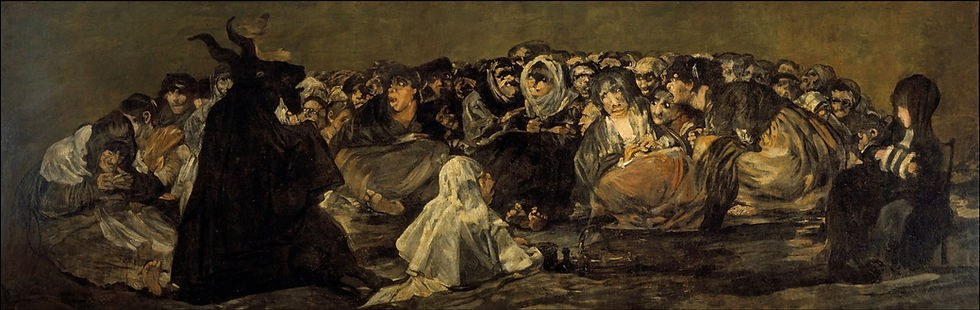
If you searched 'Francisco Goya - The Coven', this is the painting. Witches' Sabbath, called El Aquelarre in Spanish, painted directly onto the plaster wall of Goya's country house outside Madrid between 1821 and 1823. A black goat (the Devil in goat form) presides over a circle of crouching witches under a thin crescent moon. To the right, a single seated woman watches in profile, her hands hidden in a muff, distinct from the coven.
It is one of the fourteen Black Paintings (Pinturas negras), the late-period works Goya painted as private images for himself, never meant for exhibition. He was deaf, in his seventies, recovering from a near-fatal illness, watching the Spanish liberal experiment collapse around him. The Coven sits at the centre of that emotional register.
What the painting shows
The composition is built around the goat. Goya places him in dark silhouette against an indeterminate landscape, head tilted slightly toward the witches, one horn catching the moonlight. The witches themselves are bent, kneeling, leaning forward, faces drawn into rictus grins or slack ecstasy. The youngest of them sits at the front left, mouth open, eyes wide. A child lies on the ground between the goat and the women, naked but turned away from the viewer.
The lone seated figure on the right is the painting's quiet mystery. She is dressed more carefully than the others, her posture upright, her face composed. Some readings call her a novitiate, a young woman about to be initiated. Others call her a spectator, an outsider who has wandered into the wrong meadow. Her presence is the painting's hinge: with her, the scene becomes a confrontation. Without her, it would be a closed circle.
The palette is the Black Paintings palette: bitumen brown, ochre, dirty white, deep slate. There is no relief, no narrative escape route, no consoling sky. Goya painted these images on dark grounds and let the figures emerge by reduction, scratching highlights out of mass rather than building them up. The technique itself reads as suppression.
Why Goya painted it
In 1819 Goya bought a small farmhouse on the outskirts of Madrid, near the Manzanares river. The locals called it the Quinta del Sordo, the Deaf Man's Villa, after a previous owner. Between 1819 and 1823 he covered the interior walls of the ground floor and first floor with fourteen large dark images: gods devouring children, pilgrimages turning into riots, drowning dogs, two old men shouting, and this coven. He signed none of them and titled none of them. The names we use today are titles given by later cataloguers.

The witches were not a new subject for him. As early as 1798 he had painted six small witchcraft scenes for the Duke and Duchess of Osuna, and the Sleep of Reason etching from his Caprichos of 1799 (plate 43, shown above) had already framed the question that organises his late work: what does the rational mind dream up when it falls asleep? The Black Paintings answer is that it dreams up exactly the kind of scene The Coven depicts. Reason did not abolish the monsters. It just gave them a more recognisable face.
The political context matters. The brief constitutional period of 1820 to 1823 (the Trienio Liberal) was the last opening Spain had for a liberal settlement before the Bourbon restoration crushed it under Ferdinand VII. Goya, a known liberal sympathiser, watched it close. By 1824 he had left Spain for Bordeaux, where he died in 1828, still drawing.
The 1823 date
The painting is typically dated 1821 to 1823 because that is the window Goya owned the house and was painting on its walls. By the time French troops crossed the Pyrenees in April 1823 to restore Ferdinand to absolute power, the Black Paintings were finished or near finished. The Coven, with its goat-king and its small terrified human child, is one of the latest works of a long career that began painting Bourbon princes and ended painting demons in his own dining room.
Goya did not see the painting as we see it. He saw it on plaster, in dim light, with no glass between him and the surface. In the 1870s the new owner of the villa had the paintings carefully transferred from plaster to canvas, a heroic and damaging conservation campaign that nevertheless saved them from demolition. The version most reproductions are based on today is that canvas transfer, with its slightly muted contrasts and its dozens of inpaintings.
Available as a fine print
The Coven is available as an archival fine print in the ZocineArtDesign shop. Each print is colour-matched against the canvas-transfer reference, printed at scale, and despatched flat-packed. View the listing here.
Direct link: zocineartdesign.etsy.com/listing/1013374516
How to hang this print
The Coven is a heavy, horizontal, dark image. Its native register is the room where it can absorb air around it, not the room where it competes for attention. A few pragmatic notes from hanging it.
Wall colour: warm white or unbleached linen. The painting's deep browns turn muddy against cool grey and disappear against pure black.
Frame: thin black with a wide cream mat. The mat is what gives the dark image room to breathe; without it, the print reads as a hole in the wall.
Light: low, warm, indirect. A direct downward spotlight kills the painting's gradations. A bookshelf reading lamp eight feet away is closer to the conditions Goya himself worked in.
Pairing: the Sleep of Reason etching above it, or one of the other Black Paintings (Saturn, the Pilgrimage, the Fight with Cudgels) at half the scale. Avoid pairing with light or decorative work; it will only make The Coven look funereal by contrast.
Room: study, dining room, hallway leading to a private room. Not a child's bedroom and not the entrance to a co-working office.
Key takeaways
The Coven (Witches' Sabbath, El Aquelarre) is a Goya Black Painting from 1821-1823, painted directly onto the wall of his country house outside Madrid.
It shows a Devil in goat form presiding over a circle of witches, a single composed female onlooker on the right.
It belongs to the cycle of fourteen Black Paintings made for private viewing, with no exhibition intent.
Goya's lifelong subject (the rational mind dreaming up its own monsters) reaches its darkest expression here.
The fine print works best in a quiet warm-toned room with a wide cream mat and low indirect light.
Frequently asked
Where is the original?
The original was transferred from plaster to canvas in the 1870s and is held in a Spanish national collection.
Is The Coven and Witches' Sabbath the same painting?
Yes. The Coven, Witches' Sabbath, and El Aquelarre all refer to the same Goya canvas from the Black Paintings cycle, 1821-1823. There is an earlier 1797-1798 Witches' Sabbath painted for the Osunas, which is smaller, more theatrical, and uses the same goat-Devil motif.
Did Goya believe in witches?
No. Goya was an Enlightenment-trained painter who treated witchcraft as a metaphor for Spanish superstition, clerical power, and the irrationality that survives political reform. The Coven is a painting about belief, not a painting of belief.
→ Bring The Coven home: zocineartdesign.etsy.com/listing/1013374516
Browse the full archive of fine prints at zocineartdesign.etsy.com.


Comments