Friedrich's Monk by the Sea: The Painting That Invented Loneliness
Caspar David Friedrich finished The Monk by the Sea in 1810 and showed it at the Berlin Academy that autumn. It was unlike any landscape painting Europe had ever seen. A flat shore. A flat sea. A flat sky that fills two-thirds of the canvas. One tiny figure of a Capuchin monk standing on the dune, looking out. No frame within the frame, no foreground tree, no Claudian arrangement of distance, no ruin, no storm. Just three horizontal bands and a man.
Visitors complained. The painter Marie Helene von Kugelgen called it offensive. The young writer Heinrich von Kleist published a review in the Berliner Abendblatter that has shaped how the painting has been seen ever since. Looking at the canvas, Kleist wrote, was like having your eyelids cut off. The picture allowed no rest.

Two hundred years on, what Kleist saw is still what the painting does. It looks like nothing happened in it, but it makes loneliness into a structural property of the world. Below is a reading of how Friedrich built that effect and why it still works.
What Friedrich removed
X-rays of the canvas show that Friedrich painted the picture twice. In the first version he had included two sailing ships on the horizon and a flight of seabirds across the sky. By the time he finished, he had painted both out. The seascape that visitors saw at the Academy in 1810 was the result of a long act of subtraction: a year of painting things in and then painting them out again.
The pre-1810 European tradition of landscape painting expected certain props: a coulisse of trees framing the view, a piece of architecture to give scale, weather doing something dramatic, animals or figures moving through the middle ground. Friedrich removed every single one. The painting is what is left after all of European landscape convention has been edited out. What remains is the bare geometry of land, water, sky, and figure — and nothing else.
The proportions
The canvas is large — about 110 by 172 cm, broadly horizontal. The sky occupies roughly the top two-thirds. The sea occupies a narrow grey-green band. The dune and beach occupy a slightly thicker band at the bottom. The monk — the figure traditionally identified with Friedrich himself — is about eight centimetres tall in a canvas almost two metres wide.
These proportions are what produce Kleist's effect. The figure is too small to ground the viewer; the sky is too vast to bound the looking. Where a conventional landscape would give the eye a path — a road leading into the distance, a tree leading up, a figure to follow — Friedrich gives nothing. The eye lands and then has nowhere to go. The viewer is forced to do what the monk is doing: stand on the threshold and look at scale.
Kleist's review
Kleist's piece was published in October 1810 in the newspaper he co-edited. The essential lines have become some of the most quoted in the history of art criticism: "Nothing can be sadder or more uncomfortable than this position in the world: the only spark of life in the wide realm of death, the lonely centre in the lonely circle. The picture, with its two or three mysterious objects, lies before one like the Apocalypse... and since, in its monotony and boundlessness, it has no foreground except the frame, it is as if one's eyelids had been cut away."
What Kleist identified — and what no critic before him had named — is that the painting refuses the comfort of mediation. There is no foreground, no framing device, no narrative anchor, no place for the viewer's eye to rest. The looking is direct, forced, continuous. This is what people now call the sublime; Kleist was naming the experience before the vocabulary existed.
Who the monk is
Friedrich was Protestant, born in Greifswald in 1774, trained in Copenhagen, settled in Dresden. The figure on the dune is a Capuchin friar in a brown habit — a Catholic monk, not a Protestant pastor. Friedrich was painting a religious sensibility he respected from outside, not from inside. The figure is a stand-in for any contemplative person facing the natural sublime: the monk's habit signals the seriousness of the looking, not a specific theology.
Many viewers have read the figure as Friedrich himself. There is photographic evidence (from later portraits) that he wore his hair long and was tall, lean, and slightly hunched at the shoulders — the silhouette in the painting. Whether Friedrich intended a self-portrait is impossible to know. What is certain is that the figure carries the moral weight of the picture; he is the viewer's surrogate.
Why it became the founding work of Romanticism
Romanticism as a movement was already in motion by 1810 — the term was in use, the philosophical case had been made by Friedrich Schlegel and the Jena circle, the paintings of Philipp Otto Runge had appeared. But The Monk by the Sea was the first painting that translated the program into an unmistakable visual form. It rejected classical balance, declared the single figure against vast nature as a worthy subject, and made interior feeling rather than exterior story the painting's content.
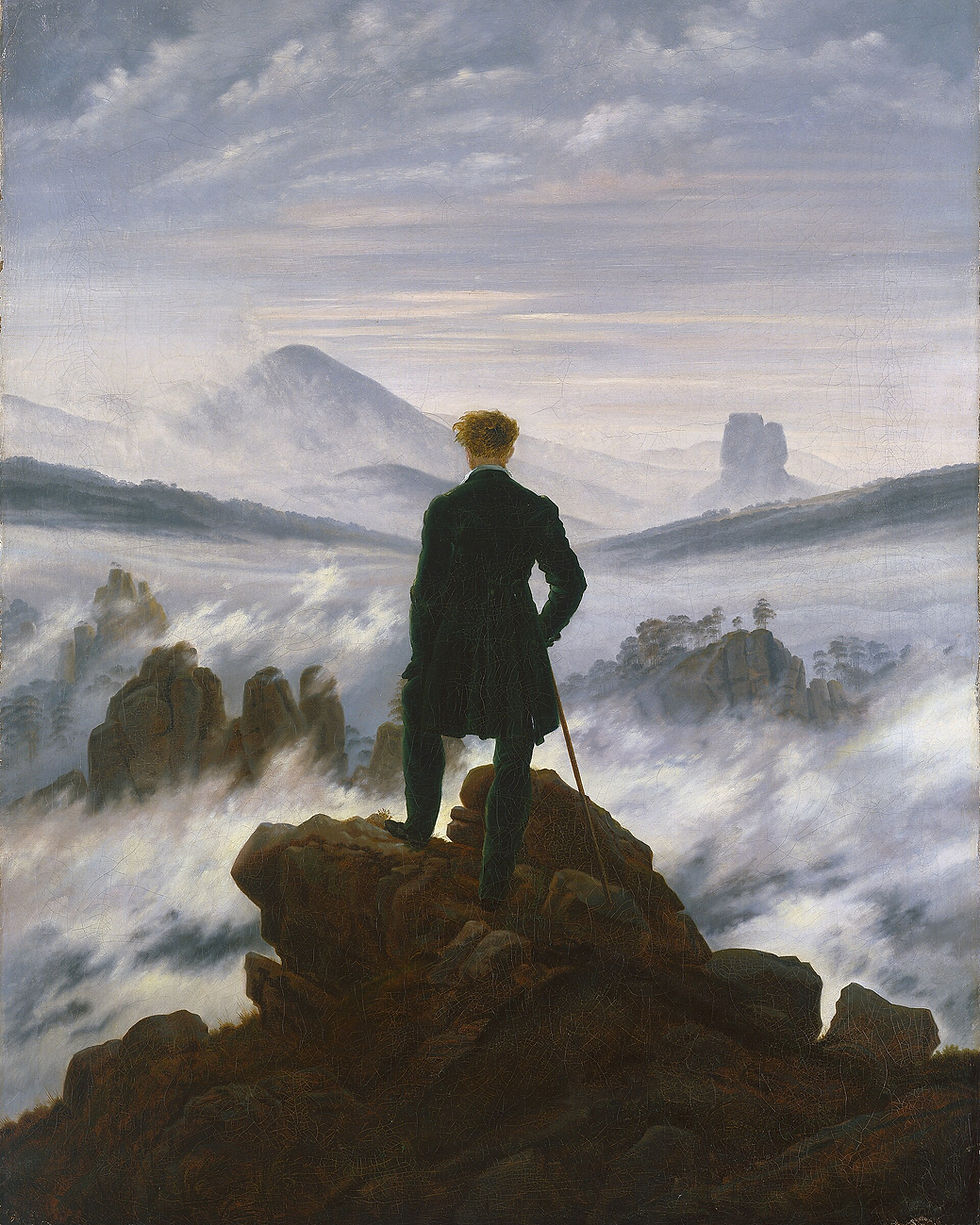
Every Romantic painter who came after — Turner's stormscapes, Blake's apocalypses, Delacroix's expressive figure groups — worked in the shadow of what Friedrich proved possible. By 1818 he had painted the Wanderer above the Sea of Fog — the figure now seen from behind, the gesture more confident, the landscape less austere. The Wanderer became the icon. But the Monk was the discovery.
How to live with the painting
The print is horizontal and wants room. A long sofa wall, a long bedroom wall behind the headboard, a stretch of staircase landing, an above-the-mantel hang in a room with high ceilings — these suit the painting. It reads at any distance; the smaller the room, the more dramatic its scale becomes. In a small bedroom it can feel like a window cut into the wall.
Frame it in matte black or unstained oak with a deep, generous cream mat — the wide mat extends the painting's emptiness into the wall and amplifies the proportions Friedrich was after. Avoid ornate gold; the painting refuses Salon decoration. Hang it slightly higher than you would hang a portrait — the monk should be looking out over the room, not at you. Pair it with another Friedrich (the Wanderer is the obvious choice) or with a single Turner storm. Avoid hanging it next to anything cluttered.
Available as a fine print: zocineartdesign.etsy.com
Key takeaways
Friedrich painted The Monk by the Sea between 1808 and 1810, removing two ships and a flight of seabirds from earlier states of the canvas to arrive at the bare three-band composition.
The proportions — a vast sky, a tiny monk — force the viewer into the same scale-confrontation the monk is in. There is no path for the eye to take.
Heinrich von Kleist's 1810 review compared the looking to having one's eyelids cut away; the phrase has stuck.
The painting is the founding work of European Romantic landscape and the structural ancestor of the more famous Wanderer above the Sea of Fog (1818).
The print wants a long horizontal wall, a deep cream mat, matte black or oak framing, and a Friedrich Wanderer or a single Turner as company.
See also: Friedrich's Wanderer above the Sea of Fog — the better-known sibling painted eight years later.
Browse the full archive at zocineartdesign.etsy.com.


Comments