Goya's Saturn Devouring His Son: The Painting on the Wall of His House
Updated: Sep 5
Francisco Goya painted Saturn Devouring His Son between 1819 and 1823, in oil applied directly to the plaster wall of the dining room of his house outside Madrid. He was in his seventies, deaf for thirty years, recovering from a near-fatal illness, and living alone in a country property called the Quinta del Sordo — the House of the Deaf Man. He did not sign the painting. He did not title it. He did not intend it to be seen.
Saturn is one of fourteen pictures Goya painted on the interior walls of the Quinta. They are known collectively as the Black Paintings. They depict witches, demons, a dog drowning, two old men eating soup, a Sabbath gathering, a pilgrimage. Saturn — mythologically, the Roman god Cronus, who devoured each of his children to prevent the prophecy that one would overthrow him — hung in the dining room.
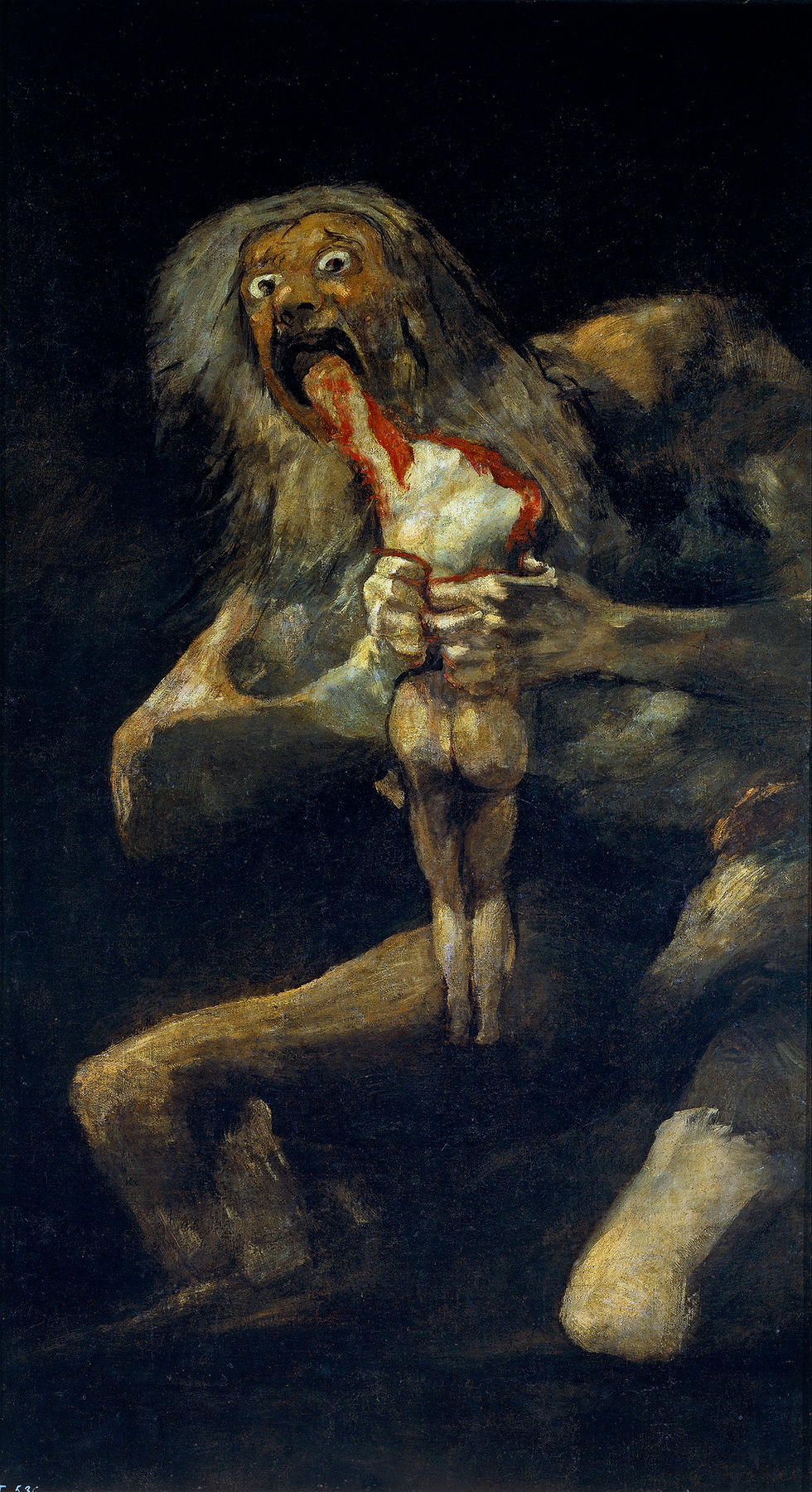
Below is a reading of the painting at four levels: what Goya was painting on the wall, what the Roman myth carries, why the picture is unsettling rather than horrifying, and what happens when a private nightmare becomes one of the most reproduced images in art.
The Quinta del Sordo
Goya bought the country house on the outskirts of Madrid in February 1819. He was 72. The property was already called the House of the Deaf Man — not for Goya, but for a previous owner. The coincidence pleased him. He lived there alone (his wife had been dead for nearly twenty years) with a housekeeper, a few servants, and his companion Leocadia Weiss. Over four years he covered the walls of the two main downstairs rooms with paintings.
We have no contemporary documentation of what Goya was thinking. He left no notebook, no letter, no aside in conversation that has come down to us. The paintings were photographed in situ in 1874, fifty years after Goya's death, by Jean Laurent. The dining room paintings included Saturn on the left as you entered. By 1874 the wall had begun to deteriorate. The Spanish state had the paintings transferred from plaster to canvas and installed in a Madrid collection, where they have been ever since.
The Saturn myth and the political moment
In Hesiod and Ovid, Cronus (Saturn to the Romans) was the youngest Titan. Warned that one of his children would overthrow him, he ate each of them at birth. His wife Rhea hid the sixth (Zeus) and gave Cronus a stone wrapped in swaddling to swallow instead. Zeus grew up, freed his siblings, and overthrew his father. The story is foundational — it explains how the Olympian generation displaced the Titans — and it has been a subject for painters since the Renaissance.
Goya knew the precedents. Peter Paul Rubens had painted a Saturn devouring his children for Philip IV of Spain in 1636 — a much earlier picture, classically composed, with Saturn as a heroic nude and the child as a beautiful body lifted toward his mouth. Goya's version refuses the heroic. His Saturn is not a god; he is a wild-haired, wide-eyed old man with grey skin and a clenched fist, biting the head off something that no longer looks like a child. The mythological respectability is gone.
Some readings have connected Saturn to Spain itself — the old monarchy under Ferdinand VII devouring the liberal generation that had tried to reform it in 1812 and 1820. Goya, who had served three regimes (Bourbon, Napoleonic, Restoration), had reason to paint a fatherland eating its children. The political reading does not exhaust the painting but it is part of the context. The Black Paintings were begun during the Trienio Liberal (1820-23) and finished as the period of repression closed in. Goya left Spain for France in 1824 and died there in 1828.
What the picture actually shows
A male nude figure emerges from a black ground. He is hunched, knees bent, white-haired, bone-thin. His hands grip the body of a smaller figure he has just bitten. The smaller body is headless — the head is in Saturn's mouth or has already been consumed — and the left arm has been bitten off; we can see the stump. Blood flows down the smaller body's right arm and shoulder. Saturn's eyes are wide, white-rimmed, not enraged so much as terrified. He is not enjoying what he is doing. He looks as if he has caught himself in the act.
The colour palette is reduced to four registers: black for the void around the figure, grey-flesh for Saturn, paler flesh for the child, deep red for the blood and (more sparingly) the warmer planes of Saturn's body. The brushwork is rapid, summary, scraped. Goya was painting on plaster with a loaded brush; the paint is laid on and not corrected. This is one of the first paintings in European art that values the speed and roughness of the mark over the finish.
Why it is unsettling rather than horrifying
The picture does not work by horror. Horror requires a sense that the action is excessive; the picture has to convince the viewer that what is happening is wrong. Goya does not do that. He paints Saturn in a register of bare, terrified recognition: the figure knows what he is doing, is unable to stop, and looks out at us as if to confess. The disturbing quality is not in the violence; it is in the recognition. It is a painting of compulsion.
Goya had spent the preceding years painting The Disasters of War (etchings of Napoleonic atrocities, 1810-1820) and the great 1814 history pictures The Second of May and The Third of May. He had been an eyewitness to mass slaughter. By 1819 he was painting the inside of what that experience had made of the human mind. The Black Paintings are a kind of survivors' record of a brutal century.
Reading the gesture
Look at Saturn's hands. The right hand grips the small figure's right shoulder, fingers spread, white-knuckled. The left hand grips the lower back — you can count the fingers wrapped around the small ribcage. The grip is the grip of someone holding on, not someone tearing. Saturn is not dismembering the body; he is preventing it from getting away while he bites. The horror is the grip.
Look at his right knee. It is bent into the lower right corner of the canvas. The thigh is raked with diagonal brushstrokes that look almost like scratches. The painter is using the rough texture of plaster against thinned paint to produce a flesh that is unfinished, hairy, wild. Goya was an old man painting an old man and was not pretending otherwise.
How the picture left the house
Goya died in 1828. The Quinta del Sordo passed through several owners. By 1873 the property was bought by Baron Frederic Emile d'Erlanger, a French banker, who decided to save the Black Paintings before the building deteriorated further. Photographer Jean Laurent documented each picture in situ; restorer Salvador Martinez Cubells transferred the paintings from plaster to canvas between 1874 and 1878. They were exhibited at the 1878 Paris World Fair (where almost no one bought them; the public found them disturbing) and finally donated to the Spanish state in 1881.
The transfer altered the surface. Cubells's restoration darkened some areas, lightened others, lost some marginal passages where the plaster had crumbled. The Saturn we see today is a transcription, not the original wall. But the central event — the figure, the grip, the eyes — has come through.
How (and whether) to live with it
Saturn is not a domestic painting. Goya never meant it to be one. It belongs in a study, a library, a workspace, a hallway — somewhere with weight and seriousness and not the place a guest sits down for coffee. A bedroom is wrong; a child's room is unthinkable; a kitchen is bizarre. Goya hung it in his own dining room, but he was Goya and he lived alone.
Frame the print in narrow matte black with a deep oxblood or grey mat. Avoid white — the picture is too much for it. Hang it alone; do not gallery-wall it. The painting needs space around it the way a person in a state of recognition needs space around them. A single warm directional fixture from the upper left gives Saturn's eyes the catchlight they need to register.
Available as a fine print: zocineartdesign.etsy.com
Key takeaways
Goya painted Saturn in oil directly on the plaster wall of his own dining room between 1819 and 1823. He did not sign it, did not title it, did not intend it to be public.
It is one of fourteen Black Paintings he made on the walls of the Quinta del Sordo — the country house outside Madrid called the House of the Deaf Man.
The Roman myth (Saturn devouring his children to prevent his overthrow) carries a likely political reading: the old monarchy devouring the liberal generation. Goya was 76 when he started.
The picture is unsettling rather than horrifying because Saturn's eyes register self-recognition: he knows what he is doing and cannot stop.
If you hang the print, hang it alone in a serious room — study, library, hallway — in narrow matte black with an oxblood mat. Never in a bedroom or near children.
Browse the full archive at zocineartdesign.etsy.com.
New in the Journal: Goya in Seven Paintings: The Career That Bridged Two Worlds


Comments