Hammershøi's Interior with Sun: Denmark's Quietest Master
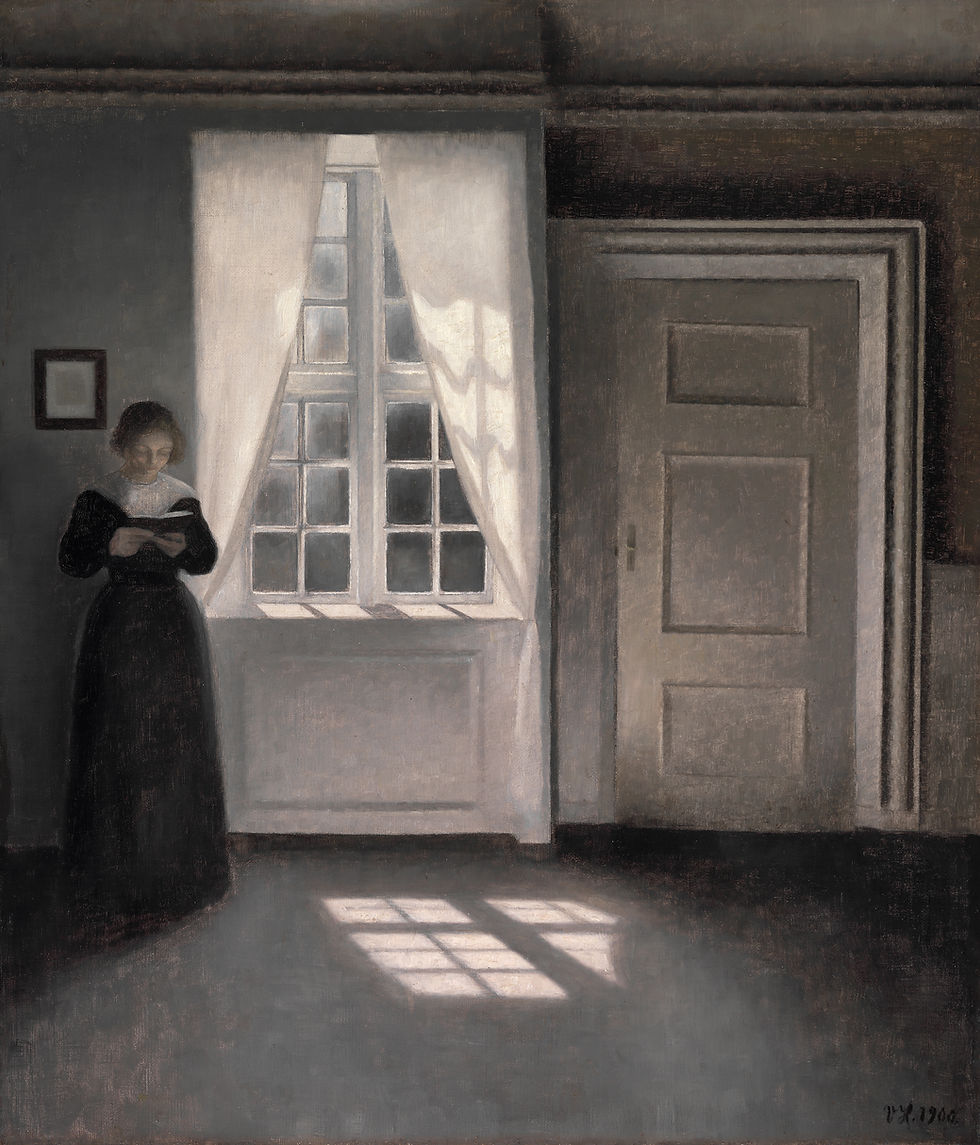
An empty Copenhagen room. The walls are pale grey, slightly chalky. The floor is unvarnished pine, worn smooth. A single half-open door on the left leads to another room, also empty, also pale. A rectangle of pale north-window light falls diagonally across the floorboards. There is no figure, no furniture, no narrative event. The painting is the room, the light, and the patient attention of the painter who spent six weeks looking at both.
This is Interior with Sunlight on the Floor — painted around 1900 by Vilhelm Hammershøi at his apartment at Strandgade 30, in the old harbour district of Copenhagen. Hammershøi spent thirty years painting the rooms of two consecutive apartments — first at Strandgade 30, then a few streets away — producing more than sixty interior paintings of essentially the same architectural subject. He is Denmark's quietest master and one of the founding figures of European modern interior painting.
Strandgade 30
Vilhelm Hammershøi married Ida Ilsted in September 1891 and moved into a four-room apartment on the second floor of Strandgade 30, a seventeenth-century building in the Christianshavn district of Copenhagen, in 1898. He lived there for ten years and painted the apartment obsessively — the same four rooms, the same north-window light, the same half-open doors, the same bare wooden floors, with a small set of recurring objects (a piano, an oval table, a tea service, a punch bowl) and a single recurring figure (Ida, his wife, almost always painted from behind).
The apartment is the entire subject of his middle and late career. The architectural geometry — high ceilings, deep window reveals, panelled doors, plain pale walls — was both the laboratory and the canvas. The light from the north-facing windows (Christianshavn faces the harbour, which faces north) was the only light Hammershøi painted. He worked slowly, returning to the same view month after month, refining the same composition through dozens of canvases until the geometry was exact.
The palette — and what is missing
Hammershøi worked from a deliberately restricted palette. Almost every interior is built from the same six colours: pale grey for the walls, off-white for the trim and the matte ceiling, soft beige for the unvarnished pine floor, charcoal grey for the deep shadows in the door reveals, the faded green of the painted panel doors, and the pale gold of north-window light. The colour temperature is uniformly cool. There is no red, no warm yellow, no saturated blue. The paintings have been described, accurately, as photographs of nothing painted in grisaille.
The reduced palette is the source of the paintings' quiet. Hammershøi's contemporary critics complained that his canvases looked unfinished — they expected more colour, more incident, more visual interest. Hammershøi was deliberately removing exactly those things. The point of the paintings is the absence of incident. The room is empty. The light moves slowly. Nothing happens. The viewer's attention falls back on the architecture and the light, which is exactly where Hammershøi wanted it.
The composition — and where the figure goes
Hammershøi's interior compositions are almost always built around a deep architectural recession — the eye is pulled through an open door into the next room, and through that room's door into the third room beyond. The recession is the structural argument of the painting. It tells the viewer that the apartment continues past the picture frame, that there is more space than the canvas shows, and that the silence of the visible room extends into invisible rooms beyond.
When a figure appears, she is almost always painted from behind. Ida Hammershøi, in a dark dress, stands at a piano, sits at the oval table, walks toward the next room, or pauses at the half-open door. Her face is rarely visible. The figure is a compositional element — the dark vertical that anchors the eye in the pale architecture — not a portrait. The painting is the room with a figure in it, not the figure in a room.
Why nothing else looks like it
Hammershøi's interiors do not resemble any of the obvious sources. They are not Vermeer (Vermeer painted figures absorbed in tasks under warm light; Hammershøi paints empty rooms under cool light). They are not Whistler (Whistler painted the Thames in fog at evening; Hammershøi paints solid architectural geometry under bright north light). They are not Symbolist (Symbolist painters loaded their canvases with allegorical content; Hammershøi removes content systematically). They are not Impressionist (Impressionism is about the rapid notation of changing light; Hammershøi works for weeks on a single canvas).
The closest visual cousin is the architectural photography of his contemporary Eugène Atget — Atget's empty Paris streets at dawn, before the city was awake, have the same compositional discipline and the same patient attention to architecture in unpopulated daylight. But Hammershøi was a generation before Atget, working independently in Copenhagen, and the resemblance is convergent rather than causal.
The reception — quiet for a century, then loud
Hammershøi was respected in Copenhagen and admired by a small international following during his lifetime — Rilke wrote about him, Diaghilev arranged exhibitions, the painter Émil Nolde and the dealer Paul Durand-Ruel collected him — but the major European art-historical conversation passed him by for most of the twentieth century. He was Danish, he painted empty rooms, his palette was monochrome, and the loud movements of the early twentieth century (Fauvism, Cubism, Expressionism) drowned him out.
The recovery began in the 1980s and accelerated in the 1990s with major retrospectives in Paris, London, and New York. By 2010 Hammershøi had become one of the most-quoted reference points in restrained contemporary interior design, in fine-art photography, in the wabi-sabi-adjacent aesthetic of the 2010s. A Hammershøi print on a wall today reads, in 2026, as the canonical image of architectural quiet — the visual equivalent of a held breath, the room as the subject, the light as the event.
Why the painting still works
Stand in front of an Hammershøi interior for any length of time and the experience is physical. The eye, expecting incident, finds none. It falls back on the geometry — the verticals of the door frame, the horizontal of the wainscot, the diagonal of the light on the floor. The breathing slows. The shoulders drop. The painting reads as architectural meditation. It does not ask the viewer to feel anything. It asks the viewer to look at a room.
The painting still works in 2026 because the experience it offers — patient attention to architectural quiet in cool north light — has become rarer in ordinary life. A Hammershøi interior on the wall of a contemporary apartment is the visual equivalent of a tea ceremony. The painting holds the register.
Key takeaways
Vilhelm Hammershøi (1864–1916) was a Danish painter who spent thirty years painting the interior of his Copenhagen apartments — Strandgade 30 between 1898 and 1909, then a second apartment until his death.
More than sixty interior paintings of essentially the same architectural subject — empty rooms, north light, half-open doors, bare pine floors, the occasional figure (his wife Ida, painted from behind).
The palette is deliberately restricted to six cool colours: pale grey walls, off-white trim, soft beige floor, charcoal door reveals, faded green panel doors, pale gold north light.
The composition is built around deep architectural recession — the eye is pulled through one door into the next room and into the room beyond.
Quiet international reputation for a century, then a 1990s recovery — Hammershøi is now one of the most-quoted reference points in restrained contemporary interior design.
The painting works in 2026 because patient attention to architectural quiet in cool north light has become rarer in ordinary life. A Hammershøi on the wall reads as the visual equivalent of a tea ceremony.
Browse the Hammershøi prints in the archive at zocineartdesign.etsy.com.


Comments