Joaquin Sorolla and the Art of Painting Light You Can Feel
Stand in front of a Joaquin Sorolla painting in person and you start sweating. The white linen on a girl's dress glares back at you. The sand under her feet looks hot enough to step around. The water at her ankles is the temperature of a real Mediterranean afternoon. Sorolla painted summer the way a thermometer reads it.
This is uncommon. Most painters of his era worked sunlight as a tonal value, a yellow that lay across the picture like a wash. Sorolla worked it as physical pressure. He painted what light pushes against, what it bounces from, what it warms.

Joaquin Sorolla, On the Beach at Biarritz, 1906.
A painter from Valencia
Sorolla was born in Valencia in 1863. He was orphaned at two and raised by an aunt and uncle in a working-class neighborhood. He grew up looking at the same light every summer for the first twenty years of his life: the white-yellow, hard-edged Mediterranean light that gives Spain its shadows. The painting in front of him became his subject because it was the only one he knew well.
He trained academically, won the gold medal at the 1900 Paris Exposition, and could have spent the rest of his career producing the dark studio portraits that were earning his contemporaries their commissions. He chose to go back to the beach.
How Sorolla painted the heat
The trick is in three places. First, the white linen of the dresses, which Sorolla treated as a mirror. Look closely at the Biarritz painting above. The white is not white. It carries pink from the sand, blue from the sea, and lavender from the shadow. The eye reads this as glare. That is how white linen actually behaves under direct sun, and almost no one had painted it that way.
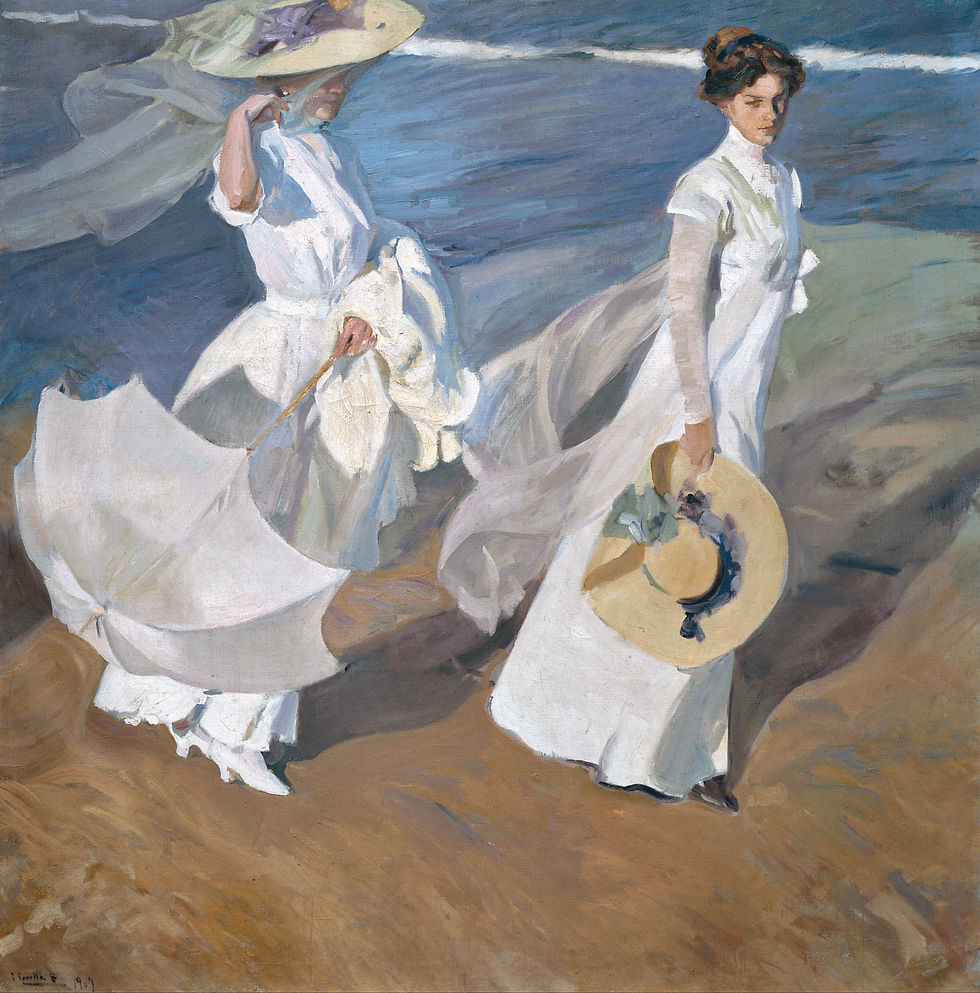
Joaquin Sorolla, Strolling along the Seashore, 1909.
Second, the shadows on the wet sand. Sorolla painted them with violet and pale green, never with black. The shadows feel like the air above warm sand actually feels: shimmering, slightly off-color, a little restless. That is how light bounces off salt-soaked grains.
Third, the brushwork. Sorolla painted alla prima, mostly outdoors, with a wide brush loaded thickly. He laid the paint down in single confident strokes and did not go back over it. The thick paint catches real light in the gallery the same way the sand catches it on the beach. The painting becomes a relief, not just a surface.
An early painting and a late one
To see Sorolla's progress, compare a beach scene from 1906 with one of his working-class subjects from a decade earlier.
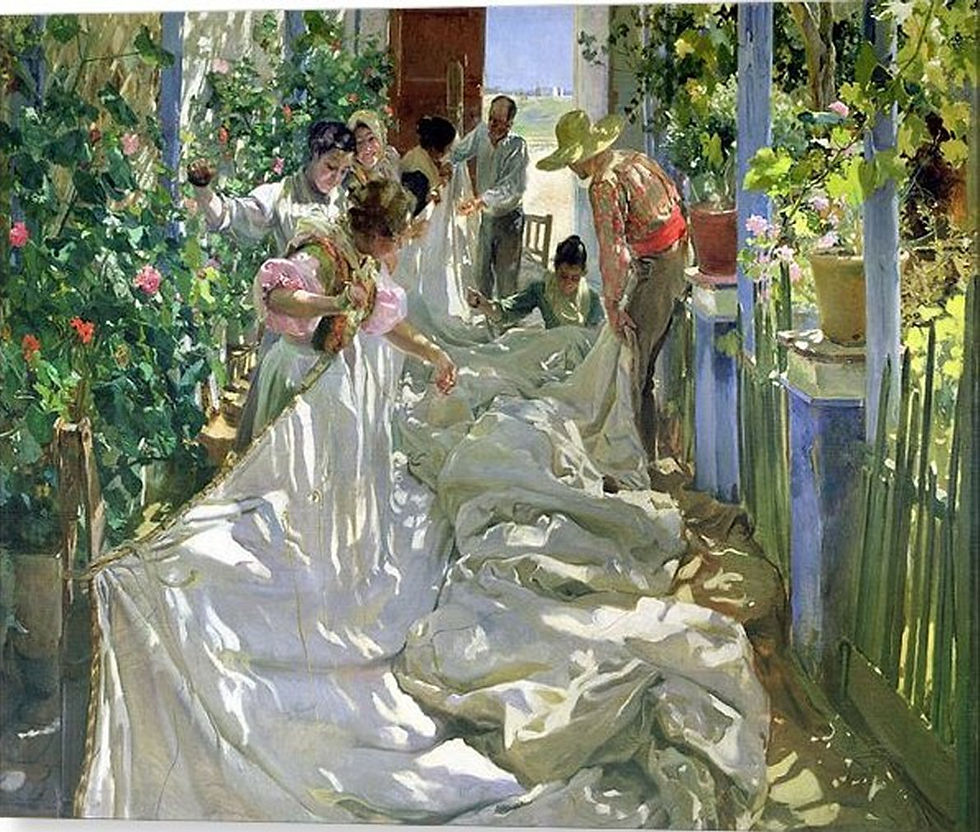
Joaquin Sorolla, Sewing the Sail, 1896.
Sewing the Sail is set in a courtyard in Valencia. Four women work on a sailcloth spread across the entire frame. Sorolla is already painting heat: the courtyard is filled with afternoon light filtered through a vine. But notice how careful the surface still is. The shadows are tighter. The whites are duller. The composition is academic.
By 1906, the courtyard has been replaced by the beach, and the composition has loosened. By 1909, the brushwork has become entirely confident. The white of a Sorolla after 1908 will not sit on the canvas. It will leave the painting and walk into your room.
A note for collectors
Sorolla's beach paintings work especially well in rooms that already have a lot of daylight: white-painted bedrooms, sun-warmed living rooms, summer houses. They do not need a sympathetic palette around them. They bring their own light.
Frame in pale oak or white-washed wood with a small mat. Avoid dark frames, which deaden the high-key palette. Hang where you take your morning coffee.
Browse the full Spanish Impressionist archive at zocineartdesign.etsy.com.


Comments